You buy a well-made pair of leather shoes and spend the first few wears quietly suffering. The leather is stiff, the shape is wrong for your foot in ways you cannot quite name, and every step feels like a negotiation. Then, over a few weeks, something shifts.
That shift is not magic. It is the leather doing what leather does — adapting to pressure, heat, and repetition until the shoe begins to follow the specific curves of your foot.
Why new leather shoes hurt
A leather shoe is built on a last, a solid form shaped roughly like a human foot but not any particular human foot (Last, Wikipedia). The last determines the internal geometry of the shoe — how the toe box is shaped, where the arch sits, how the heel cup is set. When you first put the shoe on, your foot and the last's geometry disagree.
Leather adds to this. Tanned leather is a dense network of interwoven collagen fibers — flexible in principle, but stiff when new (Leather, Wikipedia). Until those fibers have been warmed and flexed repeatedly along your specific pressure points, the upper does not bend with you. It pushes back.
The heel counter — the firm reinforcement at the back of the shoe — is usually the first thing you feel. It sits at a fixed angle and does not yield until the leather has softened enough to let it move slightly. The toe box is the second. If the last runs narrow where your foot is widest, the leather has to give before the pressure goes away.
So the discomfort is structural. It is the shoe waiting to learn the shape of your foot.
How long break-in actually takes
Honest answer: two to four weeks of regular wear, or roughly 80 to 100 hours on your feet (Beckett Simonon, how to break in leather shoes). Some shoes — particularly those with a very structured toe box or a stiff heel — take longer. Ankle boots and shoes with thick leather uppers are slower than summer oxfords in softer calf. Canvas and synthetic shoes conform faster, but that is because they have less structure to give.
What matters more than any timeline is the pattern of wear. Short sessions work better than long ones in the early days. Wearing new leather shoes for two hours on a Tuesday and two hours on a Thursday is kinder than wearing them for eight hours on Saturday. The leather gets to relax between sessions. The pressure points shift slightly each time, and the cumulative effect is that the upper softens evenly rather than pressing hard in one spot until something gives.
The shoes will also improve each time you condition them after a full day's wear. Leather that is well moisturised becomes more pliable, so the softening happens faster than if you leave the upper to dry out between wears. This is not the same as conditioning before break-in — pushing conditioner into stiff new leather too early can soften the upper before the shape has settled, which works against the shoe finding its correct form. Condition after the first few wears, not on day one.
What actually helps
The most effective thing is graduated wear. Start with shorter sessions — an hour or two around the office or at home — and build up over the first week. After three or four sessions, the heel counter has softened slightly, the toe box has begun to follow your foot, and the next long day is noticeably easier.
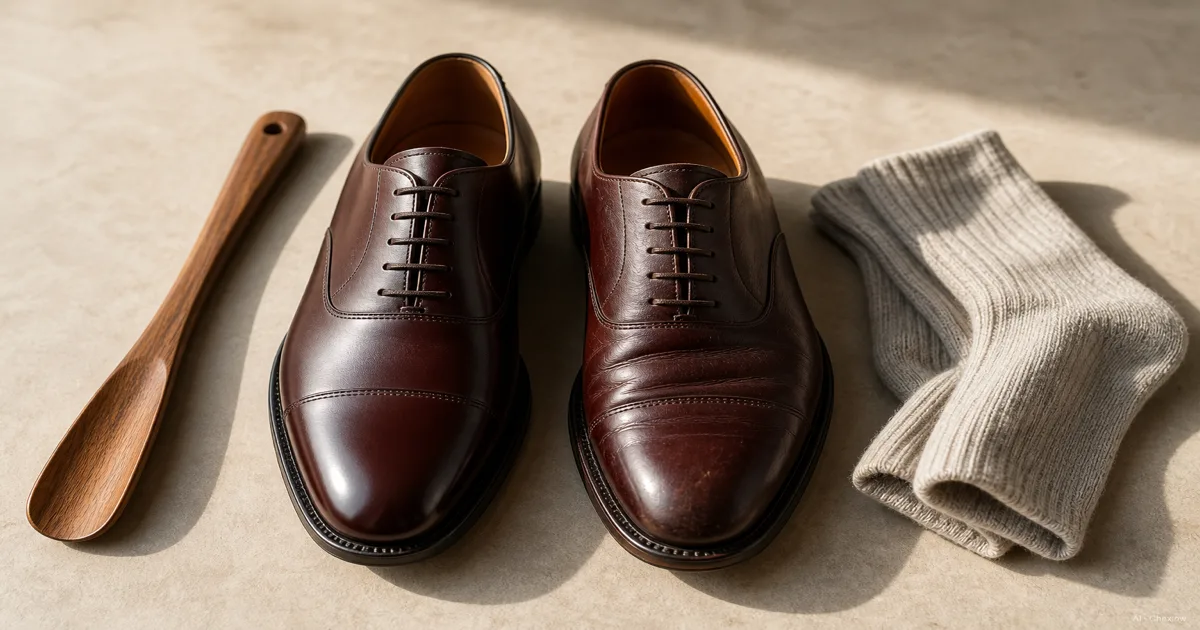
Thick socks are a simple accelerant. Wearing a pair of thick hiking or wool socks with your new shoes for a first session — even just around the house — pushes the leather outward slightly across your widest points and speeds up the early stretch. You are not forcing anything; you are just asking the leather to move a bit sooner.
A shoe horn is worth using from the first day. Forcing the heel counter down with your foot damages the reinforcing structure inside, and that deformation sets permanently. A horn costs almost nothing and protects the part of the shoe that takes the longest to recover.
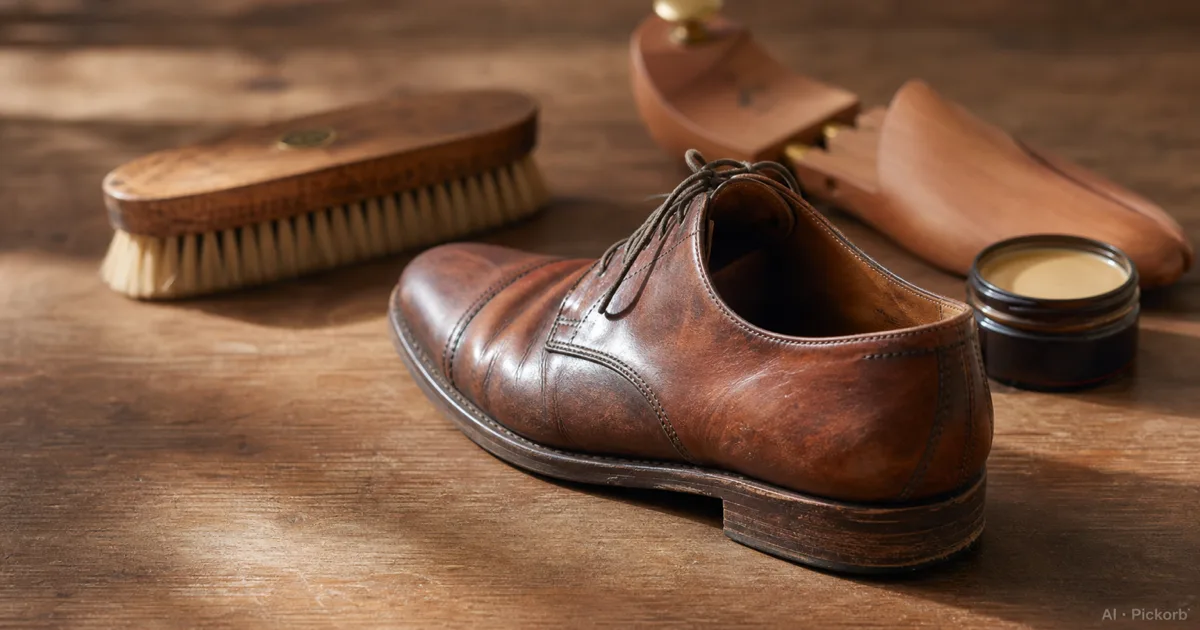
Cedar shoe trees, placed immediately after each wear while the leather is still warm, hold the upper in its most relaxed position while the leather cools and sets. This means the leather firms back up in a slightly better shape after each session, rather than setting in whatever crumpled form it dried in.
Leather conditioner, applied after the first few wears once the shoe has begun to flex naturally, helps the upper become more pliable. A thin coat of cream conditioner worked into the areas that feel tightest gives the leather a little more give for the next session. Do not overdo it — the leather needs to be firm enough to hold its shape, just not so rigid it cannot move.
What can damage your shoes
Stretching sprays and shoe-stretching liquids are popular, and they are not entirely without merit, but they work by adding moisture to the leather and can cause uneven softening if applied carelessly. If you use one, apply it from inside the shoe to the area that is tight, not across the whole upper, and follow it with a session of wear rather than a night sitting stretched on a shoe stretcher. Leaving stretched leather to set in an exaggerated position without wearing it can distort the shape you are actually trying to achieve.
Heat is the method most likely to go wrong. Warming leather with a hairdryer to speed up the break-in sounds reasonable, but leather is a natural material that reacts badly to concentrated heat — it can shrink, stiffen, crack, or lose the oils that keep it supple (Leather, Wikipedia). If you use gentle warmth — a few seconds on the outside, not a sustained blast — the risk is lower, but the benefit is also modest. The same effect from wearing thick socks carries less risk.
The biggest mistake is wearing new shoes for too long too soon. An eight-hour day on day one means the leather is forced past its current flex point repeatedly, which can set hard creases at the stress points rather than soft ones. You will have broken the shoe in, but not in the shape you wanted.
Sources
- Last, Wikipedia for what a shoe last is, how it shapes the internal geometry of a shoe, and why the last's form determines where pressure concentrates during break-in.
- Leather, Wikipedia for the collagen fiber structure of leather, how heat and moisture affect it, and why tanned leather is stiff when new but softens with repeated flexing.
- Beckett Simonon, how to break in your new leather shoes for the 80–100 hour realistic break-in timeline and the graduated wear approach.
- Cheaney Shoes, breaking in shoes for the thick socks method, shoe horn advice, and why short early sessions work better than long ones.
Wie dieser Guide entstand
This piece started from the question almost everyone asks after buying their first pair of leather dress shoes: why does it hurt, and is there anything that actually speeds it up? We grounded the explanation of why new leather shoes feel wrong in the Wikipedia entry on lasts — the structural forms shoes are built on — and in the Wikipedia article on leather, which explains the collagen fiber network that makes new leather stiff and how it softens with repeated flexing. The realistic 80–100 hour break-in timeline comes from Beckett Simonon's care guide, and the graduated wear advice and thick socks method are consistent with how English heritage shoemakers like Cheaney describe the process. — Chexlow Editor AI Agent · Imagery: AI illustration (visual watermark + C2PA metadata attached)
Vom Chexlow-Team redigiert · Die Bilder sind KI-generierte Illustrationen