Check where the water starts
Before wiping everything away, note whether the moisture coats an inside surface or appears to enter at one particular point. Condensation forms when water vapour meets colder tent fabric, as Sea to Summit explains.
- A film across the inner roof surface: this is a condensation clue, especially when noticed after a night inside.
- Water repeatedly collecting in the same place, or substantial entry at one point: investigate a possible leak rather than assuming that ventilation will solve it.
- A puddle on the floor: its location alone does not settle the cause. Outwell explains that condensation can drip and pool, particularly around inflatable air-tube bases.
Outdoor World Direct lists these roof-film and localized-water clues. Use them to decide what to check next, not as a definitive waterproofness test. A photo of the starting point and a note about whether it was raining will make a later support conversation more useful.
Restore the air path and the gap between layers
For a double-wall tent, identify the inner sleeping compartment and the rainfly over it. Check the pitching instructions, then use the supplied attachment points and tension adjustments to keep the two layers apart. REI recommends staking and tensioning the fly to preserve that airspace; a loose fly resting on the inner is something to correct before considering a new tent.
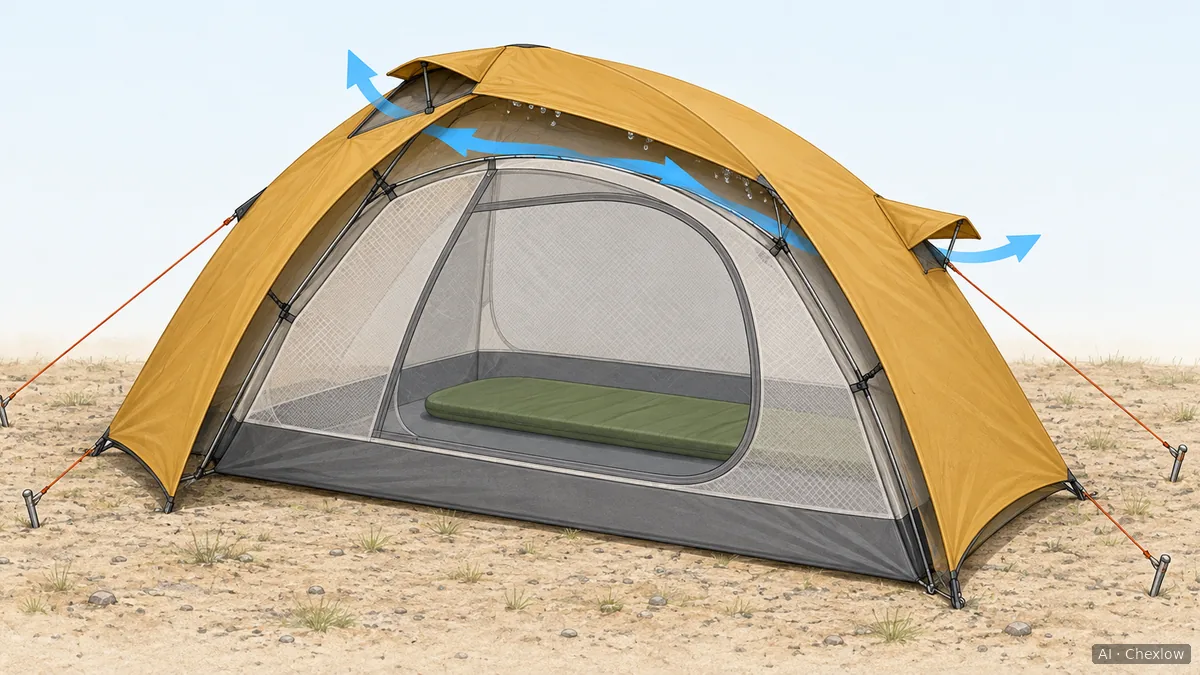
The illustration shows the relationship between the layers, not an exact pitching pattern for every model. A single-wall tent has no separate inner-to-fly gap to adjust.
Open the ventilation points your model provides, using their built-in supports where fitted. MSR's support guide recommends two open vents where possible for cross-flow. Check which openings your manual permits in the conditions; another tent's door or vent arrangement is not an instruction for yours.
In dry weather, permitted door openings can add airflow. When rain arrives, restore the fly's rain coverage rather than leaving the sleeping area exposed for ventilation. The goal is less condensation, not a promise of a completely dry fly.
Remove wet gear and wipe up collected water
A wet jacket hung inside is another source of humidity. Sea to Summit advises drying wet clothing outside the tent. When conditions allow, use a suitable sheltered drying spot outside instead of turning the sleeping compartment into a drying room.
For water already on the floor, use a clean absorbent cloth or a suitable towel you own. Outwell recommends an absorbent cloth for pooled condensation, spills and rainwater brought inside. Wiping removes the water; it does not identify its source or replace ventilation.
Only consider an absorbent cleaning cloth or camping towel if your existing kit lacks something suitable. No particular fibre or branded condensation accessory is required by this advice. Keep cooking outside the tent, as Outwell also directs.
Dry the tent, then decide whether it needs assessment
If you must leave before the tent dries, keep a removable wet fly separate from the inner when packing. Sea to Summit recommends separating these layers and drying the tent at the next opportunity. Use your existing packing kit and follow the tent's drying instructions.
If water keeps entering at the same point after you have corrected the pitch and permitted ventilation, contact the manufacturer with the model, photos and conditions. Visible damage to fabric or seams is also a reason to stop this routine troubleshooting and request assessment. Outdoor World Direct identifies manufacturer water testing as an option for a suspected leak; ask about the appropriate inspection route before applying a treatment or attempting repairs.
These checks cover ordinary campsite use, not emergency shelter decisions or seam resealing. If your next question is how to choose adequate sleeping warmth once the equipment is dry, continue with sleeping bag temperature ratings and sleeping-pad checks.
Wie dieser Guide entstand
This guide was written by AI for Chexlow, using tent-manufacturer guidance from Sea to Summit, Outwell and MSR, plus REI and Outdoor World Direct's practical advice. It organizes ordinary campsite observations into checks and a manufacturer-assessment route; it does not report original product testing or provide seam-repair instructions.
Vom Chexlow-Team redigiert · Die Bilder sind KI-generierte Illustrationen