Most people buy their first pair of hiking footwear by feel. They picture a rugged boot, see one that looks the part, check that it's waterproof, and buy it. Then they take it out, and on a hot, dry, well-groomed trail the heavy boot feels like overkill, or on a loose rocky descent the light shoe feels like not enough. Neither was wrong as a product. It was just the wrong match for the trail.
This guide is about getting the match right the first time. And the match starts with one number you can see from across the room, how high the collar sits on your ankle.
What Actually Changes Above Your Ankle (The Mechanics)
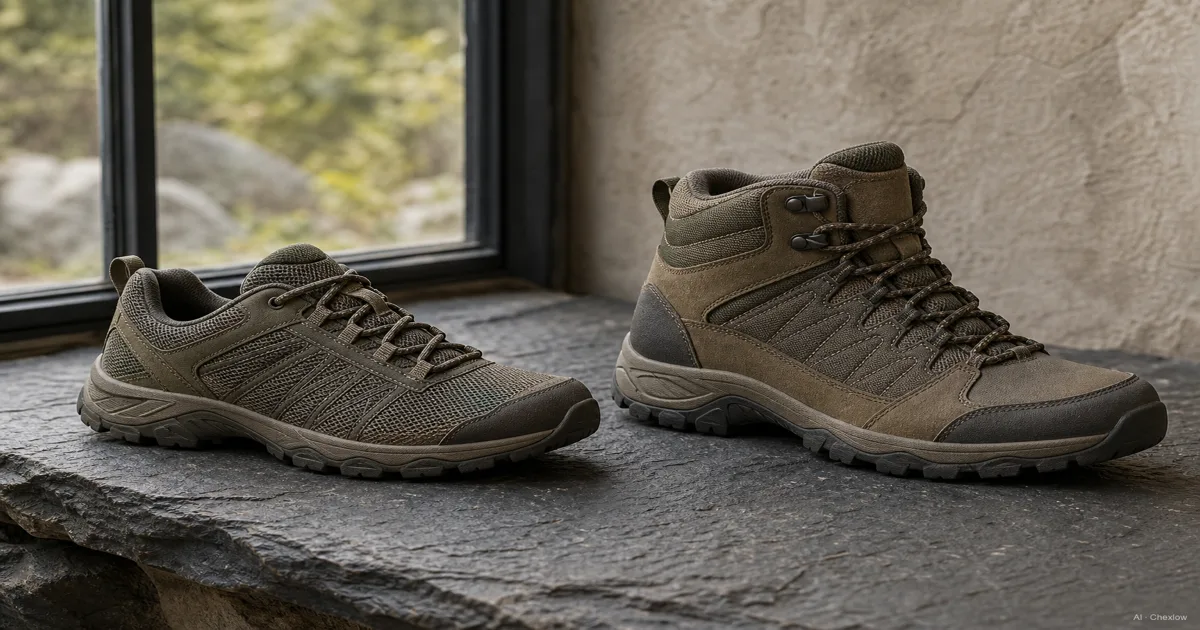
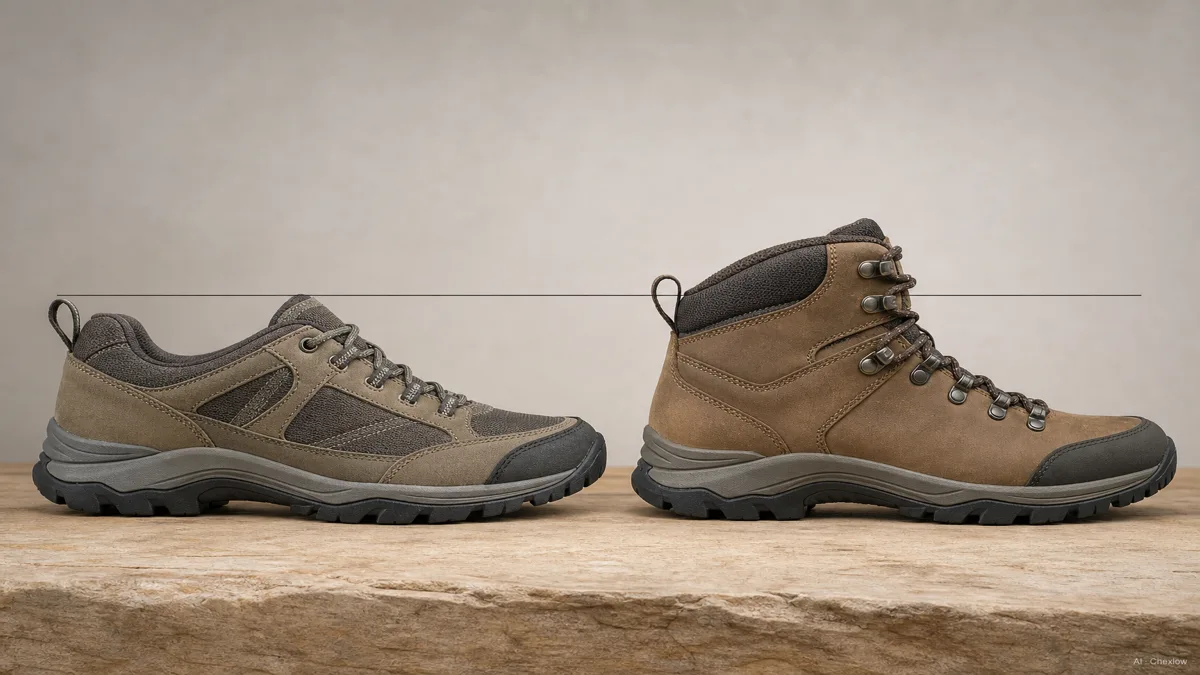
A low-cut hiking shoe sits at or just below the ankle bone, the same height as most sneakers. A mid-cut boot extends roughly 4 to 7 inches above the heel, wrapping up over the ankle bone. That extra band of material is the whole debate, so it helps to know exactly what it changes.
The first change is weight. A low-cut trail shoe averages around 300 to 450 grams per shoe. A mid-cut boot runs heavier, roughly 450 to 650 grams. That gap sounds small on paper, but it compounds. Every step lifts that weight, and over a long day the difference between the two is felt in the legs, not the spec sheet.
The second change is torsional stability, which is just resistance to the sole twisting. Mid-cut boots usually build in a stiffer shank or chassis through the midsole, so the sole resists twisting when you step across a slanted rock or a root. Low-cut shoes flex more readily underfoot, which feels nimble on smooth ground and less planted on uneven ground.
Then there's the ankle itself, and this is where expectations need adjusting. A higher collar gives some mechanical leverage on the joint, but it is not a brace. A 2014 study in the Journal of Foot and Ankle Research found that collar height alone does not statistically prevent ankle sprains when you land on a tilted surface. What actually protects the ankle is fit, sole stiffness, and conditioned muscles. So the boot helps, but it does not replace a strong, well-fitted foot.
The quietly underrated change is debris. A mid-cut boot keeps gravel, sand, and twigs out of the footbed far better than a low-cut shoe, especially on loose or off-trail terrain. First-time buyers rarely weigh this, and then they spend a hike stopping every twenty minutes to shake out a pebble.
Low-Cut vs Mid-Cut: Terrain and Load Decision Matrix
REI's Expert Advice frames the choice almost entirely around two variables, the terrain you walk on and the load you carry. That's the most honest way to cut through the marketing, so here it is laid out plainly.
Light load on groomed trails. Day hikes on well-maintained, packed trails with a small daypack. This is low-cut territory. The lighter shoe lets you move faster, breathes better in heat, and the smooth surface doesn't punish the lack of a stiff shank. You will not miss the ankle coverage here.
Multi-day trips or a heavier pack. The moment you add weight on your back, your centre of gravity shifts and your ankle has more to manage on every uneven step. A mid-cut boot's stiffer chassis and higher collar both start earning their place. The extra grams are worth it once the pack is heavy.
Moderate off-trail or loose, rocky terrain. Scree, mud, exposed roots, sections without a clear path. This is where the debris protection and torsional stiffness of a mid-cut boot pull ahead, and where a low-cut shoe starts feeling like not enough underfoot.
Hot weather, lower elevation. Breathability swings back toward low-cut. Less upper material means more airflow, which matters a lot on a sweaty summer climb at low altitude.
Notice the pattern. Low-cut wins on speed, heat, and smooth ground. Mid-cut wins on load, rough ground, and protection. The interesting part is that the mid-cut boot also handles most of the low-cut situations acceptably, just heavier, while the reverse is not true. That asymmetry matters for a first buy, and we'll come back to it.
The Break-In Reality: What First-Time Buyers Miss
Here's the thing nobody mentions until your heels are blistered, footwear has a break-in cost, and it is very different between the two.
Low-cut shoes, especially the mesh-upper models, often have effectively zero break-in. You buy them, you wear them, they're fine on day one. Modern trail shoes are built around fabrics that flex out of the box.
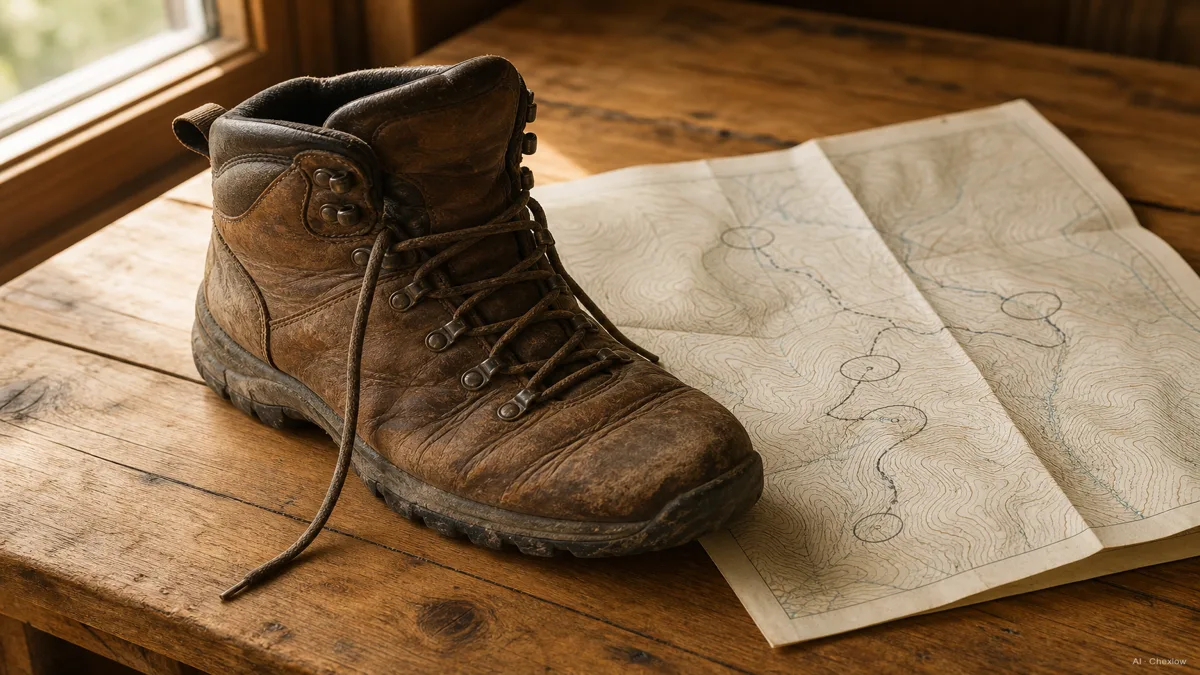
Mid-cut boots are a different story, particularly the leather and full-grain leather ones. A stiff leather boot may need 10 to 20 kilometres of pre-trip wear before it stops fighting your foot. Skip that, lace up a fresh leather boot for a long first hike, and the boot will win.
So if you buy a leather mid-cut boot, build in the break-in. Wear it around the house, then on short walks, then on a couple of easy hikes before any serious trip. This is the single most common first-buyer regret, a great boot ruined by a great hike taken too soon.
Waterproof or Not? (A Separate Question From Cut Height)
A lot of first-time buyers fuse two decisions that are actually independent. Waterproofing is not the same question as cut height.
Both low-cut shoes and mid-cut boots come in waterproof and non-waterproof versions. The waterproof ones use a membrane, Gore-Tex, eVent, or a brand's own, layered into the upper. You can get a waterproof low-cut shoe and a breathable, non-waterproof mid-cut boot. Cut height and waterproofing are two separate dials.
And waterproofing has a real trade-off. A membrane keeps water out, but it also slows how fast the shoe breathes and dries. On a hot, dry trail that membrane just makes your foot sweatier with no upside. On a wet, cold, or river-crossing route it earns its keep. So decide waterproofing on your climate and your trails, not on whether you picked a shoe or a boot.
The clean way to think about it, pick your cut height for terrain and load first, then decide waterproofing for moisture and temperature second. Two questions, answered in order, not one tangled one.
How to Pick Your First Pair: A 3-Question Framework
You don't need a perfect answer. You need a good first pair, and three questions get you there.
Question 1, do you actually know how hard your trails will be? If you're uncertain, if you can't yet say whether you'll stick to groomed paths or wander onto loose rocky sections, lean mid-cut. The ankle coverage and stiffer chassis give you a margin of error on the surprise rough section, and the boot still handles easy trails fine, just heavier. This is the asymmetry from earlier, the mid-cut is the more forgiving unknown.
Question 2, how much weight will you carry, and how long? Short day hikes with a light pack point to low-cut. Multi-day routes or a heavy pack point to mid-cut. Fatigue from carrying extra boot weight is real, but so is the strain of a heavy load on an under-supported ankle. Weigh which one applies to your hikes.
Question 3, what's your climate? Hot and dry leans low-cut and non-waterproof for breathability. Wet, cold, or variable leans toward waterproof, at whatever cut height you landed on from the first two questions.
For a genuinely uncertain first-time hiker, the most versatile single purchase is a mid-cut boot. It covers the groomed day hikes where a low-cut would also do, and the moderate backcountry where a low-cut starts to limit you. You give up some weight and some airflow, and you buy yourself room to grow into harder trails without buying a second pair first.
One last note, the best hiking footwear is the pair that fits your foot today, broken in before the trip that matters. A perfectly specced boot that blisters you on kilometre three is worth less than a well-fitted pair you've already walked in.
Sources
- REI Expert Advice — Hiking boots — terrain and load framework for choosing cut height and boot type.
- Oboz — Mid vs low height hiking shoe — practical comparison of ankle coverage, weight, and use case.
- Advnture — High-cut vs low-cut hiking boots — collar height, stability, and breathability trade-offs.
- OutdoorGearLab — Hiking boots buying advice — fit, support, and break-in guidance.
- Hanwag — Everything about low-cut hiking boots — manufacturer perspective on when low-cut is enough.
Cómo se elaboró esta guía
This piece started from a question first-time hikers keep asking, do I need the boot that covers my ankle, or is the low shoe enough. We anchored the mechanics on REI's Expert Advice (terrain and load framework) and on manufacturer and gear-test write-ups from Oboz, Advnture, OutdoorGearLab, and Hanwag, and we cross-checked the most-misunderstood claim, that a high collar prevents sprains, against a 2014 study in the Journal of Foot and Ankle Research, which found collar height alone is not statistically protective. The selection lens sits on Chexlow's hiking footwear range, so the framing reflects shoes and boots you can actually compare here.
Editado por el equipo de Chexlow · Las imágenes son ilustraciones generadas por IA