Why bags wear differently from shoes
Shoes flex thousands of times a day. A bag doesn't. But a bag has something shoes don't: points of concentrated mechanical stress that stay in the same places wear after wear.
The handles carry the bag's full weight every time you pick it up. If it's a shoulder bag or crossbody, the strap attachment points are stressed every few minutes. The corners of structured bags like briefcases hit surfaces repeatedly. The body of the bag, by contrast, mostly just expands and contracts as you fill and empty it.
This means care attention needs to be distributed differently. You can give the body of the bag a light conditioning once or twice a year and call it done. The handles and stress points need more attention — not necessarily more conditioner, but earlier inspection and targeted care before visible damage sets in.
Lining matters too. A bag with a fabric lining can trap humidity inside, which slows drying after the bag gets wet and creates conditions for mold growth in the corners and at the base. Keep this in mind whenever the bag gets wet from rain or a spill.
Handle darkening — what's causing it and what to do
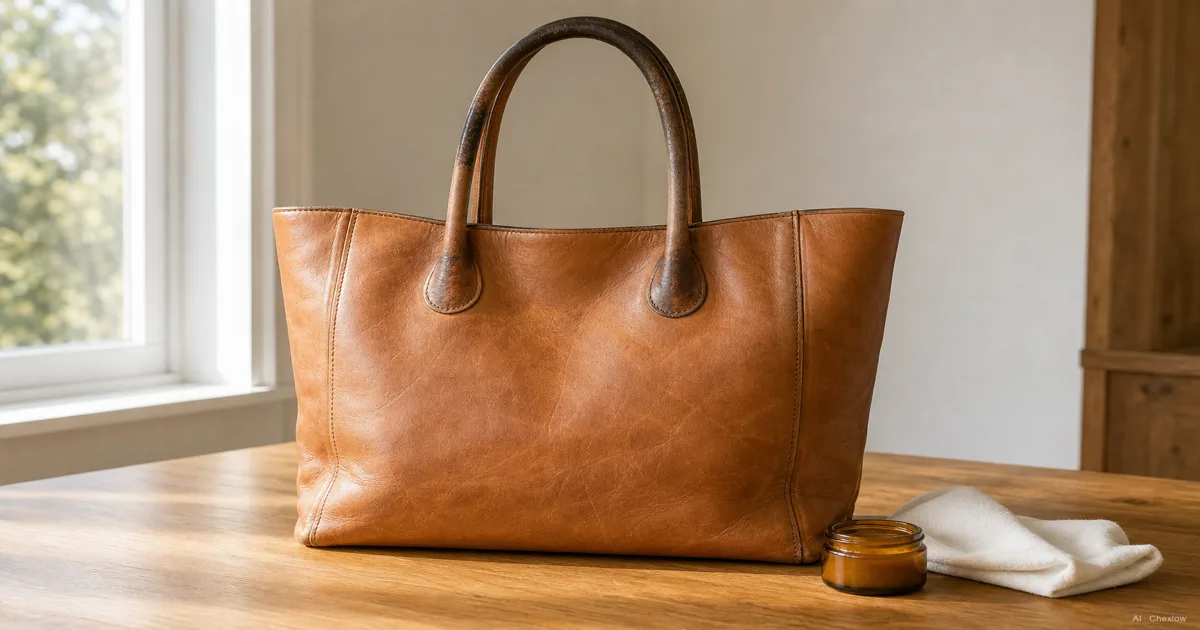
Handles darken because they absorb oils from your hands — the same natural skin oils that actually help condition leather. Over time, those oils darken the surface, especially in warm weather or if you tend to have oily skin. This is accelerated on lighter leathers and on handles that are raw or minimally finished.
Some darkening is irreversible. If the oil has deeply penetrated and oxidized, no conditioner or cleaner will fully lighten it. But there's a meaningful difference between darkening that's just surface buildup versus deep-set oxidation, and the former can often be reduced.
For surface oil buildup, try a small amount of pH-balanced leather cleaner on a soft cloth — just the handle, not the whole bag. Work gently with short strokes rather than circular scrubbing, and let it dry fully before evaluating. Don't use household cleaners, baby wipes, or anything with alcohol.
If the darkening is from sweat, you may see a white salt residue along the edges of the dark area. In that case, wipe down with a barely-damp cloth first, let it dry, then apply a conditioner with beeswax or lanolin afterward.
Prevention is more effective than reversal: handle your bag less with bare hands in summer, or choose a bag with a darker handle if you know this will be an issue.
Patina — learning to read it instead of fighting it
Patina is the gradual change in a leather's surface color, texture, and sheen that comes from use and time. On vegetable-tanned leather — the traditional, plant-based tanning process used for many quality bags — it's expected and considered desirable. A well-worn briefcase or tote that's developed an even honey-gold patina is widely seen as more beautiful than a new one.
On chrome-tanned leather, which is softer and more uniform in color, patina develops more slowly and less dramatically. It's still present, but more subtle.
What you're managing with patina is evenness and direction. Uneven patina — bright patches next to dark patches, or staining that discolors one corner — looks like damage. Even patina that darkens the whole surface gradually looks like age.
To encourage even patina development:
- Use the bag regularly. Consistent exposure to light and handling creates a more uniform surface change than sporadic use.
- Condition lightly every few months with a natural conditioner (beeswax or lanolin base). This keeps the leather supple and helps oils distribute evenly rather than pooling at contact points.
- Avoid leaving the bag in direct sunlight for extended periods, which creates hot spots that darken unevenly.
- Rotate sides if you habitually carry on one shoulder — this prevents one side from aging faster.
If you don't want patina — if you want to keep the leather looking as close to new as possible — a protective leather wax applied from early on creates a surface barrier that slows the process. Fully aniline leathers without any surface coating will still develop some patina regardless, but you can slow it significantly.
Conditioning frequency — less than you probably think
Most leather bags need conditioning two to four times a year at most, and many bags do fine with once or twice a year.
Shoes flex so much that they dry out quickly and need frequent conditioning to stay supple. A bag mostly hangs or sits, with stress concentrated at a few specific points. The body of a typical tote or briefcase simply doesn't work hard enough to need constant re-oiling.
The exceptions are:
- Bags stored in very dry or very hot environments
- Bags exposed to salt air (coastal climates accelerate drying)
- Bags that are used in rain regularly
The signs you need to condition: the leather looks matte and flat rather than having any natural sheen, it feels stiff or papery when you flex it, or you can see small surface cracks forming at the corners or handle attachment points.
Apply with a soft cloth, work in small sections, and use less product than you think you need. A thin, even coat absorbs better than a heavy application and leaves less residue to attract dust. Allow 15–20 minutes for absorption, then wipe off any excess.
Stain removal by type
Oil stains (food, hand cream, lipstick) Blot immediately — don't rub. Sprinkle cornstarch or talcum powder on the stain and leave it overnight. The powder absorbs the oil. Brush off the next morning and assess. If a shadow remains, a very small amount of pH-balanced leather cleaner on a cloth can help, but don't saturate. Wait 24 hours before conditioning the area.
Water stains Water stains on leather happen when water dries unevenly, leaving a tide mark. The fix: dampen the entire panel — not just the spot — with a clean, barely-wet cloth, then let the whole panel dry uniformly at room temperature. When the leather dries as one piece rather than a patchy area, the tide mark usually disappears. Follow with a light conditioning once fully dry.
Ink Act immediately. Isopropyl alcohol on a cotton swab, dabbed (not rubbed) directly onto the ink, often lifts fresh ink before it sets. Test on a hidden area first. Dried ink is much harder to remove without damaging the finish — professional leather restoration is worth considering.
Mold and mildew Mix equal parts water and white vinegar. Lightly dampen a cloth and wipe the affected area, then dry immediately with a clean cloth. Allow to air-dry fully in a well-ventilated area. Do not seal the bag after this — let it breathe for several hours. Once dry, condition the area.
Hardware and lining care
Brass and gold-tone hardware develops patina of its own, which is typically fine and gives character. If you want to slow tarnishing, keep it dry and buff occasionally with a dry cloth.
Silver and nickel hardware can oxidize and, more importantly, the dark residue can transfer to the leather underneath. Check the area around the hardware occasionally. If you see dark staining, clean the hardware lightly with a dry cloth and apply a very thin layer of conditioner to the affected leather to create a barrier.
Avoid getting conditioner or cleaner directly on hardware — oils can tarnish some metals faster, and water-based cleaners can accelerate oxidation.
For fabric linings, shake out debris regularly and spot-clean with a slightly damp cloth if needed. Never saturate a fabric lining — the moisture has nowhere to go and will be trapped against the leather for hours.
Storage — the details that make the difference
Shape retention Structured bags — briefcases, box totes, doctor bags — should be stored with something inside them to hold their shape. Bubble wrap, tissue paper, a small pillow, or even crumpled newspaper works. An unstructured tote or hobo bag can be stored flat or loosely packed.
No hanging by handles Hanging a bag by its handles for long-term storage stretches and distorts the leather at the attachment points. If you need to hang it, use a hook through the hardware or a bag stand.
Breathable covers only The same rule as for jackets: no plastic, no sealed bags. Leather needs to breathe. Use a fabric dust bag (the one the bag came with is usually fine) or a cotton pillowcase.
Away from direct light and heat UV fades leather and accelerates drying. Keep bags in a cupboard or on a shelf away from windows, not displayed on a windowsill.
Metal hardware contact When storing, make sure the hardware doesn't press directly against the body of the bag for months on end. Tucking a piece of tissue or cloth between hardware and leather prevents the kind of slow pressure marks that don't show up until you take the bag out the following season.
Sources
- Carl Friedrik — Leather Bag Care Guide — general conditioning and cleaning overview for structured bags
- Maxwell-Scott — Complete Leather Care Guide — briefcase and tote care specifics
- Santana Leather Care — Why Leather Handbag Handles Darken Over Time — handle darkening causes and treatment
- Romestation — Handle Darkening: Causes, Prevention, and Gentle Remedies — prevention and sweat stain treatment
- Von Baer — Leather Patina Complete Guide — patina formation, management, and vegetable vs chrome tanning
- Leather Honey — Leather Patina: What You Need to Age Leather Beautifully — conditioning for even patina development
- Anuent — How to Remove Stains from a Leather Bag — stain removal by type