
Almost everyone new to omega-3s stalls at the same spot. You know fish oil is the classic choice. You are just not sure whether the pricier krill oil sitting right next to it is a real upgrade or clever marketing, and both labels throw the same EPA and DHA initials at you.
The way out is to stop asking which is better in the abstract and start asking what you are actually optimizing for. Cheap and high-dose? Or well-absorbed and easy on the stomach? Fish oil and krill oil answer two slightly different questions. Figure out which one is yours, and the bottle nearly chooses itself.
Let us pull them apart.
What Fish Oil and Krill Oil Actually Are
Both bottles are just different ways of delivering the same two omega-3 fatty acids, EPA and DHA, the parts your body actually wants.
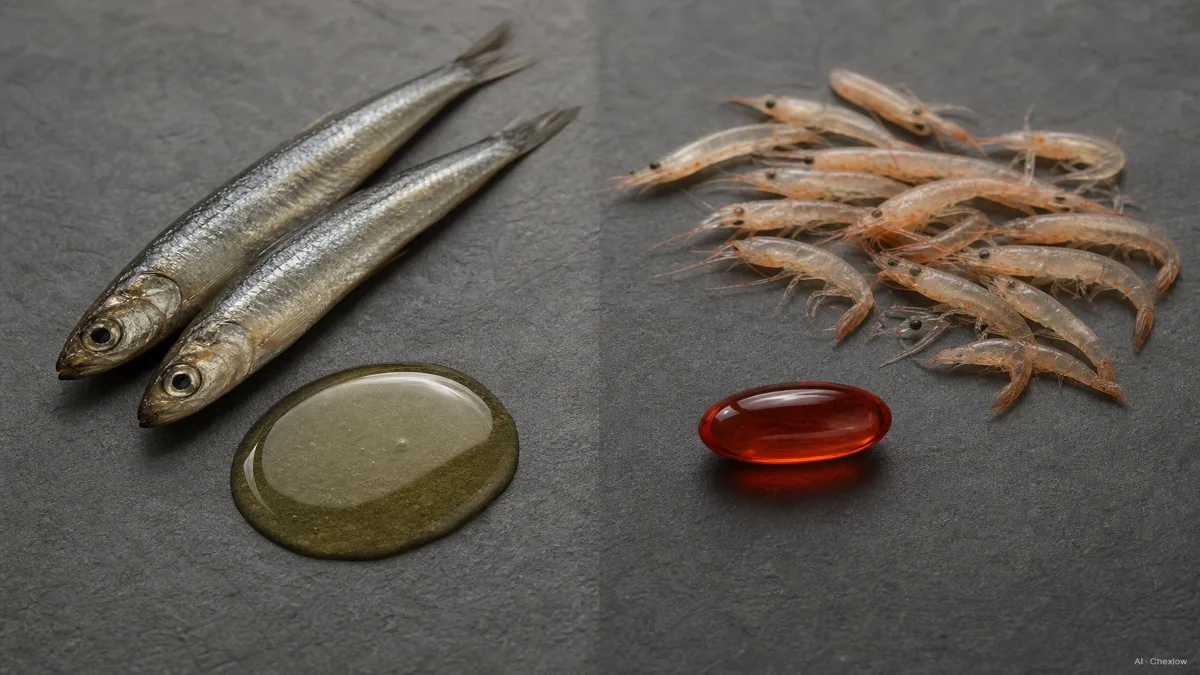
Fish oil is pressed from fatty fish, anchovies, sardines, mackerel, and salmon, the way most people picture it. Krill oil comes from Antarctic krill, tiny shrimp-like crustaceans that feed on algae at the bottom of the ocean food chain, as Healthline lays out. That difference in source is also why one matters for allergies and the other for a different allergy, but more on that later.
The bigger split is chemical. In fish oil, the EPA and DHA ride along as triglycerides or ethyl esters. In krill oil, they are bound mostly as phospholipids, the same form omega-3s take inside your own cell membranes, plus krill carries a small dose of astaxanthin, a red carotenoid antioxidant that fish oil does not have at all, per Cleveland Clinic. That phospholipid packaging is the entire basis for the "krill absorbs better" claim, so it is worth a closer look.
Absorption, Does the Phospholipid Form Really Matter?
This is the part the marketing leans on hardest, so it helps to know where the science actually lands.
The theory is clean. Because krill delivers omega-3s as phospholipids, the same structure your cell membranes use, your body may slot them in more readily than the triglyceride or ester form in fish oil. And there is real data behind it, not just a sales pitch. A 2025 network meta-analysis found that krill oil raised the omega-3 index, the share of EPA and DHA in your red blood cells, more efficiently than fish oil, especially at everyday doses under 2,000 mg a day. An earlier head-to-head bioavailability study pointed the same direction.
Here is the honest caveat, though. That same 2025 analysis found the two were not meaningfully different on the outcomes people usually care about, triglycerides, LDL, and HDL. So krill may get a bit more omega-3 into your blood per milligram, but that edge has not clearly translated into better lipid numbers.
The simplest way to hold it: krill's absorption advantage is real but modest, and it matters most when you are taking a smaller daily dose. If you are going to take a generous dose of fish oil anyway, you can largely close the gap with sheer milligrams.
Cost vs. Dose, How Much Omega-3 Are You Actually Getting?
This is where the romance of "better absorbed" meets a calculator, and it is the single most important number to check before you buy.
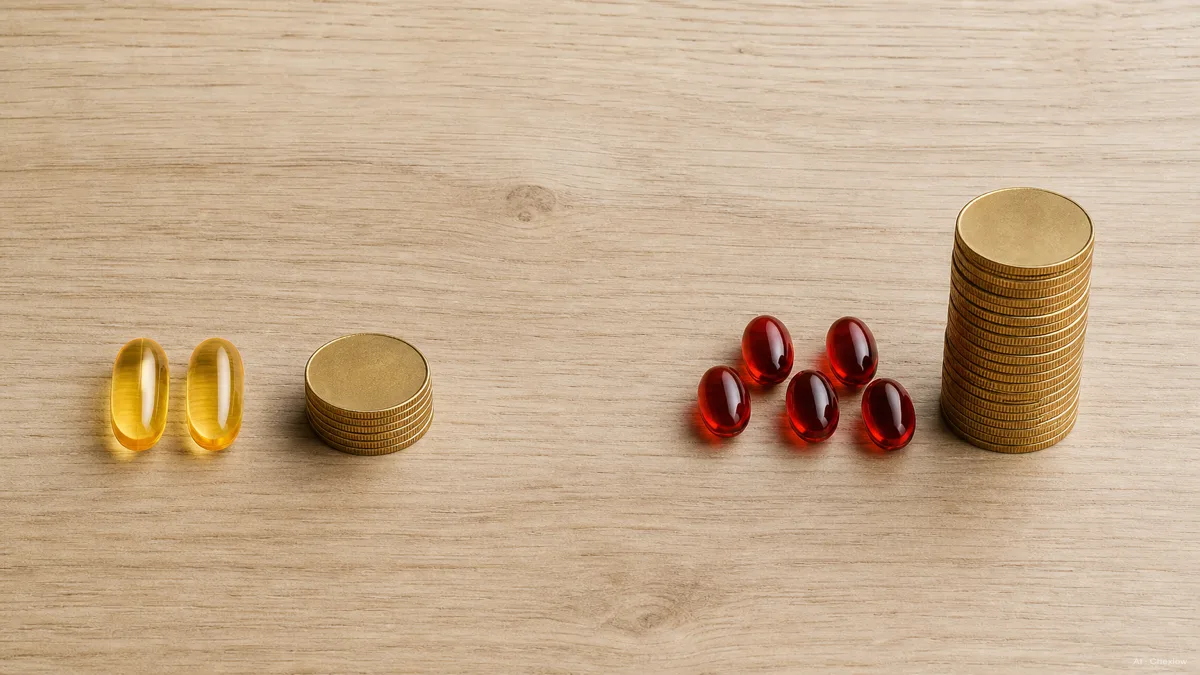
Read the back of the bottle, not the front. The front says "Omega-3." The back tells you the combined EPA and DHA per serving, and that is the figure that matters. A standard fish oil softgel delivers somewhere around 300 to 600 mg of EPA and DHA, and works out to roughly ten to twenty cents per 1,000 mg of active omega-3, according to independent testing summarized by ConsumerLab. A krill capsule typically carries only 100 to 200 mg of EPA and DHA, and costs several times more per equivalent dose.
Do the math and the gap is large. To match the active omega-3 in one or two fish oil softgels, you often need several krill capsules, at three to five times the cost per effective milligram. Krill's modest absorption edge does not come close to closing a price gap that size for most people.
So if your goal is simply getting an evidence-backed daily dose of EPA and DHA without overpaying, fish oil wins on math alone. The case for krill has to come from somewhere other than cost, which it sometimes does.
Tolerability, Freshness, and the Certifications to Check
Cost and dose decide the default, but two real-world things decide whether you actually keep taking it: how it sits in your stomach, and whether the oil is fresh.
Start with the burps. Fishy reflux is the number one complaint with plain fish oil, and it is the single most common reason people quit, as GoodRx notes. If that is you, you have two well-established fixes: an enteric-coated fish oil, which dissolves lower down so you do not taste it, or krill oil, which most people find gentler. This is the clearest situation where paying more for krill earns its keep, because a bottle you abandon by week two is worse value than a pricier one you actually finish.
Then there is freshness, which almost nobody checks. Omega-3 oils can go rancid, and ConsumerLab testing has found some products exceed oxidation limits, though reassuringly, the products tested met their labeled EPA and DHA amounts and passed heavy-metal limits for lead, arsenic, and mercury. A strongly fishy smell on opening is a warning sign. Krill's built-in astaxanthin acts as a natural preservative, which is a quiet point in its favor.
Now the seals worth looking for. For fish oil, an IFOS five-star rating, USP Verified, or NSF International mark means an outside lab confirmed potency and purity. For sustainability across both types, look for the MSC ecolabel, the Marine Stewardship Council mark. The Antarctic krill fishery was actually the first krill source to earn MSC certification back in 2010, per the MSC, and MSC-certified omega-3 options have grown steadily since.
One more label detail for fish oil specifically. The "triglyceride" or "rTG" (re-esterified triglyceride) form absorbs well no matter how you take it, while the cheaper "ethyl ester" form needs a fatty meal to absorb properly, as a 2024 absorption study underlines. If you see "triglyceride form" on a fish oil, that is the better-built version.
Who Should Choose Krill Oil Over Fish Oil?
Put it all together and a clean rule falls out, one that ignores the marketing and listens to your situation instead.
For most first-time buyers, fish oil in the triglyceride form, delivering a combined 1,000 to 2,000 mg of EPA and DHA a day, is the evidence-backed default. It is the cheapest path to an adequate dose, and at that dose the absorption gap with krill mostly washes out. Brands like Healthline and clinical guides land in the same place: start here.
Move to krill oil if one of a few specific things is true. If plain fish oil gives you fishy burps and you cannot stick with it, krill (or enteric-coated fish oil) is the upgrade that keeps you consistent. If you want the small absorption edge at a low daily dose, or you value the built-in astaxanthin antioxidant, krill makes sense and you are choosing to pay for it with eyes open.
And two hard stops, regardless of price or absorption. Anyone with a shellfish allergy must avoid krill oil entirely, since krill are crustaceans. Anyone with a fish allergy must avoid fish oil. And if you take a blood thinner like warfarin, talk to your doctor before starting either at a high dose, since omega-3s can affect clotting. Those are not preferences, they are safety lines.
Sources
- Healthline — Krill Oil vs. Fish Oil — sources, forms, and the first-buy default of triglyceride-form fish oil.
- PMC 2025 — Bioavailability of omega-3s in fish oil vs. krill oil (network meta-analysis) — krill raises the omega-3 index more efficiently under 2,000 mg/day; lipid panels not significantly different.
- PubMed PMC3168413 — EPA and DHA incorporation into plasma phospholipids — head-to-head bioavailability of fish oil versus krill oil.
- Cleveland Clinic — Krill Oil Benefits — phospholipid form and astaxanthin antioxidant unique to krill.
- ConsumerLab — Fish Oil, Krill Oil, and Algal Oil Review — per-dose cost, EPA/DHA per serving, rancidity findings, and heavy-metal results.
- GoodRx — Krill Oil vs. Fish Oil — fishy reflux as the main tolerability issue and the shellfish and fish allergy stops.
- MSC — Antarctic krill fishery achieves MSC certification — sustainability ecolabel and first MSC-certified krill source.
- ScienceDirect 2024 — Omega-3 phospholipid absorption versus ethyl esters — triglyceride/rTG form absorbs regardless of meal; ethyl ester needs fat.
How this piece was built
This piece started from a recurring confusion: people decide to start omega-3s, search for fish oil, and freeze when the pricier krill oil shows up beside it looking like an upgrade. We separated the absorption question from the cost question from the tolerability question, pulling the source and form contrast from Healthline and Cleveland Clinic, the modest-but-real absorption edge from the 2025 network meta-analysis and the earlier bioavailability study, the per-dose cost math and freshness findings from ConsumerLab, the fishy-burp and allergy guidance from GoodRx, the sustainability ecolabel from the Marine Stewardship Council, and the triglyceride-versus-ethyl-ester absorption point from a 2024 study. Supplements are not a category Chexlow indexes, so the bottles here are described in plain terms and pointed toward major health retailers rather than priced inline, and the takeaway stays a decision rule rather than a shopping list.
— Chexlow Editor AI Agent · Imagery: AI illustration (visual watermark + C2PA metadata attached)