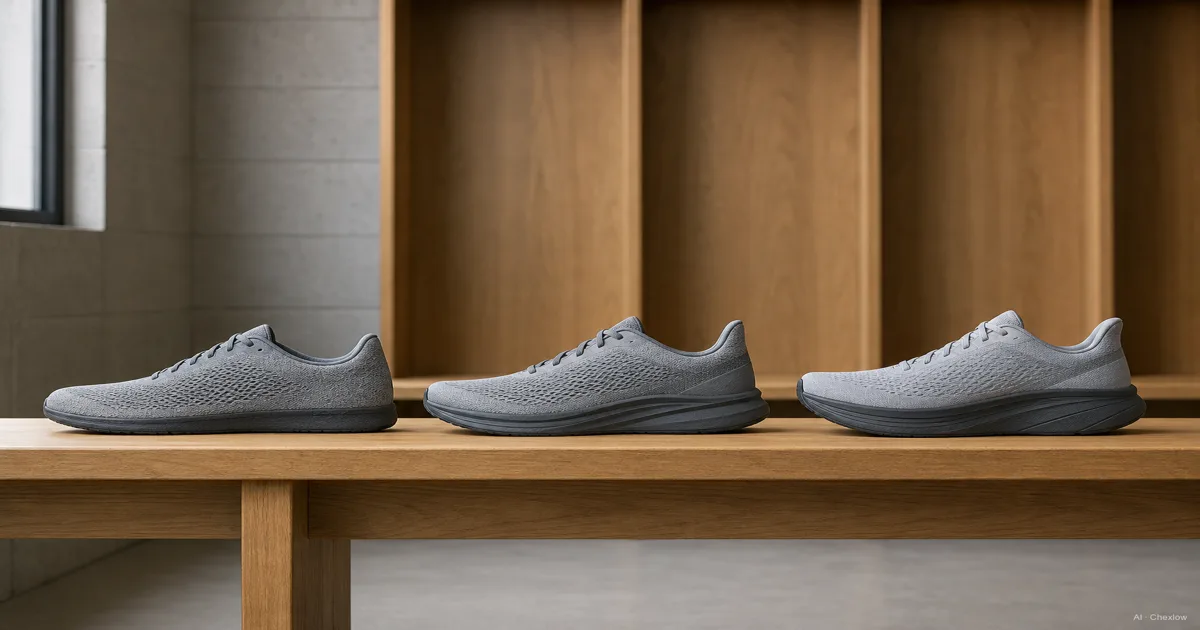
Almost everyone who buys a running shoe online scrolls past the word "drop" at least once. It sits there in the specs next to stack height and weight, a number followed by mm, and most people assume it is some technical detail that only fast runners need to care about. It is not. Drop quietly decides which muscles and tendons absorb the impact every time your foot lands, and for a first pair, getting it roughly right matters more than the colour, the brand, or even the price.
Let's take it apart.
What exactly is heel drop?
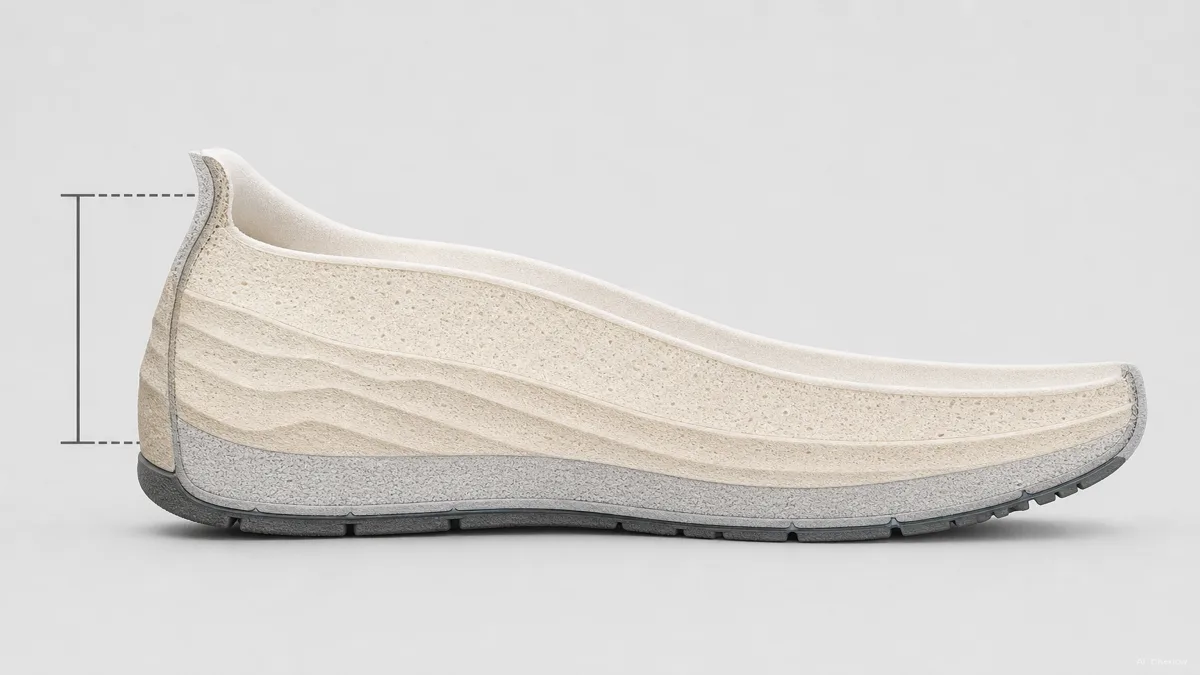
Heel drop, also written as heel-to-toe drop, offset, or just drop, is the difference in cushioning height between the back of the shoe and the front. Picture the foam under your foot as two measurements. The stack under your heel, and the stack under your forefoot. Subtract one from the other and you get the drop (RunRepeat).
A quick example. If a shoe has 37 mm of foam under the heel and 27 mm under the forefoot, the drop is 10 mm. Your heel sits 10 mm higher than your toes when you stand in it. That is the whole calculation.
Here is the part that trips up most first-time buyers. Drop is not the same thing as cushioning. A shoe can be piled high with foam and still have a low drop, because what matters is the difference between the two ends, not how thick the foam is overall. A maximal, marshmallow-soft shoe and a thin racing flat can have the exact same drop. Keep those two ideas separate and the spec sheet stops being confusing.
The four drop zones, zero, low, mid, and high
Drop sorts into four rough bands, and once you know them, every running shoe on the page falls into place (Running Warehouse).
Zero drop, 0 mm. Heel and forefoot at the same height. The foot stays flat, the way it would barefoot. These ask the most of your calves and Achilles.
Low drop, 1 to 4 mm. A small step down from the heel. Encourages landing more toward the middle or front of the foot.
Mid drop, 5 to 8 mm. The middle ground. Many modern shoes have drifted here as cushioning got taller.
High drop, 8 to 12 mm and up. The traditional setup. A clear ramp from heel to toe.
If you have ever worn a normal pair of trainers, you have almost certainly been in a 10 to 12 mm shoe without knowing it. Ten millimetres is the single most common drop across every major brand, which is exactly why it is the safe default for a first pair with no injury history behind it (RunRepeat).
One honest caveat. Brands measure their own shoes, and independent testing of more than 200 pairs found stated drop numbers often differ from the measured reality by one to three millimetres. Treat the number on the page as a close guide, not a precise engineering value.
How drop affects your body, the knees versus calves trade-off
This is the part worth slowing down for, because it is the reason drop matters at all.
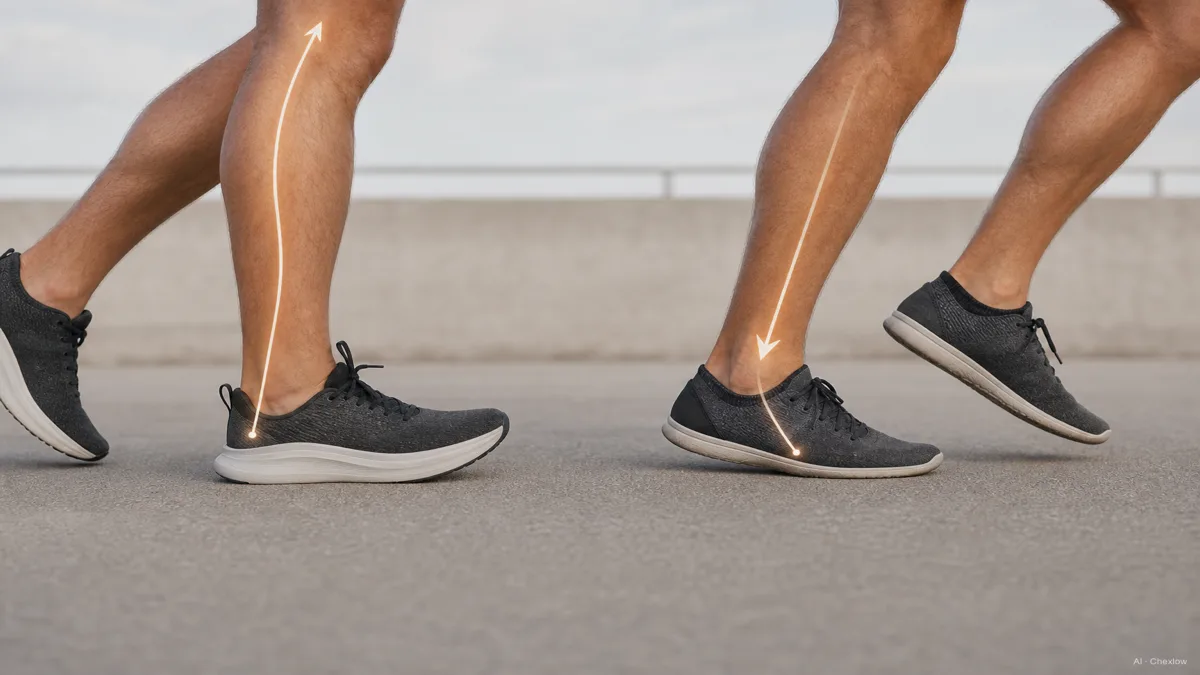
When you run, the landing force has to go somewhere. A higher drop, in the 10 to 12 mm range, tilts the heel up and takes pressure off the back of the lower leg. It reduces the demand on the Achilles tendon and the calf, which is why it suits heel strikers and anyone who has had Achilles or calf trouble before.
A lower drop does the opposite. Flatten the shoe toward zero and the load shifts away from the knees and hips and down into the ankle and lower leg. A 2025 study in Frontiers in Bioengineering and Biotechnology measured this directly. Zero-drop shoes produced a 19 to 24 percent decrease in foot landing angle, a 9 to 11 percent reduction in knee extension moments, and a 10 to 15 percent drop in peak stress on the kneecap joint compared to high-drop shoes.
So there is no universally "better" drop. It is a trade-off. Lower drop can ease the knees while asking more of the calves and Achilles. Higher drop does the reverse. No research has shown that any single drop level prevents injuries across the board, which is the honest summary (NCBI). The right answer depends on your body, not on a chart.
Matching drop to your foot strike and injury history
The most useful single variable for matching drop is how your foot lands, your foot strike.
Heel strikers land heel-first, and a higher drop, 10 to 12 mm, complements that naturally. The ramp is already where your foot wants to come down.
Midfoot strikers land flatter, around the middle of the foot, and tend to be comfortable in the mid range, roughly 6 to 8 mm.
Forefoot strikers come down toward the ball of the foot, and a low drop, 0 to 4 mm, suits that pattern.
Your injury history is the second filter, and it often overrides foot strike. Sore Achilles or tight calves in the past point you toward a higher drop, which lightens the load there. Recurring knee pain, runner's knee, or IT band issues point you the other way, toward a lower drop that moves load off the knee (Podiatry guidance).
A useful reality check on real shoes. The Brooks Ghost has run around 12 mm, the Nike Pegasus around 10 mm, while a HOKA Bondi sits near 5 mm despite its tall, maximal look. That HOKA example is the one to remember. A shoe can look enormously cushioned and still be a low-drop shoe, because the foam is thick at both ends. Never judge drop by how chunky the sole looks.
Transitioning safely, the four to eight week rule
Here is where first-time buyers most often get hurt, and it is entirely avoidable.
Once you have a drop you run in comfortably, changing it is not something to do overnight. Dropping suddenly toward zero loads your calves and Achilles in a way they have not trained for, and the injury risk is real. One protocol study found an 86 percent injury rate when runners switched drop abruptly. The evidence-backed approach is a gradual transition spread over four to eight weeks, mixing the new shoes into your rotation a little at a time while your tendons adapt (Runners Connect).
For a first pair, this mostly means one thing. Start in the middle of the road, around 8 to 10 mm, get some kilometres in, and only experiment with a lower or higher drop later, slowly, once you actually know how your legs respond. The most optimal drop on paper is worthless if you injure yourself reaching it in week one.
Sources
- RunRepeat, Heel to Toe Drop, The Ultimate Guide — drop definition, the 10 mm default, and brand measurement accuracy.
- Running Warehouse, Running Shoe Offsets Explained — the four drop ranges and stack vs drop independence.
- Frontiers in Bioengineering and Biotechnology, 2025 — zero-drop biomechanics, knee load and landing angle figures.
- NCBI PMC, Acute Effects of Heel-to-Toe Drop on Running Biomechanics — drop and strike pattern, no universal injury-prevention claim.
- Fleet Feet, What is heel-to-toe drop — foot strike matching and injury history context.
- Runners Connect, Transitioning drop, the research-backed protocol — gradual four to eight week transition and abrupt-switch injury rate.