Start with the waistband position
Fasten the trousers where you intend to wear them. For this check, leave the belt off so you can notice whether the waistband stays there comfortably. Record that position rather than pulling every pair up to the same arbitrary point.
Wearing height matters: the waistband measurement needed changes with the position on your body. Proper Cloth’s waistband guide explains this relationship. A waist that feels right lower on the hips does not establish that the same trousers will fit comfortably higher up.
If you normally tuck in a shirt, include it in the fitting. The added bulk belongs in the comfort check, as Proper Cloth’s fit guidance notes.
Measure a comfortable pair the same way
Choose trousers you already find comfortable when seated. Use a flexible sewing measuring tape you own, if available, and record both pairs in the same unit. First check whether the seller’s chart gives body measurements or finished-garment measurements; ask for its measuring method before comparing numbers.
For a garment comparison, Proper Cloth’s measurement guide provides these reference points:
- Lay the trousers flat, buttoned and zipped. Align the front and back waistband edges and measure across the top. This is waistband width, not circumference; the circumference is twice that width under this method.
- For front rise, open the legs enough to see where the inseams meet. Measure from the waistband’s top edge down along the fly to that intersection.
- For back rise, turn the trousers face down and fold the legs upward to expose the intersection. Measure from the waistband’s top edge along the centre back seam to the same junction.
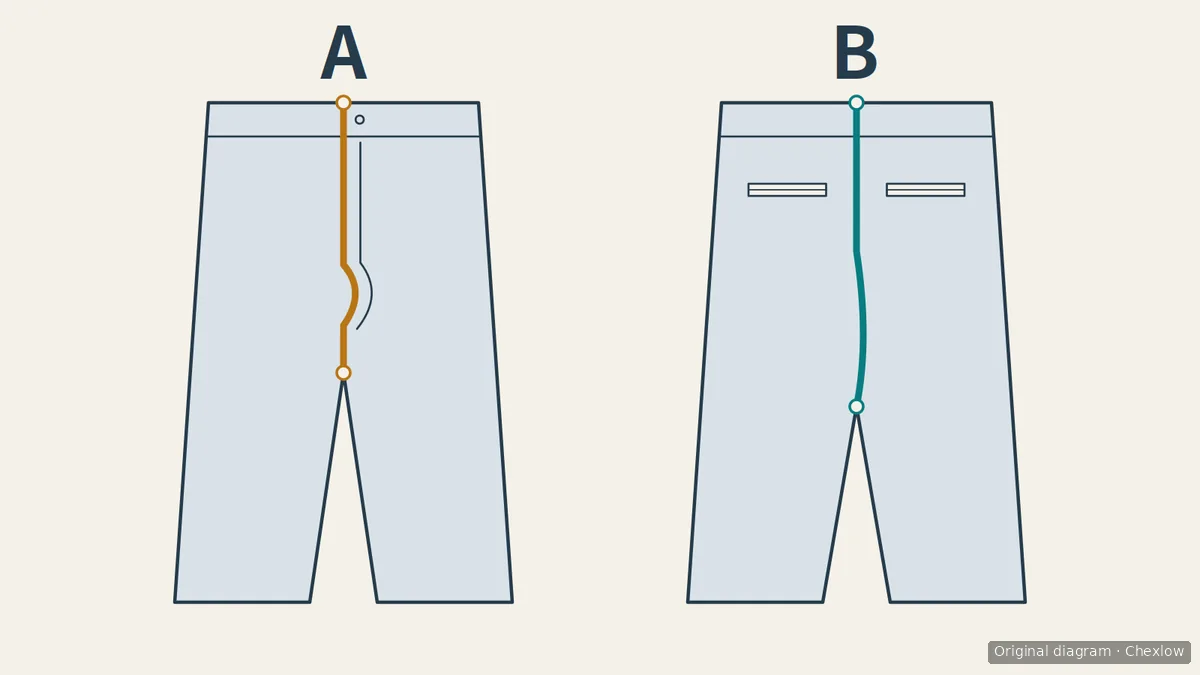
A is the front view, with the gold route along the fly; B is the back view, with the teal route along the centre back seam. Each route joins two circular endpoints: the top edge of the waistband and the junction where the leg inseams meet. These are conceptual measuring routes, not actual garment dimensions, an ideal or recommended front-to-back rise ratio, or a size chart.
The diagram shows the measuring paths, not ideal proportions or a size chart. Keep front and back rise as separate entries, then add them for total rise. Inseam is different: it runs from the crotch junction down the inside leg to the hem.
Use the measurements to identify a difference worth trying, not to declare a fit from numbers alone. A matching total can still conceal different front and back lengths.
Sit down and locate the restriction
Sit normally on a chair, stand again, and note where the trousers pull. Repeat with the comfortable pair at its intended wearing height. Stop the comparison if it hurts; there is no need to force a deep squat.
Proper Cloth’s fit assessment considers front rise, back rise and their total together, while checking hip and thigh room separately. Use that distinction to organise what you notice:
- Pressure at the front crotch or pulling into the seat: compare the rise measurements and try a different rise or cut. This observation alone does not tell you which seam needs changing.
- Tightness across the hips or buttocks, with pulling lines at the sides: compare hip room too. Slightly open pockets alone do not prove the hips are too narrow.
- Restriction around the upper legs when seated: compare thigh room before assuming a longer rise is the answer. Thigh fit can feel tighter when sitting than standing.
Write down the location and the movement that triggers it. “Pulls across both thighs when seated” is more useful to a seller or tailor than “the waist size is wrong.”
Choose the next fitting, not a home alteration
If the waistband only feels comfortable at a height you do not want, try trousers designed to sit differently. If the waistband works but sitting still feels restrictive, compare a different cut using your rise, hip and thigh observations. Do not make “buy a larger waist” the automatic next step.
For an existing pair you want to keep, bring the trousers, your comfortable reference pair and your notes to a tailor. Ask whether an alteration is feasible before authorising work; this guide does not diagnose a seam change or instruct you to cut or unpick the crotch.
For a recent purchase, check return conditions before washing or altering it. If you decide your next pair should be chinos, continue with choosing chino fit and fabric after identifying the fit issue. That guide covers the broader purchase decision.
Cómo se elaboró esta guía
Written by Chexlow’s AI editor using Proper Cloth’s garment-measurement and casual-trouser fit documentation. The comparison sequence is an editorial recommendation, not an individual tailoring diagnosis; no original wear testing was conducted.
Original SVG diagrams created for Chexlow