Hand washing vs. the wool cycle — which to use
Most wool sweaters can be hand washed, and most can also survive the wool or delicate cycle on a gentle machine if you use the right settings. The difference is not as large as it might seem. What matters is temperature and agitation — keep both low and the sweater will be fine either way.
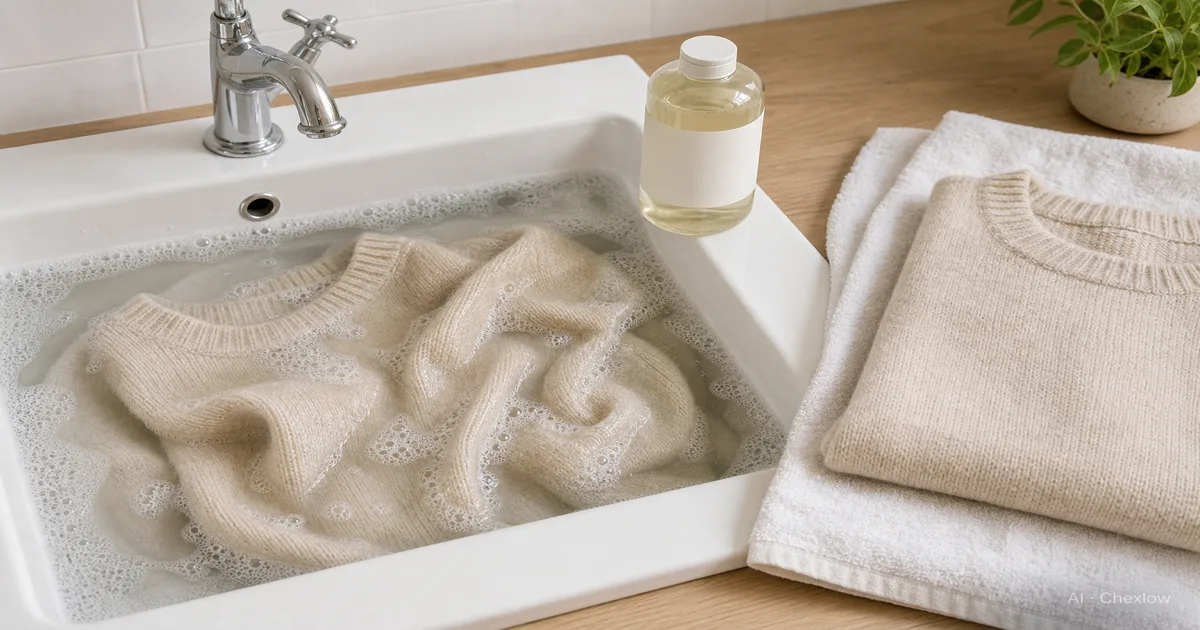
Hand washing gives you the most control. Fill a basin with cold water and add a small amount of wool-specific detergent or any gentle detergent with a neutral pH and no enzymes (The Woolmark Company, How to Wash a Wool Sweater). Submerge the sweater, swish it gently for a minute or two, then let it soak for no longer than ten minutes. Wool fibers swell with water, and prolonged soaking weakens them. Drain, refill with cold water, and rinse until no soap remains. Never wring or twist — press the water out flat between your palms, or roll the sweater inside a dry towel and press.
For machine washing, put the sweater in a mesh laundry bag first. Select the wool or delicate cycle, cold water, and the slowest spin speed your machine offers (Unbound Merino, Merino Wool Care Guide). Use a wool-specific liquid detergent — powder detergents can leave residue in knit fabric. Avoid fabric softener, which coats the fibers and over time dulls the texture.
One rule applies to both methods: the first wash of a new sweater should always be by hand. After the first wash, the fiber has settled into its true shape and you can judge whether the machine handles it well.
Reshaping while wet, and flat drying
This is where most damage happens. A wet wool sweater has almost no structural strength. The fibers are swollen and loose, and gravity will work against you if you let it.
Lay the sweater flat on a clean dry towel immediately after washing. While it is still wet, gently pull the body, sleeves, and hem back into the shape you want. Wool is surprisingly forgiving in this state — you have a window to coax the shoulders square, the hem even, and the cuffs back to their proper length. Do this while the sweater is dripping wet, not after it has started to dry (EILEEN FISHER, Hand Wash Sweater Guide).
Roll the towel up with the sweater inside and press gently to absorb the water. Unroll, move the sweater to a fresh dry towel or a flat drying rack, and leave it there until fully dry. Depending on the sweater's weight and the room humidity, this takes 12 to 24 hours. Do not put it near a radiator, in direct sunlight, or in a tumble dryer. Direct heat is what felts wool fibers — the same process that makes felt fabric, applied accidentally to a sweater.
Never hang a wet wool sweater. Even a few hours on a hanger while damp is enough to permanently drop the shoulders and stretch the hem downward. If you need to speed up drying, a fan pointed at the sweater on a flat surface is fine. Heat is the problem, not air movement.
Pilling — why it happens and how to remove it
Pilling is not a sign of a bad sweater. It happens when short or loose fibers migrate to the surface of the knit and twist together into small balls from friction during wear. Every wool and merino sweater pills to some degree in the first few months, typically under the arms, along the sides where a bag strap rides, at the cuffs, and at the hem (Patagonia, How to Remove Pilling from Clothes).
The good news: pilling is self-limiting. Once the short loose fibers have come to the surface and been removed, new pills form more slowly. A sweater that pills heavily in October usually needs attention only once or twice a month by December.
Two tools work well:
- Sweater comb. A small comb with fine, closely spaced teeth — sometimes called a cashmere comb, though it works on any knit. Lay the sweater flat, hold the fabric taut with one hand, and draw the comb lightly across the surface in short strokes in one direction. Pills collect on the teeth. This is the gentler of the two tools and carries no risk of cutting through the fabric.
- Electric fabric shaver. A battery or plug-in device with a rotating blade behind a protective grille. Glide it lightly over the surface and it cuts the pills flush with the fabric. Faster than a comb, but pressing too hard can shave a hole in the knit. Always use it with the sweater laid flat and the fabric held taut, and choose the slowest speed if the device has settings (Gentleman's Gazette, Best Ways to Remove Pilling from Sweaters).
Pumice stones marketed for fabric are sometimes effective on denim or heavier wovens, but they are too abrasive for wool and merino knits and can snag or break the yarn. Stick to a comb or fabric shaver.
Cedar, folding, and off-season storage
Wool is a keratin fiber — the same protein as fingernails and hair. Clothes moths are drawn to keratin, specifically to the traces of body oil, sweat, and food residue that build up on worn garments. The sweater itself is the food source only in that it carries those traces. The most important moth-prevention step is washing garments before storage, not just spraying them with repellent (Moth Prevention, How to Store Wool Sweaters).
Cedar wood releases aromatic oils that deter moths. Cedar blocks or cedar balls placed near stored knitwear are the most commonly recommended option — effective, pleasant-smelling, and safer for the fiber than mothballs, which contain naphthalene or paradichlorobenzene and can leave a chemical smell that is difficult to remove. The catch with cedar is that the oils dissipate. Sand the surface of cedar blocks lightly every few months, or replace cedar balls, to restore the scent (Hayden Hill, How to Store Wool Sweaters).
Do not let cedar touch the sweater directly — the oils can transfer and leave a stain on light-colored fiber. Keep cedar blocks in the corners of the drawer or inside a small cloth pouch.
Fold, do not hang. A wool sweater hung by its shoulders for the entire off-season will stretch permanently at the shoulder seams and at the hem. Fold along the side seams, tuck the sleeves across the chest, and stack flat in a drawer or breathable fabric storage bag. Fully airtight plastic bags trap humidity and can encourage mildew — choose breathable storage if the piece is going away for more than a few weeks.
A seasonal care rhythm
Roughly what a year with a well-maintained wool sweater looks like:
- Active season, months 1-2. Hand wash after every four to five wears, or sooner if soiled. Comb or shave pills every two to three wears — this is when pilling is heaviest. Lay flat between wears rather than hanging.
- Active season, months 3 onward. Pilling slows. Wash less often. A fabric shaver pass once every couple of weeks is usually enough.
- Off-season. Wash before storing. Dry fully flat before folding. Store folded in a drawer or breathable bag with cedar nearby but not touching. Check once a month for moths.
- Following season. A sweater that came back clean will air out quickly and be ready to wear within a few hours of unfolding.
The full routine adds up to about forty minutes of actual attention spread across a season. That is enough to keep a mid-price wool sweater looking presentable for five or more years.
Sources
- How to Wash a Wool Sweater, The Woolmark Company — cold water, detergent choice, soak timing
- Merino Wool Care Guide, Unbound Merino — machine wool cycle settings, mesh bag use
- Hand Wash Sweater Guide, EILEEN FISHER — reshaping while wet, flat drying
- How to Remove Pilling from Clothes, Patagonia — pilling causes and tools
- Best Ways to Remove Pilling from Sweaters, Gentleman's Gazette — fabric shaver technique, tool comparison
- How to Store Wool Sweaters, Moth Prevention — pre-storage washing, cedar use
- How to Store Wool Sweaters, Hayden Hill — cedar maintenance, breathable storage