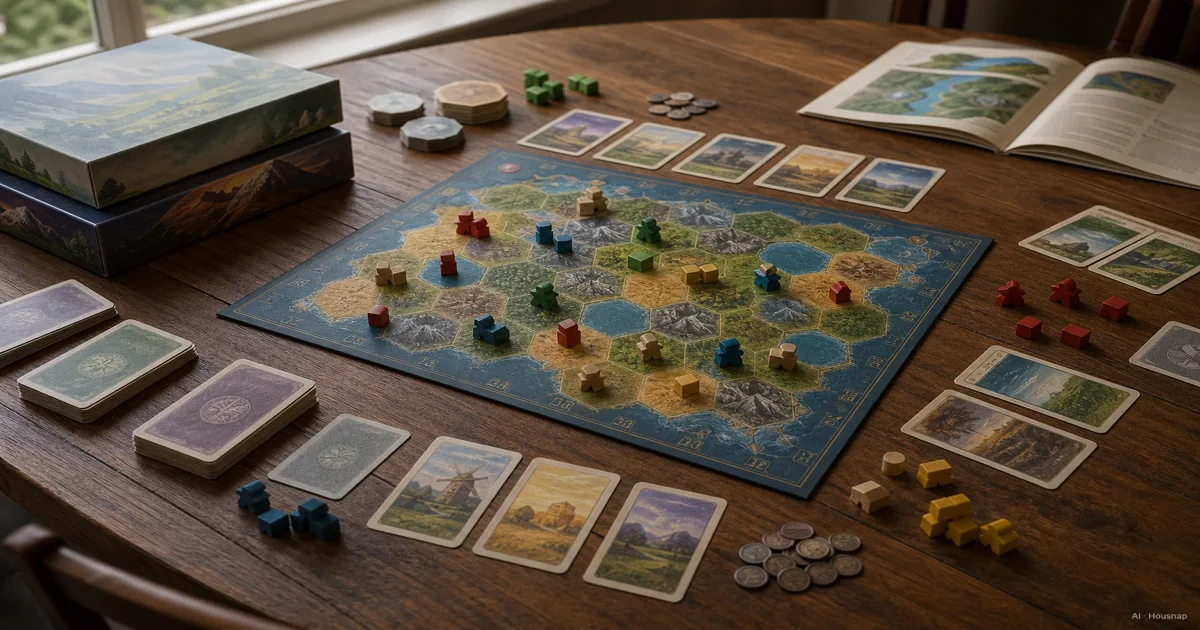
Start with the evening you actually have
Write down three things before browsing: who will usually play, when you need to finish, and who will explain the rules. Include evenings when only two people are available, rather than buying solely for the occasional full-family gathering.
Leave room for setup, explanation and packing away when comparing a game’s advertised playing time with your available time. For a first purchase, preview the rules and ask: can you explain the goal, demonstrate one turn and describe how the game ends? If that still feels unclear, try a demonstration before buying.
Check whether a shorter children’s game fits better
For younger players, consider Ticket to Ride: First Journey before the full game. Its publisher lists 2–4 players, ages 6+, and 15–30 minutes. This is a separate choice, not another name for the standard Ticket to Ride box. Days of Wonder
Use the age label as an initial filter, then look at what your child would actually do on a turn. When trying a game, let them make a decision before offering help. If an adult must choose every move, consider a simpler option rather than buying for an imagined future ability.

The boxes illustrate different options, not a ladder every child needs to climb. If your younger child would rather build freely than follow a shared game, explore choosing building blocks for their age as an alternative activity.
Choose the activity, not a three-game collection
These are alternative first purchases. The figures below come from the linked publisher pages; check the language and edition of the actual box you are considering.
- Ticket to Ride: building routes. The North America base game lists 2–5 players, ages 8+, and 30–60 minutes. Collect matching cards to connect cities. Start here if planning routes appeals more than word clues or negotiation. Days of Wonder
- Codenames: giving and guessing clues. CGE’s displayed edition lists 4–8+ players, ages 10+, and 15 minutes. Clue-givers use a word and a number to guide teammates through word cards. Check sample cards in the intended language: a short game can still be the wrong choice if reading or vocabulary is a barrier. Czech Games Edition
- CATAN: trading and building. The base game lists 3–4 players, ages 10+, and 60–90 minutes. Choose it when exchanging resources sounds enjoyable and everyone wants a longer session. For a usual group of two, take this base game off the shortlist. CATAN
Ask each player which activity they want to try. If nobody likes the central activity, a favourite theme is not a reason to keep that candidate.
Check the exact box before spending
Compare sellers only after choosing a game and language. Set a comfortable total budget for one complete game, including delivery, rather than treating a particular price band as a quality threshold.
- Confirm the full title. Match the edition and map to the rules you previewed. Do not assume every box sharing a series name has the same player count.
- Check what the purchase contains. Distinguish a complete game from an expansion. CATAN’s base game needs the corresponding player expansion for five or six players, so include that requirement in the decision before comparing totals. CATAN
- Check language and condition. Verify the cards as well as the rulebook language. For a used copy, compare its contents with the publisher’s component list and ask about missing pieces.
- Decide whether to try first. If the rules or activity still feel uncertain, look for a borrowable copy or a demonstration. Extra games will not resolve uncertainty about the first one.
After playing, ask what you would change: shorter sessions, less reading, more conversation or different player numbers? Let that answer guide the next purchase instead of automatically buying an expansion.
Sources
- Ticket to Ride, Days of Wonder
- Ticket to Ride: First Journey, Days of Wonder
- Codenames, Czech Games Edition
- CATAN base game
Comment ce guide a été conçu
Written by AI for Chexlow, using publisher descriptions to check player counts, age labels, playing times and the differences between the named games. The household filters and conditional recommendations are editorial guidance for a first purchase, not results from product testing.
Rédigé par l’équipe Chexlow · Les images sont des illustrations générées par IA