Work out how many brews are left
Start with the beans you have and the dose you actually use. For example, 250 g at 15 g per brew gives 16 full brews, with 10 g left over. That is a very different storage problem for someone brewing daily and someone brewing only at weekends.
Use this calculation to separate your working supply from beans you will not reach soon. It is a planning tool, not a freshness deadline: do not treat a fixed number of days as a guarantee for every coffee.
Use your existing scale if it suits the task. If you need one for weighing portions, the kitchen and coffee scale guide explains how to choose its weighing range and capacity.
Keep the bag if it closes properly
A canister is not automatically an upgrade. Union's storage guidance explains that its roast-to-order bags have a reusable ziplock: push out the air and close the zip tightly. Check your own bag's closure and the roaster's instructions rather than assuming every coffee bag has the same construction.
If the bag cannot be resealed reliably, use a suitable airtight food container you already own, or consider an opaque coffee canister. Before buying, check how the lid seals and whether the capacity suits the quantity you intend to keep outside the freezer.
Location matters too. The National Coffee Association identifies air, moisture, heat and light as storage problems and recommends opaque containers away from warm appliances and strong sun. Choose a cool cupboard, not the shelf above the oven. A clear jar belongs inside the cupboard rather than on display.
Do not make the refrigerator the compromise between cupboard and freezer. Union advises against it because coffee takes up moisture and surrounding aromas.
Freeze portions you can use separately
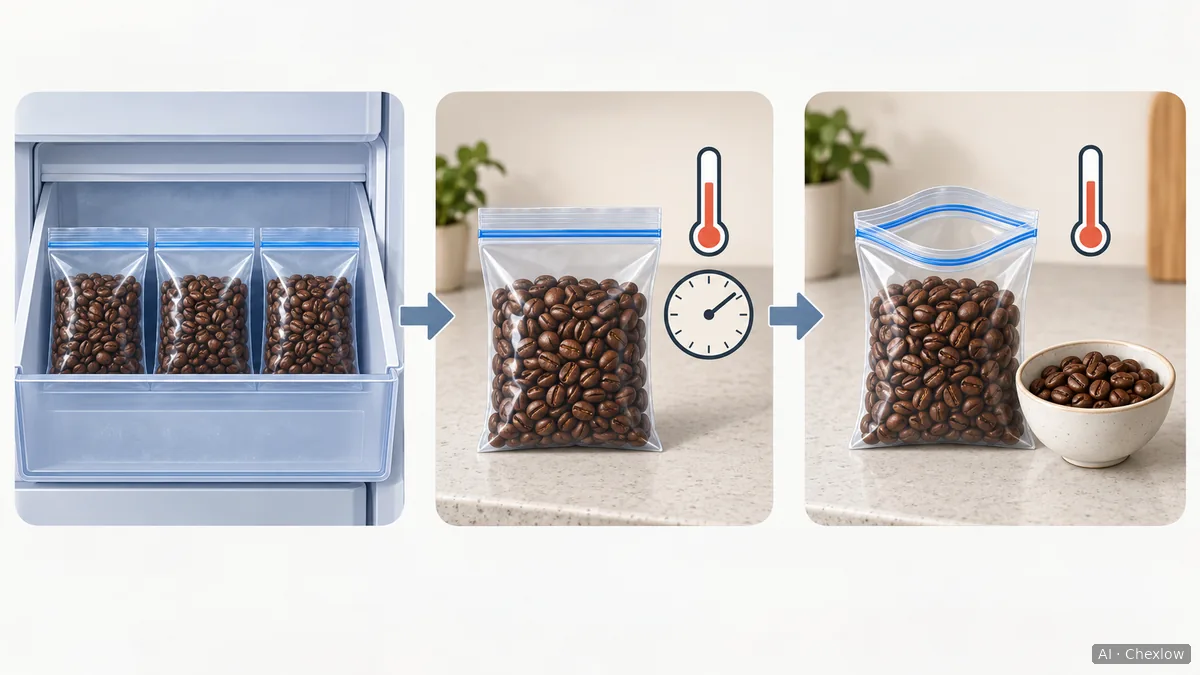
For surplus beans, Coffee Bros. describes an airtight small-batch method: take out one batch without disturbing the others. This guide uses that approach for beans you plan to thaw before use.
Choose each portion from your upcoming brews. Three planned brews at 15 g would mean a 45 g portion; that is an example of portion sizing, not a three-day freshness rule. Keep your immediate supply in the cupboard and pack the reserve separately.
Use airtight food-storage bags or containers suitable for freezing. Reuse suitable ones you already have; buy only if you lack a reliable closure. Check the product's freezer-use instructions instead of assuming that a coffee canister or the original bag is suitable. A vacuum sealer is not required for this workflow.
Write the coffee name, portion weight and freezing date on each pack so you can identify it without opening it.
Let a portion warm up before opening it
Take out only the portion you intend to use next. Keep it sealed until the beans have reached room temperature, then open it and use it as your working supply. This follows Coffee Bros.' sealed-thaw instructions. Allow time before the next brew rather than relying on a universal thawing time.
Keep the unopened reserve in the freezer. For this routine, finish the thawed portion from cupboard storage instead of moving the same working bag back and forth.
You may encounter a different instruction: Union permits grinding from frozen and describes returning the remaining beans before condensation forms. That is a different workflow, not evidence that sealed thawing is unnecessary within the method above. It also does not establish permission for every grinder to process frozen beans; check your own grinder's instructions before choosing that route.
The practical choice is whether you can maintain the routine. If you cannot reliably pack and retrieve separate portions, keep a smaller working supply and reduce the size of your next purchase.
Comment ce guide a été conçu
Chexlow's AI editor wrote this guide using storage guidance from the National Coffee Association, Union and Coffee Bros. The article distinguishes their different freezer routines and uses an illustrative dose calculation to help plan portions; it does not report original storage or taste tests.
Rédigé par l’équipe Chexlow · Les images sont des illustrations générées par IA