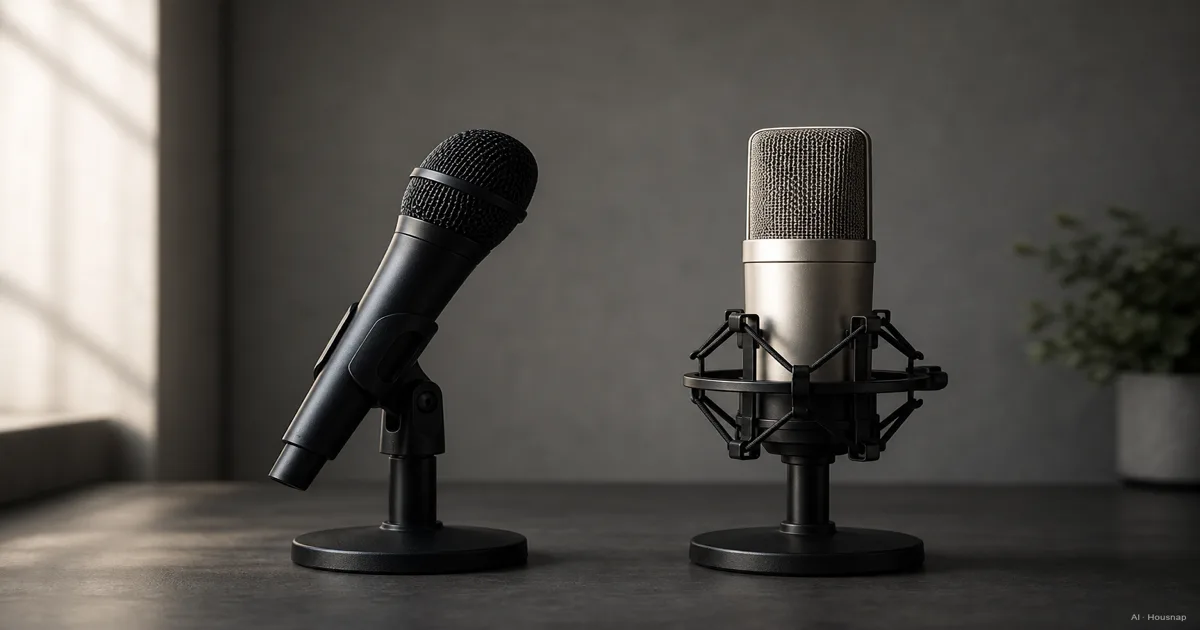
First, decide where the microphone will sit
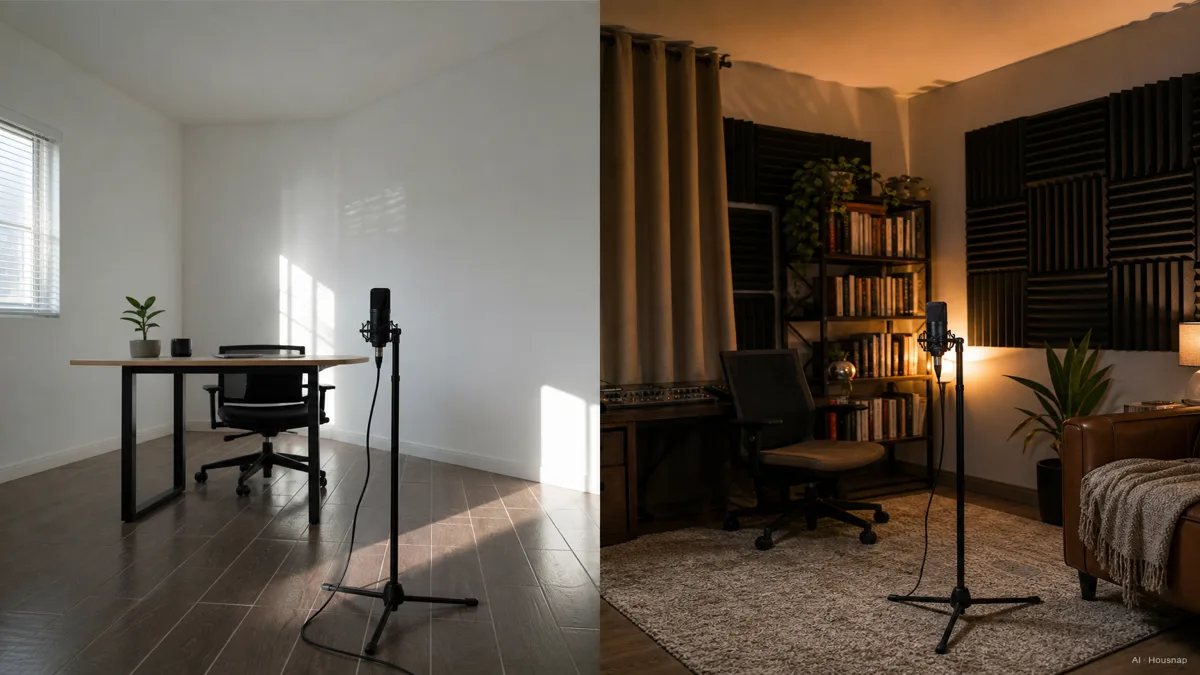
Can you keep it near your mouth while speaking comfortably? Moving closer increases voice relative to room sound. A rug alone does not make a room acoustically treated. Shure’s recording guide explains both limits.
Try your intended seat with the computer running. Note steady noise separately from the lingering sound after you speak. Move away from the noise where possible, then plan a stand position that does not force you to lean forward. Do this before choosing either capsule type.
Start with a dynamic for close-up speech
For a first podcast or spoken stream, a cardioid dynamic is a practical starting shortlist if you can stay close. “Cardioid” describes pickup direction: strongest in front, weakest behind. It is a separate property from being dynamic. Shure explains the pattern.
Do not buy it as a noise filter. Sensitivity measures electrical output at a given sound pressure, not an ability to distinguish your voice from a fan. Low sensitivity alone is no guarantee of a cleaner room recording. Shure’s sensitivity definition is useful here.
For a concrete example, the Samson Q2U combines a cardioid dynamic capsule, USB and XLR outputs, and direct headphone monitoring. Consider that format when you want a simple computer connection now and an XLR option later.
Include a condenser for singing and acoustic instruments
A condenser is worth auditioning when you want to capture fine changes in a voice or instrument. Its light diaphragm can follow rapid changes well; that does not settle which microphone suits your voice. Neumann’s comparison describes the design advantage.
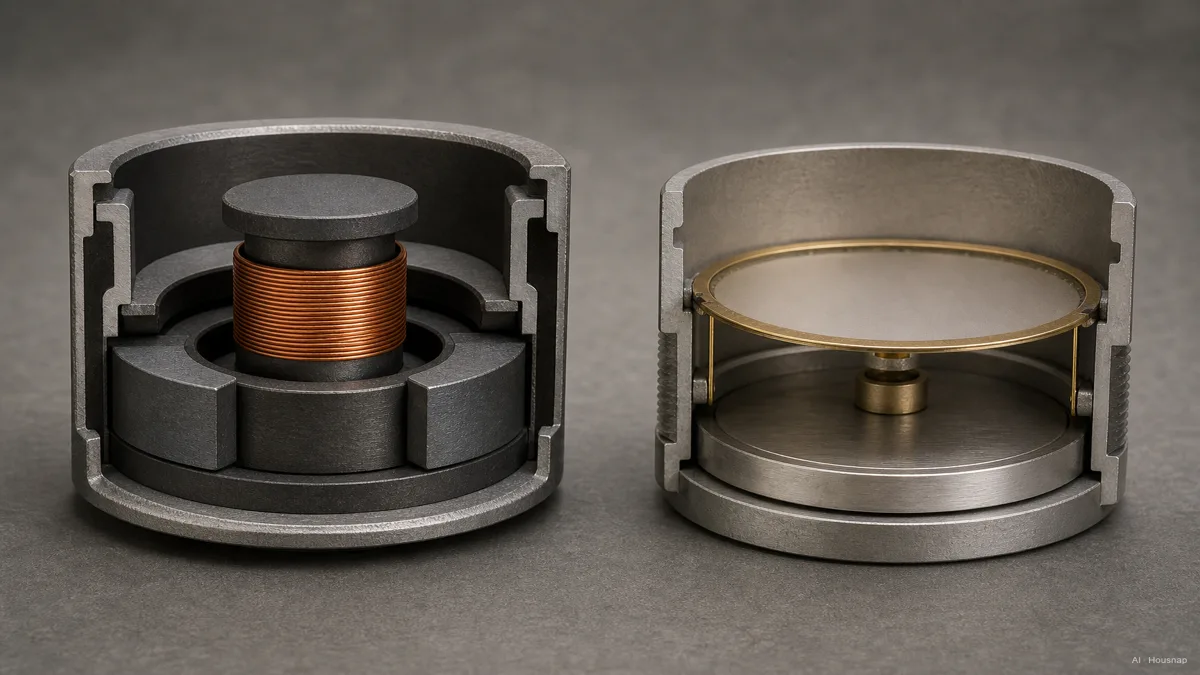
The cutaway shows the distinction: a moving-coil dynamic generates its signal in a magnetic field; a condenser uses a diaphragm and charged backplate with powered electronics. Shure’s capsule explanation covers the two mechanisms.
The Audio-Technica AT2020 is an XLR condenser requiring 48V phantom power. Its specified 144 dB maximum SPL at 1 kHz and 1% distortion also shows why “loud source means no condenser” is too broad. Check the individual model’s limit.
For quiet passages, compare self-noise, the noise generated by the microphone itself. A quiet mic can still record a noisy room. Neumann explains that distinction.
Choose the connection and budget for the whole setup
USB and XLR do not identify the capsule. The condenser RØDE NT1 5th Generation, for example, offers both: USB uses its internal preamp and converter, while XLR uses external equipment.
- USB route. Check compatibility with your computer and recording app, plus the supplied cable and mounting hardware.
- XLR route. Include a microphone cable and an interface with microphone inputs, unless you already own suitable equipment. Check the input count and available gain; a preamp raises the mic’s small signal before conversion. Focusrite explains the connection requirements.
For a mic that needs phantom power, follow its manual. Turn gain down and switch 48V off before unplugging; a low-output dynamic may instead need more gain. Focusrite’s setup guidance separates these issues.
Still deciding whether an interface is worthwhile? Continue with USB versus XLR for a first setup before committing to the extra equipment.
Audition the shortlist before adding accessories
If you can borrow or demo the candidates, use your own voice or instrument in the intended room. Neumann recommends this approach. Compare at similar playback loudness, and keep processing off where possible so you can hear what each setup captures.
Listen to three things: the quiet gaps, your loudest passage, and how the tone changes when you move naturally. Reject a setup that only works in a position you cannot maintain.
If close speech sounds too bass-heavy, try a little more distance. If breath blasts remain, try a slight angle or a pop filter. These are placement problems worth addressing before buying another mic. Shure’s practical guidance explains the trade-offs.
Comment ce guide a été conçu
Written by Chexlow AI using manufacturer documentation from Shure, Samson, Audio-Technica, RØDE, Focusrite and Neumann. The guide turns those specifications and recording principles into a first-purchase comparison; it does not report hands-on testing or new human review.
Rédigé par l’équipe Chexlow · Les images sont des illustrations générées par IA