Identify the three surfaces first
The surface under your foot is not necessarily bare cork. BIRKENSTOCK Australia describes its footbeds as layers of jute and cork covered with suede. Check your own pair’s lining and upper specification before following that example.
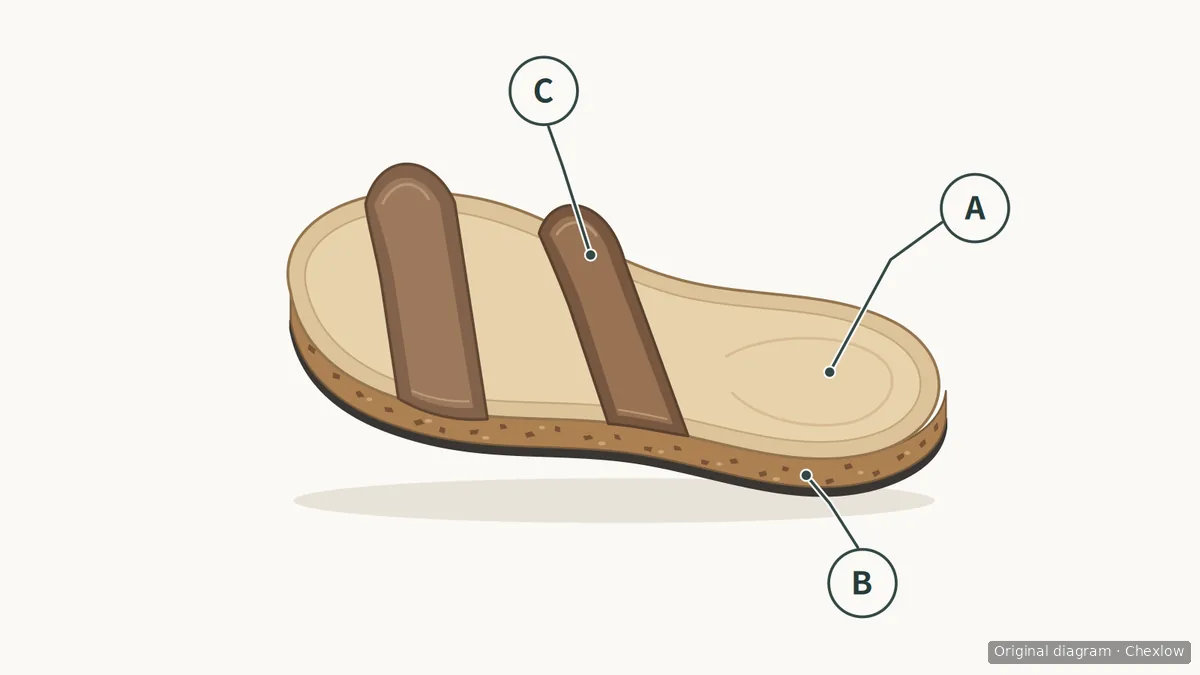
A is the lining touching your foot, B the exposed cork edge, and C the upper holding the sandal on. These letters identify surfaces, not an order for applying products. The drawing shows a generic sandal, not a verified construction for every model.
If the lining is synthetic, shearling or unidentified, obtain its specific care instructions first. This guide covers owned cork-footbed sandals, not all-EVA footwear. BIRKENSTOCK’s US guidance warns against immersing most styles and notes that treatment can change their appearance.
Clean the lining with controlled moisture
Open the buckles so you can reach the lining. Use a cleaner only after checking that both the sandal maker and the product instructions permit it on that lining. An existing suitable cleaner, small brush and clean cloth may be all you need.
For its leather-lined sandal footbeds, BIRKENSTOCK’s European guide describes this method:
- Apply a small amount of the cleaning product and work it in carefully with a small brush.
- Remove all lather with a damp cloth, then wipe with a clean cloth dampened with lukewarm water. Do not hold the sandal under running water.
- Allow at least 24 hours to dry, away from sun and direct heat. Wait until the footbed is completely dry before brushing its napped surface.
That drying minimum belongs to this method; it does not guarantee every sandal is dry after 24 hours. A suede-and-nubuck brush can restore the nap on a compatible lining. It is not a universal scrubbing tool for every footbed.
Choose the upper’s method separately
Keep the lining-cleaning routine separate from the straps. The same maker gives different instructions for different uppers:
- Suede or nubuck: remove dried loose dirt with a suitable brush.
- Natural or smooth leather: remove dust with a lint-free, slightly damp cloth.
- Oiled leather: the Australian guide permits a brush or damp cloth for surface dust.
- Birko-Flor or Birkibuc: the US guide uses a damp cloth, with soap and water for stubborn stains.
Metallic Birko-Flor and patent finishes have separate entries in the Australian guide. Do not treat those finishes as ordinary smooth leather or assume they need leather grease. Follow the exact finish and care-product instructions before going beyond dust removal.
When applying an upper treatment, keep it off the lining. The European guide specifically covers the footbed with paper while treating the outside of the upper.
If a suede or nubuck upper still has marks after brushing, continue with stain-specific suede and nubuck care. That advice concerns the upper; it does not replace the sandal maker’s footbed instructions.
Inspect the cork, then let everything dry
For its exposed cork edges, the US guide recommends a thin coat of BIRKENSTOCK Cork Sealer when the cork looks as though it is drying out. This is a conditional edge treatment, not a cleaner for the lining or a reason to coat the whole sandal. Check compatibility before buying a sealer.
For this guide, cracking, crumbling or separation is the point to stop cleaning and ask the maker or a repairer to assess the sandal. Do not try to fill structural damage with a care coating. The Australian guide also calls for sole repair or replacement before wear reaches the cork.
Let wet sandals air dry slowly, away from heaters, radiators and direct sun. Air the footbeds between wears as well. If they remain damp after the stated drying period, give them more time rather than adding heat or another cleaning treatment.
Comment ce guide a été conçu
Written by AI for Chexlow using BIRKENSTOCK’s US, European and Australian care guidance. The article separates lining, cork-edge and upper care, with manufacturer examples kept within their stated scope. No original cleaning test or human approval is claimed.
Original SVG diagrams created for Chexlow