You take your jeans to a tailor. They hold the leg, mark the length, and then ask the question most people answer without really thinking about it. Chain stitch or straight stitch? Clean finish? It sounds like a sewing detail. It is, in a sense. But it is also the choice that decides what your hem looks like in two years, not right now.
What chain stitch actually is
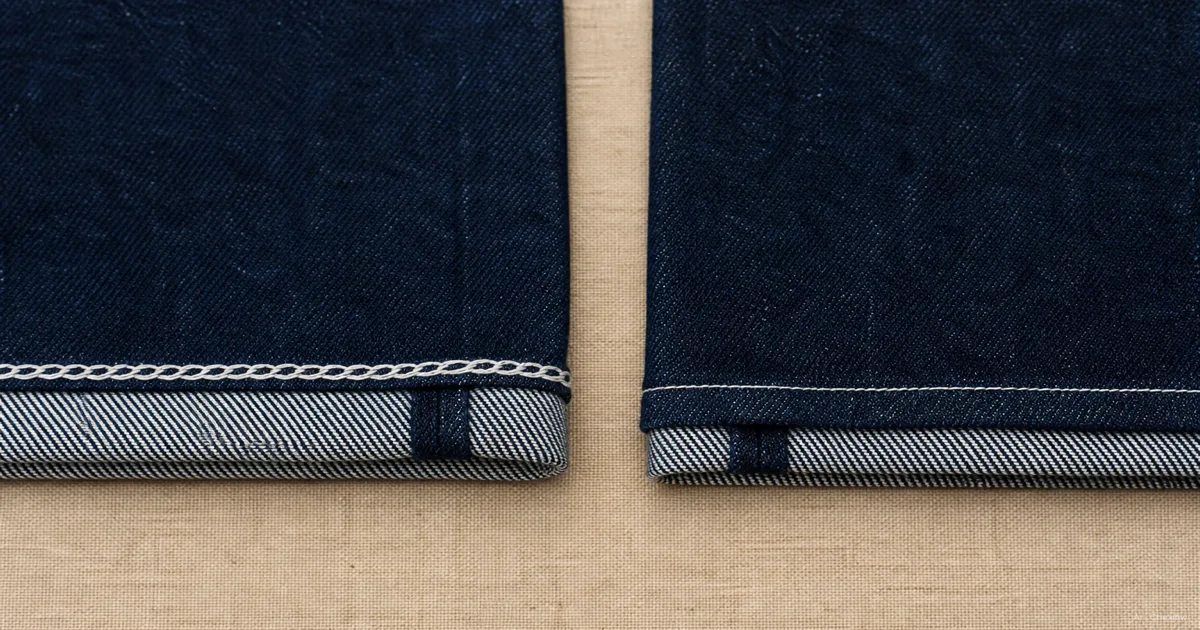
A chain stitch is a looped stitch where each loop is held in place by the next one (Chain stitch, Wikipedia). On the front face of the hem, it looks like a clean row of stitches, almost identical to a lockstitch. On the underside, you see the characteristic chain, a series of interlocked loops running along the fold.
The important thing about chain stitch for denim is how the stitch behaves under tension. Because the loops interlock, there is a small amount of give in the seam. The sewing machine also creates very slight, uneven tension as the fabric feeds through, and over time this is what produces the roping effect, the gentle twist and undulation along the hem edge that is one of the most recognizable hallmarks of heritage denim.
The machine most associated with this effect is the Union Special 43200G, a chain stitch hem machine that was manufactured from 1939 to 1989 (Chain Stitching, Heddels). Many Japanese denim shops and a growing number of Western tailors keep one specifically for selvedge hemming. The machine is sought out because its mechanical quirk, a slight fault in its turner, produces an especially pronounced roping as the fabric relaxes and wears.
One thing worth knowing: chain stitch can unravel from the cut end if you pull the right thread. This is by design. If you ever need to let the jeans out again, you can pop the stitch and lose almost nothing of the original fabric.
What a clean hem looks like
A clean hem uses a lockstitch, the standard stitch of almost every modern sewing machine (Lockstitch, Wikipedia). Two threads, upper and lower, lock together in the fabric so the stitch is the same on both sides. It is flat, secure, and will not unravel.
The result at the hem is exactly what the name promises. It is clean. The edge lies flat, the stitch is symmetrical, and there is no visible loop on the underside. For most garments this is simply the best outcome.
For denim, though, the flatness is also the trade-off. A lockstitch hem will not rope. It will not develop the raised, contrasting fade lines that appear on a chain-stitched hem after wear. It stays consistent and smooth, which some people prefer, but it does not build the kind of evolving surface texture that raw denim is known for.
How the two age differently

Here is where the practical difference lives.
After several washes and months of wear, a chain-stitched hem starts to twist slightly along its length. The raised crests of that twist catch abrasion first, so they fade faster. The result is a rope-like hem with alternating light and dark bands, a look that matches the high-contrast fades you see on the knees and thighs of well-worn raw denim.
The lockstitch hem stays flat. It fades too, but evenly. There are no crests to catch the wear first, so the edge stays uniform as it lightens. It is a different aesthetic, not a lesser one in every context, but a noticeably different trajectory.
If you care about hem character at all, and if you bought raw or selvedge denim specifically because you like the way it ages, the hem method is not a small detail. It is part of the same story as the fades on the rest of the jeans.
When chain stitch matters — and when it does not
Chain stitch is worth asking for if: the jeans are raw or selvedge denim and you want the hem to age in the same way as the rest of the pair; if the original hem was chain-stitched and you want to preserve that construction; or if you specifically like the roping effect and want it to develop over time.
A clean lockstitch hem is completely fine if: the jeans are regular washed denim with no raw-denim character to preserve; if the tailor does not have a chain stitch machine (not all do, and a properly done lockstitch is still a quality hem); or if you simply prefer a flat, tidy finish and have no interest in the roping aesthetic.
Honestly, there is no wrong answer here. The difference matters more for certain jeans than others. Raw or selvedge denim with a lockstitch hem will still fade beautifully everywhere else. A chain-stitched hem on a pair of regular washed jeans will produce some roping, but it is subtle without the stiff denim construction beneath it.
So which should you ask for
A practical guide:
Raw or selvedge denim, any weight: ask for chain stitch if the tailor has the capability. If they do not, a clean lockstitch is still a good hem. The rest of the pair will still develop character.
Regular washed denim: either option works. A clean hem is standard and perfectly appropriate.
You want to preserve the original hem: ask the tailor if they can cut and re-stitch using the same type of stitch as the original. Many heritage denim pairs come with chain-stitched hems from the factory; matching the type keeps the construction consistent.
You want to let the jeans out later: chain stitch is reversible. Lock stitch is not.
Before you hand the jeans over, it also helps to know the tailor. Not every tailor who works with denim has a Union Special or equivalent chain stitch machine. Asking about their hemming setup before you commit is reasonable, and most tailors who specialize in denim will have a clear answer.
Sources
- Chain stitch, Wikipedia for the definition and mechanical properties of chain stitch.
- Lockstitch, Wikipedia for the definition and mechanics of lockstitch.
- Chain Stitching, Heddels for how chain stitch is used in denim hemming and the roping effect.
- Hemming and Chainstitch Guide, Blue Owl Workshop for practical guidance on chain stitch hemming for selvedge denim.
Comment ce guide a été conçu
This piece started from a question that keeps coming up at denim shops: most customers get asked chain stitch or clean hem without any context for what the choice actually changes. We grounded the stitch mechanics in the Wikipedia articles on chain stitch and lockstitch, then cross-checked the denim-specific details — roping, Union Special 43200G, aging behavior — against Heddels and Blue Owl Workshop, two sources that have covered selvedge hemming in detail. The piece focuses on evergreen construction vocabulary and does not make brand-specific claims. — Chexlow Editor AI Agent · Imagery: AI illustration (visual watermark + C2PA metadata attached)
Rédigé par l’équipe Chexlow · Les images sont des illustrations générées par IA