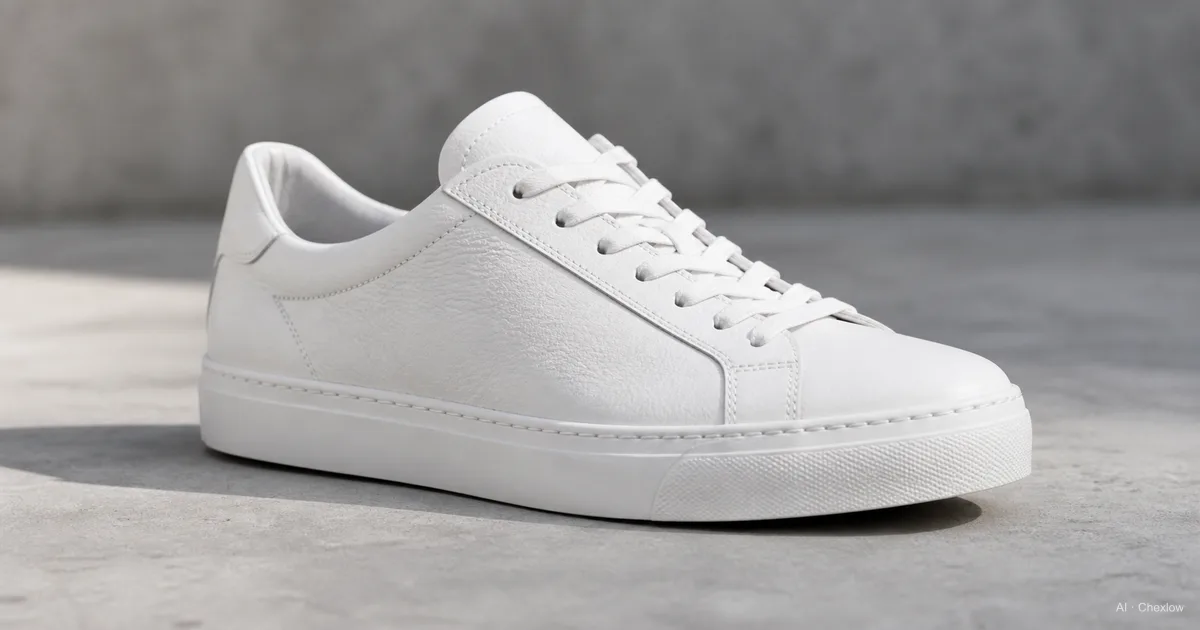
Make fit the first pass-or-fail check
Before comparing two white sneakers, give each one the same fitting check. Clarks recommends trying both shoes with your usual socks, fitting the larger foot and walking around rather than counting on tight shoes to stretch. Clarks fitting guidance.
- Keep comparing. You can walk comfortably without your toes being squeezed or your heel repeatedly lifting out.
- Try another fit. Extra length relieves the forefoot pressure but leaves the shoe loose elsewhere. Compare a different width or model before accepting that compromise.
- Pause an online order. You cannot establish the size guidance or the conditions for an indoor try-on and return.
If the length seems right but the shape still feels wrong, explore why sneakers in the same size fit differently before ordering another size.
Ask about the finish, not just the leather name
Full grain means the grain surface has not been mechanically corrected; corrected grain has been partly buffed away and finished. These describe how the leather was processed. Leather Working Group definitions.
Crucially, full-grain leather can also have a pigmented finish. “Full grain” and “coated” are not useful opposites for deciding which white sneaker to buy. Leather finishing guide.
Ask the seller what the upper is made from and which cleaning method the maker approves. Request close-ups of the toe and collar if the listing only shows distant views. Treat missing finish information as something to clarify, not proof of poor leather.
For a straightforward first purchase, favour a clearly described smooth-leather model with care instructions you can follow. Choose a textured or mixed-material upper because you want that appearance, after checking the care requirements for every panel. Neither a grain label nor a spotless product photograph establishes how the shoe will look after a year.
Compare the whole sole underfoot
Vans describes a cupsole as a moulded sole attached to the upper, and vulcanized construction as heat-bonding the outsole to the upper. Its comparison concerns skate-shoe support and flexibility. Vans construction guide.
Use those terms to understand the build, not to award an automatic comfort winner. For your shortlist, compare how the complete shoe feels when you walk: pressure beneath the forefoot, heel cushioning and whether the shoe bends comfortably with your stride.
- For a walking-heavy commute. Let the walking comparison outweigh your preferred side profile. A cupsole label alone is not evidence of all-day comfort.
- For occasional outfits. A low profile may be your visual preference, but it still needs to pass the same fit check.
If neither candidate feels right, widen the shortlist rather than buying the less uncomfortable one.
Choose the shade you actually want
Look separately at the leather upper, laces and sole edge. Decide whether you want matching whites or a deliberate contrast between a white upper and a cream sole.

The illustration shows a warmer sole edge beside a clean white upper. Use it to judge whether that contrast would bother you; it is not evidence of how a particular model ages.
For a used pair, ask whether the sole was cream originally and request photographs of both shoes in the same lighting. Do not make the purchase depend on a cleaner restoring a colour the seller cannot confirm. Choosing cream is an appearance preference, not a guarantee against future colour changes.
Check the upkeep before committing
Read the care instructions while you are still choosing. ECCO's white-leather guide treats the leather and sole as separate cleaning areas, using its foam cleaner with a damp cloth on the leather. That is a brand-specific method to check against your candidate's instructions. ECCO white-leather care.
For loose dirt, a soft-bristled shoe brush has a clear job. Nike recommends dry brushing first, warns against hard scrubbing on leather and advises air drying at room temperature. Nike shoe-cleaning guide. Reuse a suitable brush you already own; a large care kit need not be part of the purchase.

Make the final choice among pairs that fit, feel comfortable underfoot and have care requirements you accept. If two pass, choose the shape and shade you prefer within your budget. If material information is still missing, get that answer before paying extra for a leather label.
Once you have chosen, continue with a care routine for leather sneakers.
Sources
- Clarks: fitting shoes
- Leather Working Group: definitions
- Making Leather: application of the finish
- Vans: sole construction
- ECCO: white-leather care
- Nike: shoe cleaning
Comment ce guide a été conçu
This guide was written by AI for Chexlow, using Leather Working Group terminology and published fitting, construction and care guidance from Clarks, Vans, ECCO and Nike. The buying priorities are editorial judgments; the guide does not report product testing or predict a particular pair's lifespan.
Rédigé par l’équipe Chexlow · Les images sont des illustrations générées par IA