Start with a gentle clean and a dry surface
Before cleaning, look for an obvious crack, displaced handle or broken edge. If you see one, set the knife aside for assessment rather than handling it through a cleaning routine.
For an otherwise intact knife, use lukewarm water, mild dish soap and a non-scratch cloth or sponge, following the knife’s own instructions. This is the handwashing method recommended by ZWILLING. Keep the edge visible and your fingers clear; do not run a finger along it to check for damage.
Use a suitable sponge you already own. Dry with a clean cotton or linen kitchen towel immediately after washing; Victorinox explains that leaving a blade to air-dry can produce limescale spots. You only need replacement cleaning supplies if yours are unsuitable or dirty. Do not leave the knife soaking while deciding what to do: Shun advises against leaving knives in a sink of soapy water.
Read the marks without guessing from color alone
Look again once the blade is clean and dry. A mark that disappears during gentle washing needs no further stain-removal treatment. A mark that remains needs identification before stronger cleaning, not an automatic verdict that the knife is ruined.
- Pale spots or a film: limescale is one possibility described by Victorinox, but appearance alone cannot confirm the cause.
- Orange or brown areas: ask the maker about corrosion and a compatible treatment. Shun warns that moisture left on its knives can cause rust; do not assume a persistent patch is harmless residue.
- A darkened carbon-steel edge: check the exact knife. Shun specifically says the protective dark patina on its Narukami Blue II edge should remain. That instruction does not identify every dark mark on every knife.
Shun directs Narukami owners with orange or brown discoloration toward its care kit or sharpening team and says that the team removes only light rust. That limited guidance is not a universal rust-removal recipe. Avoid choosing an abrasive, acid or polish until the manufacturer confirms it suits your blade and finish.
Separate a faded handle from a damaged connection
Inspect the handle and the place where it meets the blade without twisting or flexing the knife. Our stop-use threshold is a visible crack, a new gap, looseness, or swelling that changes the fit. These signs call for the maker’s assessment, not oiling, gluing or tightening at home.
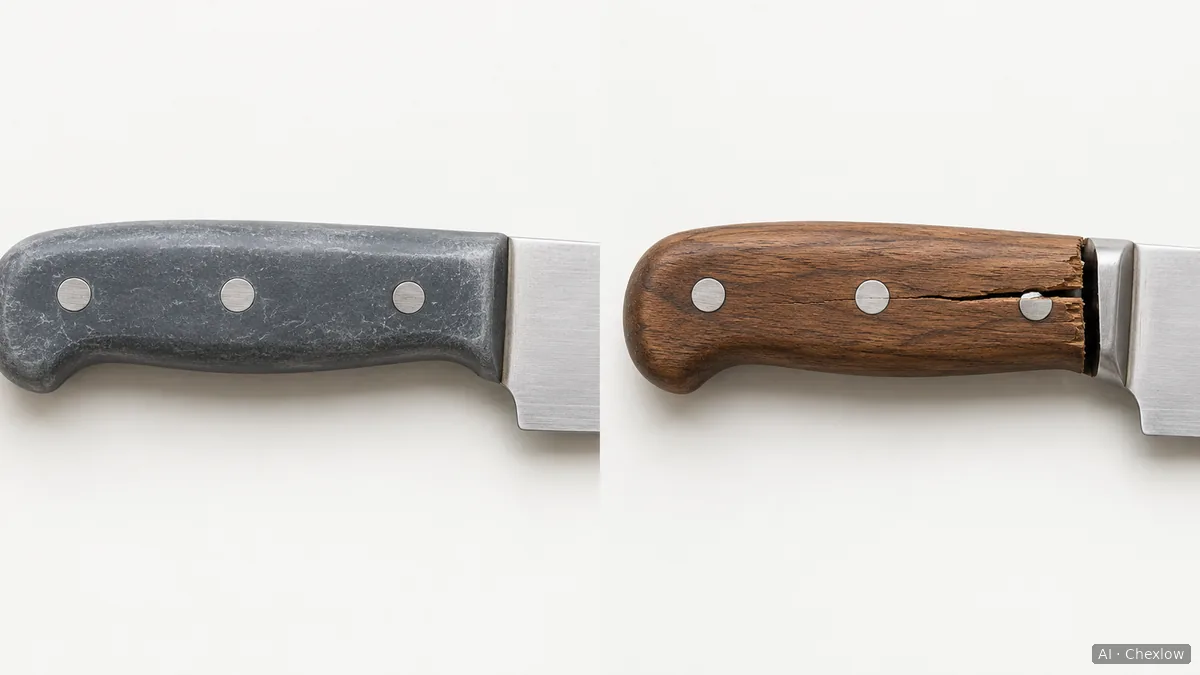
The illustration separates a surface change from a visible structural concern; it cannot certify a knife as safe. In its plastic-handle care discussion, ZWILLING describes greying or faded color as an appearance issue. That does not clear a cracked or loose handle for use, nor establish that another maker’s handle has the same problem.
Wood needs a separate check. Victorinox recommends a damp cloth for wooden handles and avoiding excess moisture, extreme temperatures and aggressive cleaners. Shun explains that even its stabilized wood can swell in very humid conditions. If the handle’s shape or fit has changed, ask about that change before applying any conditioner.
Decide what happens next
Send the manufacturer the model name, photographs of the whole knife and affected area, and a description of the dishwasher exposure. Ask whether the knife should remain out of use, whether the mark is cosmetic, and whether repair or replacement is appropriate. This guide’s inspection thresholds are editorial precautions, not a remote diagnosis or a warranty decision.
For future cleaning, check the actual model rather than treating “dishwasher-safe” as a universal rule. Victorinox permits dishwashing for its synthetic-handled household knives but still recommends handwashing all large knives. ZWILLING warns that dishwasher chemicals can damage plastic and steel surfaces. Keeping this knife on a suitable handwashing routine avoids repeating the same exposure while you resolve its condition.
Once damage concerns have been resolved, a knife that is simply dull presents a different question: does it need honing, sharpening or professional help? Do not use sharpening as a way to investigate a damaged handle or an unidentified blade defect.
Put a clean, dry, serviceable knife back in protected storage you already own. Victorinox warns that unprotected blades rubbing together in a drawer can damage their edges.
Comment ce guide a été conçu
Written by AI for Chexlow using official knife-care guidance from Victorinox, ZWILLING and Shun. The article separates manufacturer statements from editorial stop-use precautions after accidental dishwasher exposure; it does not diagnose an individual knife or provide sharpening or structural-repair instructions.
Rédigé par l’équipe Chexlow · Les images sont des illustrations générées par IA