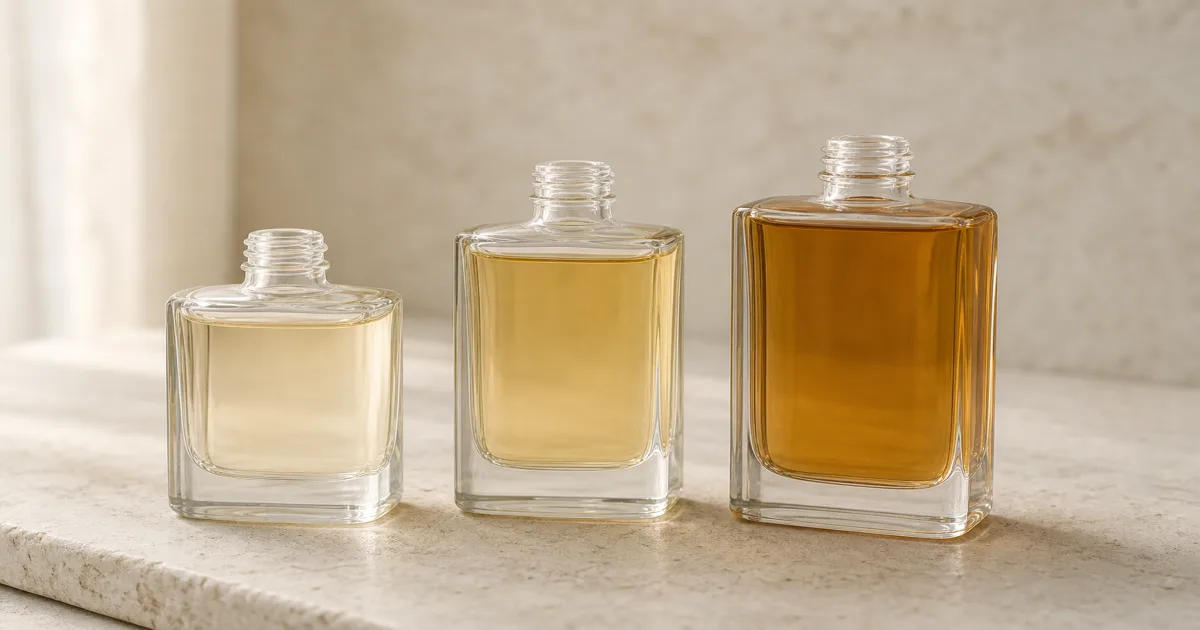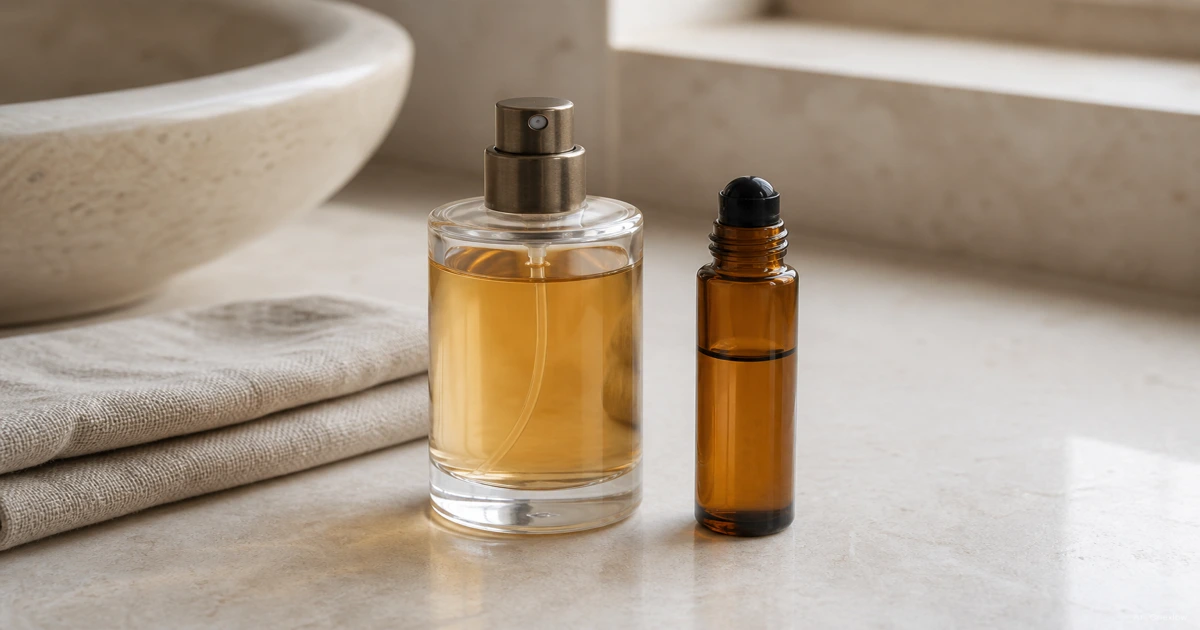
You find a fragrance you like online, and then notice it comes in two very different forms. One is a glass bottle meant for spraying, sitting at 15 to 20 percent fragrance concentration in mostly ethanol. The other is a small vial or rollerball, no alcohol at all, just 15 to 30 percent fragrance oil suspended in a carrier like jojoba or fractionated coconut oil.
Neither one is a lesser version of the other. They are built to behave differently on your skin, and picking between them matters more than picking between two random spray bottles at the same concentration.
What's Actually Different, Oil-Based vs Alcohol-Based Perfume
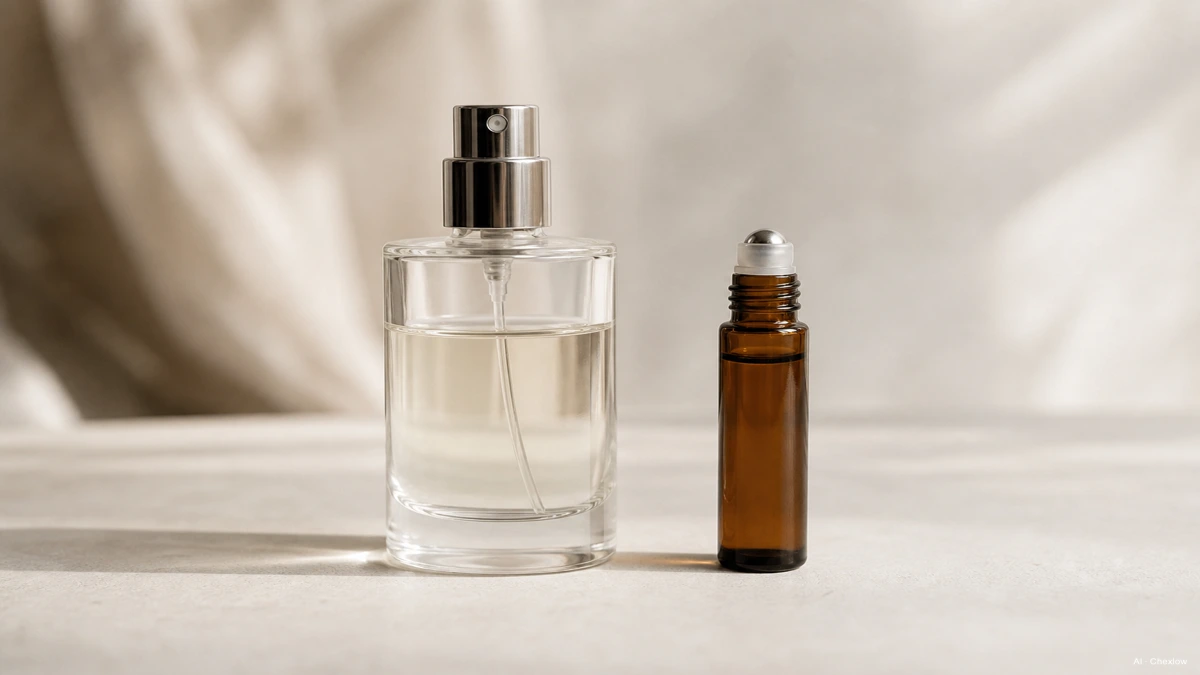
Alcohol-based perfume dissolves fragrance oil in ethanol, usually with a touch of water. The concentration ladder runs from a light Eau de Toilette around 8 to 12 percent, up through Eau de Parfum at roughly 12 to 18 percent, to Parfum or Extrait at 20 to 30 percent (Perfume Concentrations Explained, Scento). Whatever the tier, the carrier doing the work is alcohol.
Perfume oil skips the alcohol entirely. Fragrance concentration typically sits at 15 to 30 percent, similar to Eau de Parfum or even Extrait, but it is suspended in a carrier oil instead of dissolved in ethanol (Perfume Oils vs Alcohol Perfumes, Homecourt). In raw concentration terms, perfume oil sits conceptually alongside Extrait, just built on a different base.
That base swap is the whole story. Ethanol evaporates fast, which is why sprays feel bright and immediate on first contact. Oil barely evaporates at all, so it releases scent slowly as your body heat gently pulls fragrance molecules out over hours.
Longevity and Sillage, Which One Lasts and Which One Projects
Here is where the two formats genuinely diverge, and it trips up a lot of first-time buyers.
Perfume oil tends to last longer on skin, often 8 to 15 hours, because oil has far lower volatility than ethanol and lets scent out gradually rather than all at once (Perfume Oil vs Eau de Parfum, Aramystic). Alcohol-based Eau de Parfum or Eau de Toilette usually runs 3 to 6 hours, since ethanol carries the scent up and off quickly.
But there is a real nuance that gets skipped in a lot of comparisons. If you compare two fragrances at the same concentration level, on skin that is equally moisturized, longevity ends up close either way (Oil vs Alcohol Perfume, Unity Scents). Concentration matters just as much as carrier. A 30 percent oil and a 30 percent Extrait are closer in wear time than the popular "oil always wins" framing suggests.
Where alcohol clearly wins is projection, the trail of scent that people nearby can actually smell. Ethanol helps atomize fragrance molecules and push them into the air, so alcohol-based perfume tends to announce itself the way a spray does (Perfume Oils vs Alcohol Perfumes, Homecourt). Perfume oil stays much closer to skin, more of a private scent that someone notices only when they are close to you.
So the real question is not which format is objectively better. It is whether you want a quiet, long-lasting scent that lives near your skin, or a scent with a trail that reaches other people.
Which Is Better for Sensitive Skin
This is where oil format earns a real recommendation rather than just a preference.
Alcohol is a known irritant for some skin types. It can strip surface lipids and speed up transepidermal water loss, which shows up as dryness, tightness, or a light sting right after spraying (Best Perfume for Sensitive Skin, Onekind). If your skin already reacts to toner, hand sanitizer, or other alcohol-forward products, alcohol-based perfume can carry that same friction.
Perfume oil skips that problem almost entirely. A carrier oil like jojoba or sweet almond behaves more like a light moisturizer than a solvent, so it tends to sit more comfortably on dry or reactive skin (Best Perfume for Sensitive Skin, Ramsons). It will not fix a genuine fragrance allergy, since the scent compounds themselves are still present, but it removes one common source of irritation.
If sensitive or easily dried-out skin is a factor in what you buy, perfume oil is worth trying before you write off fragrance altogether.
How to Apply Each Format for Best Results
Application is not just a formality, it actually changes how each format performs.
Alcohol-based perfume is built for misting. A light spritz from a few centimeters away lets the alcohol carry fragrance evenly, though some product is always lost to the air around your target spot. Two to three sprays on pulse points is usually plenty, more just adds evaporation, not more hours of wear.
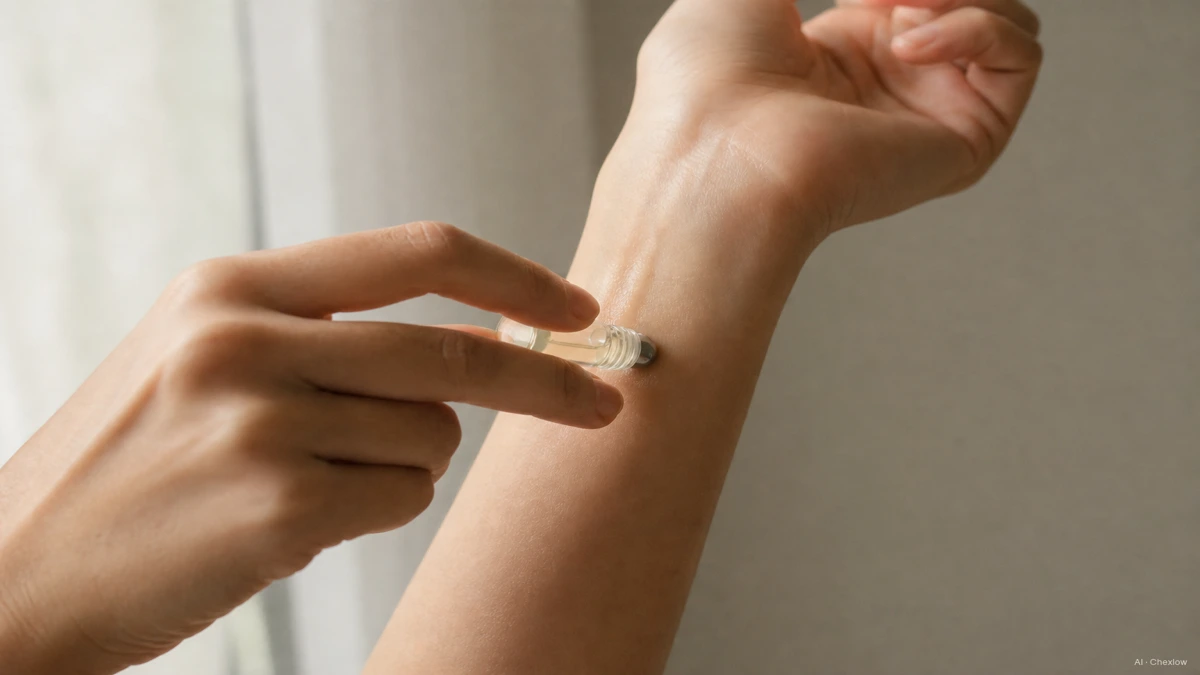
Perfume oil is built for dabbing or rolling directly onto skin. Because there is no spray pattern to manage, you can place it precisely where you want it, with almost nothing wasted in the air (How to Apply Perfume Oil, Homecourt). The tradeoff is that oil does not thin out the way a spray does, so a light hand matters. Overapplying oil format can feel heavy fast, since it is not evaporating the excess away for you.
Both formats reward the same pulse points, wrists, sides of the neck, behind the ears, and inner elbows. These spots run warm, and that warmth is what gently coaxes the scent to open and diffuse through the day (Perfume Pulse Points Guide, Nikura). Apply to clean, slightly moisturized skin rather than skin that is dripping wet or bone dry, and two or three placements are enough for either format.
Which Should Your First Bottle Be?
If your goal is a scent that lasts most of the day and stays close and personal, and you want something gentler on sensitive or dry skin, start with a perfume oil. Rollerballs and small vials also travel well, they are less prone to leaking than glass spray bottles and their size fits carry-on liquid limits without a second thought (Why Perfume Oils Travel Better, Onekind).
If your goal is the classic sillage, that noticeable trail as you walk into a room, and the cold, fresh sensation of a spray, an alcohol-based Eau de Parfum or Eau de Toilette is the more traditional first pick. It is also the format with by far the widest selection, since most major fragrance houses release their signature scents in EDT and EDP first.
Neither format is a beginner mistake. The honest way to choose is by what you actually want people, including yourself, to notice, a scent that quietly lasts on you, or one that travels with you into the room.
Sources
- Perfume Concentrations Explained, From Eau Fraîche to Perfume Oils, Scento — concentration ladder and where perfume oil sits
- Perfume Oils vs Alcohol-Based Perfumes, Homecourt — carrier differences, sillage behavior
- Perfume Oil vs Eau de Parfum, Which Lasts Longer, Aramystic — longevity comparison and volatility
- Oil-Based vs Alcohol-Based Perfume, Unity Scents — same-concentration longevity nuance
- Best Perfume for Sensitive Skin, Onekind — alcohol irritation, travel-friendly formats
- Perfume Oil vs Alcohol Perfume for Sensitive Skin, Ramsons — carrier oil skin behavior
- How to Apply Perfume Oil at Pulse Points, Homecourt — dab and roll application
- Best Pulse Points for Perfume, Nikura — pulse point locations and body heat
Comment ce guide a été conçu
This piece started from a mix-up that shows up constantly in fragrance shopping, the same fragrance name selling as both an alcohol-based spray and an oil-based rollerball, with almost nothing on the listing explaining why. We cross-checked concentration ranges and carrier behavior across Scento and Homecourt, longevity claims against Aramystic and Unity Scents, including the nuance that same-concentration comparisons narrow the longevity gap, and the sensitive-skin angle against Onekind and Ramsons on how alcohol affects skin barrier function differently from carrier oils. Application guidance draws on Homecourt and Nikura for pulse-point placement. The framing stays on matching a carrier to how you want a scent to behave, not on perfumery chemistry.
Rédigé par l’équipe Chexlow · Les images sont des illustrations générées par IA