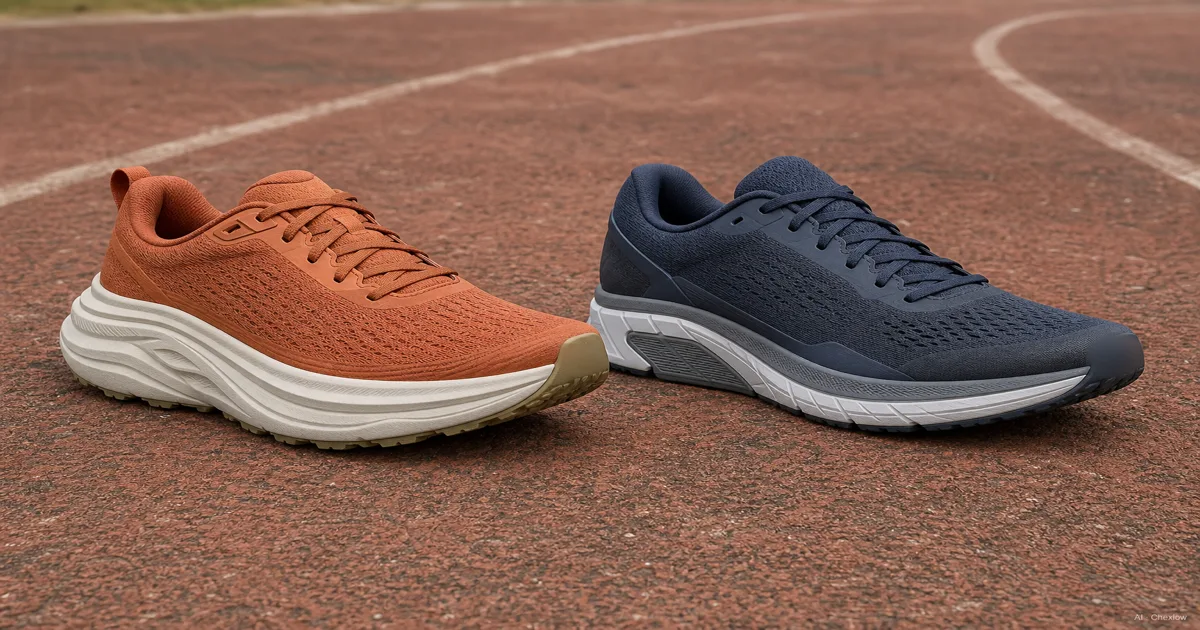
Start with the route you will actually run
Write down your usual surface before browsing: pavement, a treadmill, or an uneven trail. For this guide, start with everyday road-running shoes. Road shoes suit paved surfaces; trail shoes add grip for loose and uneven ground. REI’s buying guide explains that distinction.
If rocks, roots or mud are part of your regular route, use the first trail-running shoe guide to compare tread and protection before choosing cushioning. A shoe looking sturdy in a photograph is not enough to settle that choice.
Compare neutral and stability without diagnosing your feet
The labels answer a support question, not a softness question. Brooks, for example, places cushioned shoes in both its neutral and support groups. Support designs add guidance for excess movement; neutral designs omit that targeted guidance. See Brooks’ explanation of shoe categories.
Pronation means the foot rolls inward during walking or running. If you are unsure about that movement, Brooks recommends having a running shop observe you moving.
For a useful comparison, try a neutral shoe and a stability shoe with a similar fit and cushioning feel. This is a shopping method, not a clinical test:
- Keep the neutral option if it feels comfortable and controlled, without wanting extra guidance.
- Keep the stability option if its guidance feels more comfortable without pressing into your arch.
- Keep looking if either shoe feels intrusive or awkward. A category label is not a reason to tolerate it.
Do not make a wet footprint your prescription. Cochrane found uncertain injury-prevention benefits for stability versus neutral shoes; foot-posture-based prescription probably made little difference in trials involving military recruits. Read the evidence summary.
Separate cushion thickness, softness and drop
A thick sole is not necessarily soft. REI distinguishes foam firmness from stack height, the thickness underfoot. Try a moderately cushioned option alongside a more cushioned one and compare them while moving, not just by pressing the foam with your thumb.
- Prefer the more cushioned option if you enjoy its feel and still feel in control.
- Prefer the less cushioned option if the taller shoe feels cumbersome or distracts you from your stride.
Drop is heel height minus forefoot height. It describes a difference, not total cushioning, so zero drop does not mean no cushion. Running Warehouse’s drop guide prioritizes comfort for first-time buyers and identifies no universally best number.
Record each candidate’s drop, but do not use it to overrule a poor fit or choose a shoe as a treatment for pain.
Check fit in the socks you will use
ASICS recommends your usual running socks and roughly half to one thumb’s width of space at the toes. Use that clearance as a starting check, not a reason to accept a loose heel.
Put both shoes on, lace them normally, then walk and, if the shop permits, jog briefly. Check each candidate in the same way:
- At the front: can your toes move without hitting the end?
- Across the foot: is anything pinching or pressing into the arch?
- At the heel: does your foot stay seated without tightening the laces excessively?
If the length seems right but the sides squeeze, ask to compare widths or another shape. Write down the exact model, size and width of the pair that works; a size label alone is not a useful shopping note.
Buy, try another fit, or pause
Make the final choice from the pairs that passed the moving comparison. Use these outcomes rather than a foot-type chart:
- Buy: the intended surface, fit and preferred support all line up, and nothing bothers you during the trial. Choose between remaining candidates by budget and preference.
- Try another pair: toe pressure, heel movement or an intrusive arch remains. Change the size, width or model and repeat the comparison.
- Pause for advice: pain is driving the purchase. Do not keep running through pain or try to diagnose it from shoe wear. Seek clinical advice for persistent symptoms; the NHS running-injury guidance explains when to get help.
Buying online? Check the seller’s return conditions before ordering, including whether an indoor try-on or running trial is permitted. Keep the packaging until you have made the fit decision.
Comment ce guide a été conçu
AI wrote this guide for Chexlow using Brooks and ASICS guidance, specialist retail explanations, Cochrane’s evidence review and NHS injury advice. The comparison sequence is an editorial shopping framework, not a diagnosis or a report of product testing.
Rédigé par l’équipe Chexlow · Les images sont des illustrations générées par IA