Check the bag and the washer together
Find the care label and the instructions for your exact bag, including whether the filling is down or synthetic. For a small surface mark, consider permitted spot cleaning first; a whole-bag wash may be unnecessary. Serious holes or a broken zip need repair assessment before washing. REI’s care guide covers these distinctions.
A bag fitting through the washer door does not establish that the machine is suitable. REI notes that some home front-loaders leave too little room for the bag to tumble and clean thoroughly. Check the appliance’s instructions for bulky items as well as the bag’s care requirements; this guide does not assign a universal kilogram capacity.
Machine advice also differs. REI permits top-loaders without an agitator, whereas Sea to Summit advises against top-loading machines. Do not use the broader advice to override your bag’s manufacturer.
Choose the drying location before the washing location
Check the drying method permitted for your bag, then decide where the whole job can be completed.
- At home: proceed only if both washing and drying equipment meet the instructions and provide enough usable space.
- At a laundromat: check its rules for sleeping bags, the available programmes and the dryer before starting the wash. REI identifies a bag staying balled up as a sign that the dryer is too small.
- With a specialist: choose this route if you cannot arrange the required drying, cannot manage the wet bag or remain unsure about the process. Ask how the service will clean and dry your particular filling.
Mountain Equipment explicitly tells owners of its down bags not to wash them themselves without immediate access to a tumble dryer. It recommends specialist down cleaning when the owner is unsure. Hand washing therefore does not automatically solve an unsuitable home setup: drying still needs arranging.
Match the cleaner, then support the wet bag
Use a down-specific wash for down, or a performance wash explicitly suitable for synthetic sleeping-bag filling, following the bag and cleaner instructions. Sea to Summit distinguishes these cleaner choices. Reuse a suitable product you already own; you do not need both types. REI advises against fabric softener and bleach.
Follow the exact bag instructions for temperature, programme, spin and fasteners. Rinse thoroughly; for hand washing, Sea to Summit says to continue rinsing until no suds remain.
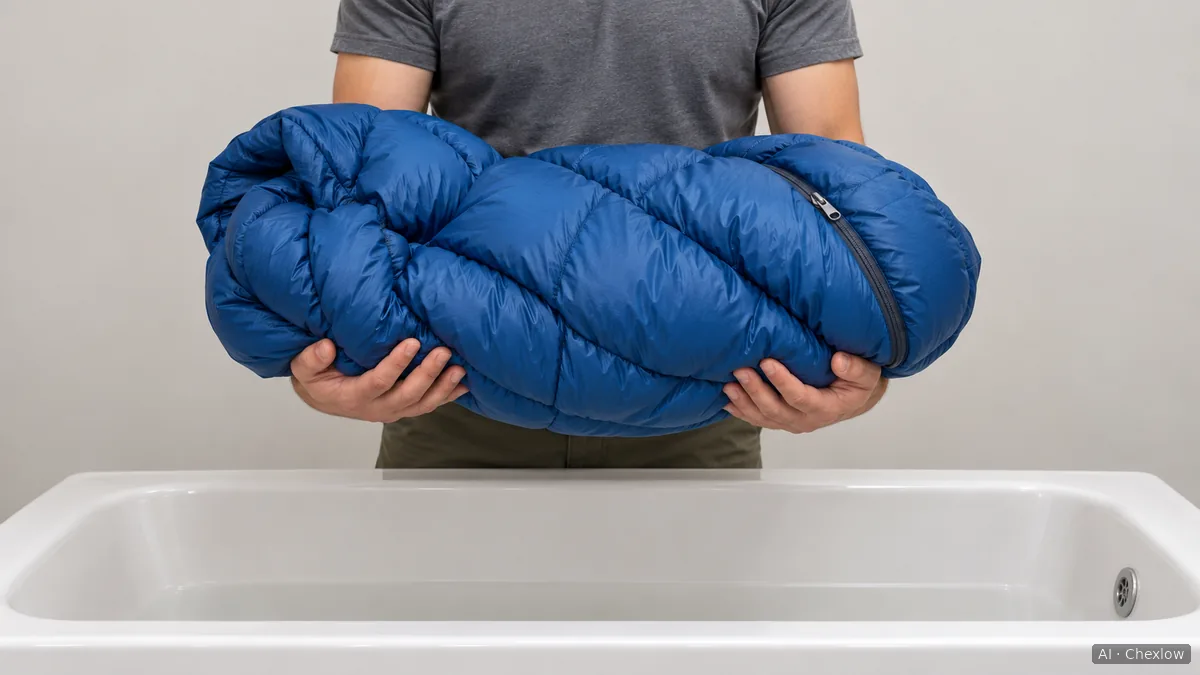
Do not lift a waterlogged down bag. First remove water using its permitted method, then gather the whole bag with your hands underneath and cradle it when moving it, as REI describes. The illustration shows this supported transfer after water removal, not lifting a saturated bag by one end.
Dry the filling, not just the outer fabric
For permitted tumble drying, use the bag’s specified low-heat setting and check it periodically. Mountain Equipment warns that increasing heat to hurry drying can damage the bag; its down-bag process takes several hours. Leave time for checks and further drying rather than treating one cycle as completion.
For down, clean tennis balls can help separate clumps where the manufacturer recommends them. Sea to Summit includes them in its drying method. They are optional care tools, not proof that the filling is dry, and this is not a requirement for synthetic bags.
Check the filling throughout the bag before stopping. If clumps remain after following the drying instructions, ask the maker or specialist for advice before repeating the wash or increasing heat. Stop for assessment if you find damage.
Store loosely, then reassess any remaining warmth problem
Do not pack away a slightly damp bag: Sea to Summit warns that mold or mildew can form. Once thoroughly dry, store it loosely in a roomy cotton or mesh sack, following REI’s storage guidance. Use the supplied storage sack if suitable; buy another only if you lack one that accommodates the bag without compression.
If the clean, fully dry bag still seems unsuitable for the trip, revisit sleeping-bag comfort ratings and the rest of your sleeping setup. That is a separate suitability question, not a reason to keep washing the bag.
Comment ce guide a été conçu
This guide was written by AI for Chexlow, using REI, Sea to Summit and Mountain Equipment care guidance. It focuses on arranging washing, drying and handling for an owned sleeping bag, preserves manufacturer-specific restrictions and does not report hands-on testing.
Rédigé par l’équipe Chexlow · Les images sont des illustrations générées par IA