Lug width: the one measurement that determines compatibility
Before anything else, measure your watch's lug width. This is the gap between the two metal lugs — the protruding arms at the top and bottom of the case where the strap attaches. It's measured in millimeters, from the inner edge of one lug to the inner edge of the other.
A strap that's 1mm too wide won't slide into the lugs at all. One that's 1mm too narrow will fit loosely and look wrong. Lug width is not a preference — it's a hard compatibility spec.
The most common lug widths on modern watches are 18mm, 20mm, and 22mm, with 20mm being the most prevalent on everyday sport and dress watches. Some dress watches run 18mm; larger sport watches often use 22mm. Older vintage pieces can run 17mm, 19mm, or other odd sizes (Veblenist Strap Width Guide).
How to measure. Lay your watch face-down on a soft cloth. Place a digital caliper or a millimeter ruler across the opening between the lugs, measuring from inner edge to inner edge. Digital calipers give the most precise reading — a good one costs $10-15 and is useful for many other things. A ruler works if you hold it steady.
If you're between sizes, go with the smaller mm. A slightly narrower strap creates a small visual gap at the lug edge; a slightly wider strap simply won't fit.
Strap width notation. Most straps are sold with two numbers, like 20/18 or 22/20. The first number is the lug width (where the strap meets the watch). The second is the buckle end width (the tapered end). The lug width is the number that must match your watch exactly.
Leather strap types and when each fits
Leather straps span a wide range of looks and durability levels. The main types you'll encounter:
Smooth calfskin. The most common leather used on watches from entry to luxury. Soft, supple, and breathable right away, with a fine grain that polishes to a clean look. The reason calfskin appears on dress watches and business straps is that the surface is smooth enough to read as formal. The downside: calfskin absorbs moisture, so sweat and rain accelerate wear. It also develops a patina — the surface darkens and creases over time, which many people like, but it happens faster than most expect with daily wear (Helvetus Watch Strap Materials Guide).
Replace a calfskin strap every 12-24 months under daily use. Rotation between two straps extends that significantly.
Alligator or crocodile embossed grain. Most straps sold as "alligator grain" or "croco" are not real exotic leather — they're embossed calfskin or a synthetic material with a scale pattern pressed into the surface. Real alligator costs hundreds of dollars for a strap; embossed alternatives cost $20-80 and are perfectly reasonable for everyday wear. The embossed surface is slightly more resistant to water spotting than smooth calf and holds its appearance longer because the grain pattern hides minor creasing.
If you want a more textured strap with a dressier read than plain calfskin, embossed grain is a practical option.
Vintage and distressed leather. Pre-treated to look worn from the start: surface irregularities, color variation, softer hand. Works well on field watches, pilot watches, or any case with a more rugged character. Not appropriate for dress wear — the casual, aged look is intentional and reads that way.
Suede and nubuck. Suede is split from the underside of the hide; nubuck is sanded full-grain leather. Both have a soft, brushed surface texture. They look excellent in fall-winter styling and pair naturally with casual watches. The major limitation: suede and nubuck are highly vulnerable to moisture and sweat. In warm weather or on an active wrist, they degrade quickly and retain odor. These are seasonal or rotation straps, not all-weather daily drivers.
NATO straps: the casual alternative
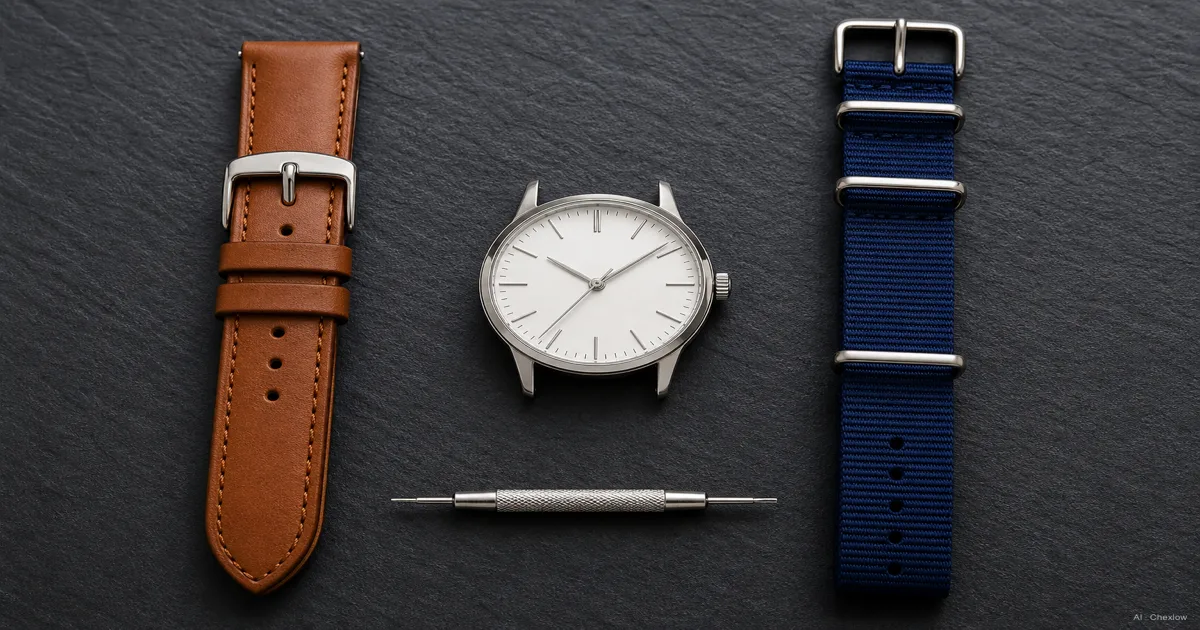
NATO straps are not leather — they're nylon (sometimes polyester), woven into a flat band with metal rings. They share the wrist with leather straps only because they're the other common choice for casual wear.
The name comes from a NATO stock number. The design originated as the G10 strap issued to British military personnel in the early 1970s — a single piece of nylon that threads under the watch case and through the spring bars on both sides, then wraps around the wrist and fastens with a buckle.
The one-piece threading is the reason NATO straps have stayed popular: if one spring bar fails (a real failure mode — spring bars fatigue and snap), the watch stays on your wrist because the strap passes underneath the case. On a standard two-piece leather strap, a single spring bar failure drops the watch (Crown & Buckle About NATO Straps).
Price range is roughly $10-35 for nylon NATOs, with premium versions using heavier ballistic nylon or stainless hardware. They're light, washable under a tap, and quick-drying — the practical choice for travel, outdoor activity, or anywhere leather would suffer.
Style note: NATO straps read as casual. Pairing a NATO with a formal dress watch looks deliberate at best, incongruous at worst. They work best on sport cases, pilot watches, field watches, and tool watches. A slim dress watch on leather belongs at an office; the same watch on a striped NATO belongs at a weekend barbecue.
How to change a strap: spring bar tool vs quick release
Spring bar method. The spring bar is the small cylindrical metal bar that sits horizontally inside each lug slot, holding the strap in place. It has a spring inside that allows it to compress, releasing from the lug hole.
You need a spring bar tool — a small tool with a forked tip on one end and a pointed tip on the other. Cost: $5-15. A proper tool is essential. Using a flathead screwdriver or a knife is how people scratch the case and gouge the lug opening (Watch Straps Australia Guide).
Steps:
1. Place the watch face-down on a soft cloth. This protects the crystal and keeps the watch from sliding. 2. Locate the thin cylindrical bar sitting between the strap and the lug wall. 3. Insert the forked tip of the tool between the strap and the lug, engaging the shoulder notch at the spring bar end. 4. Push inward to compress the spring bar while gently levering the strap away from the lug. The bar retracts and the strap comes free. 5. Repeat on the other side. 6. To install the new strap: seat one end of the spring bar into one lug hole, compress the other end with the tool, position it over the opposite lug hole, and slowly release. You'll feel and hear a small click. 7. Tug both ends firmly to confirm the strap is seated.
Spring bars are spring-loaded and small. Work over a towel or tray — they launch themselves across the room when released uncontrolled.
Quick-release straps. Many strap makers now offer quick-release spring bars — a modified bar with a small lever or button that compresses it without a tool. You pull the lever with a fingernail, slide the strap sideways, and it comes free. Reinstallation is the reverse. If you plan to swap straps regularly, quick-release is worth the slight price premium over standard straps.
Deployment clasp vs tang buckle
Standard straps come with a tang buckle — the same pin-through-hole buckle used on a leather belt. Simple, repairable, inexpensive. The main friction point is that opening and closing a tang buckle every day slightly accelerates wear on the hole the pin sits in.
A deployment clasp (also called a deployant or butterfly clasp) folds open instead of unbuckling. It allows the strap to stay looped around the wrist, which means less wear at the buckle hole and a more secure fastening — the clasp won't pop open accidentally. Deployment clasps are more common on dress watches and higher-end straps; they add $20-60 to the cost of a strap setup but extend the functional life of the strap and feel more finished.
For most people starting out: a tang buckle on a $25-40 calfskin strap is the right first swap. Deployment clasps are worth considering once you have a strap you want to keep for years.
Strap care and when to replace
Leather watch straps age differently from leather shoes and bags. The main difference is contact with sweat. A strap sits directly against skin for hours, absorbing moisture that shoes and bags don't encounter in the same way.
What to do. Keep leather straps dry when possible. Remove the watch before swimming, showering, or heavy physical activity. If the strap gets wet, let it dry naturally — away from direct heat, which cracks leather. A light application of leather conditioner (not shoe polish or wax — something without dye or heavy petroleum content) every few months slows surface drying and cracking. Less is more; saturating a strap causes the leather to soften unevenly.
When to replace. Signs the strap is done: visible cracking along the fold where the buckle sits, splitting at the lug holes, stitching pulling away from the edge, or a persistent odor that doesn't clear after drying and airing. Most calfskin straps under daily use need replacing every 12-24 months. Rotating between two or three straps extends that to 2-3 years each.
NATO straps have a different care story: rinse under water, air dry, done. Replace when the nylon shows fraying or the hardware develops surface corrosion.
Sources
- Veblenist Strap Width Guide — lug width measurement method and standard sizes
- Crown & Buckle About NATO Straps — NATO construction, one-piece threading, and safety advantage
- Watch Straps Australia: How to Change a Watch Strap — spring bar tool method and quick-release mechanism
- Helvetus Watch Strap Materials Guide — leather types, water resistance, replacement timeline, and patina