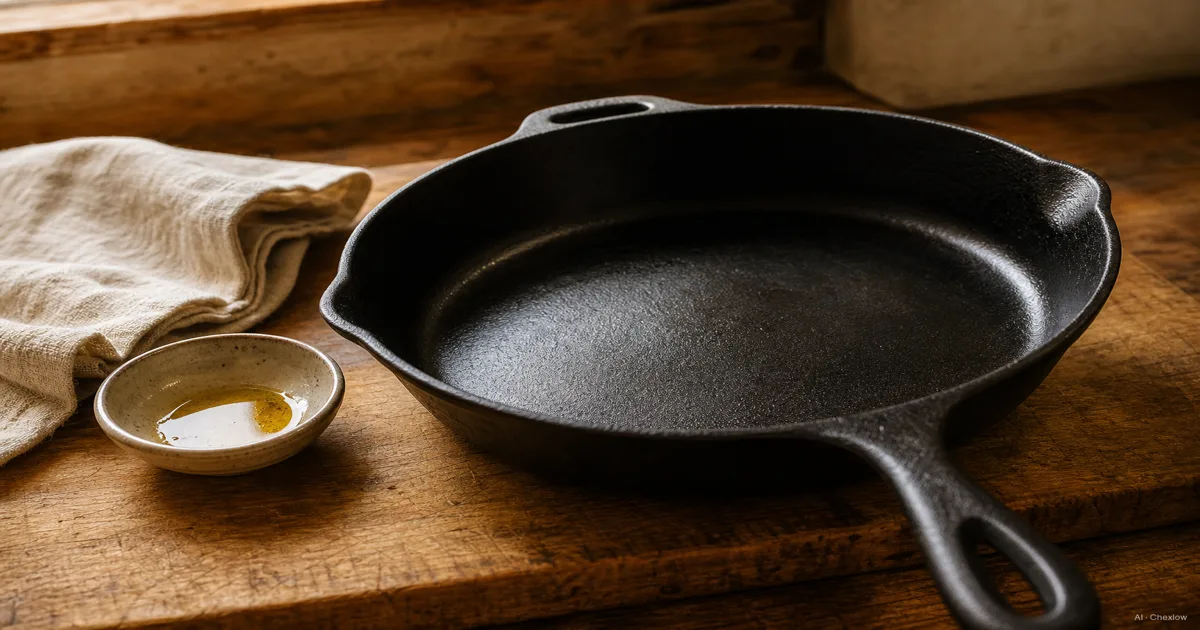

Decide whether it fits your cooking
Consider bare cast iron if you want a pan for browning food and oven cooking, and can make room for hand washing and thorough drying. Those are more useful buying criteria than the promise of a pan that does everything. Lodge's care overview describes stovetop and oven use alongside the wash, dry, oil routine.
Check the surface description before buying. Seasoned iron and enamel are different finishes. Le Creuset's enameled cast iron, for example, needs no seasoning. Follow its own care instructions rather than the bare-iron routine below. Le Creuset's enamel guide
Choose the size you can handle
Compare roughly 10–12-inch skillets, then narrow the choice to your normal meal. As a reference, Lodge lists its 10.25-inch skillet for dinner for two and its 12-inch for family dinners; these are meal suggestions, not guaranteed portion capacities. Lodge's size guide
Before ordering, check three things:
- Cooking space. Look for the flat cooking-base dimensions, not just the rim diameter.
- Kitchen fit. Check the cooktop's pan-size guidance and, if you plan to bake, the oven space including handles.
- Lifting. Compare empty weights and grip both handles if possible. Allow for the food's weight, too.
Choose the smaller candidate if it fits your usual meal and the larger one would be awkward to wash or carry. If handling remains the obstacle, compare carbon steel and cast iron before committing.
Check what preparation your new pan needs
Seasoning is oil transformed by heat into a bonded, hardened layer. It is different from the liquid oil you wipe on after cleaning. Lodge's seasoning explanation
- Factory-seasoned and ready to use. Follow the maker's initial wash and drying instructions, then cook with oil. Lodge explicitly says its seasoned pans need no additional seasoning before use. Lodge's oil and seasoning guidance
- Unseasoned or carrying a protective finish. Follow that manufacturer's removal and first-seasoning instructions. Do not assume every shipping coating comes off the same way.
- Enameled. Use the enamel instructions; skip the seasoning process.
For a first purchase, a ready-to-use finish is a practical way to avoid making surface preparation your first project.
Make the first meal about heat control
Try sautéed vegetables with oil. Start around medium-low, preheat gradually and give food time before moving it. These habits follow Lodge's beginner guidance; buying a darker-looking pan does not replace them.
Keep tomato-heavy or lemon-based dishes for another pan while the seasoning develops. There is no useful calendar deadline for this choice. If your main goal is long, covered braises, explore choosing a Dutch oven before buying a shallow skillet for that job.
Wash it, dry it, put it away
Let the pan cool before washing. Use warm water and dish soap; for stuck food, reach for a nylon brush or pan scraper. Avoid soaking and the dishwasher. Lodge's cleaning instructions
Dry thoroughly, then wipe on a thin coat of oil before storing. Judge dryness by the pan, not a promised two-minute timer. You can start with an appropriate brush and cloth you already own; a dedicated care kit is not a prerequisite. Lodge's care routine
Reseason when the surface needs it
Rust needs removal before oil goes on. A sticky finish can mean excess oil or insufficient heating; adding another thick layer is not the answer. Lodge's restoration guide
For an oven-compatible bare-iron pan, check its instructions first. Lodge's method is:
- Wash and dry. Wash the pan and dry it completely.
- Apply oil. Wipe an extremely thin coat over the inside and outside.
- Position in the oven. Place upside down in a preheated 450–500°F oven, about 230–260°C, with foil on the lower rack for drips.
- Bake and cool. Bake for one hour, switch off and let it cool inside.
This is a conditional maintenance step, not a ritual after every meal. Lodge's oven-seasoning method
Come è stata costruita questa guida
Written by Chexlow's AI editor using Lodge's size, cooking and care documentation and Le Creuset's enamel guidance. The article focuses on choosing a first bare cast iron skillet and deciding which preparation steps apply; the selection checklist is editorial guidance, not a product test.
Curato dal team Chexlow · Le immagini sono illustrazioni generate dall’IA