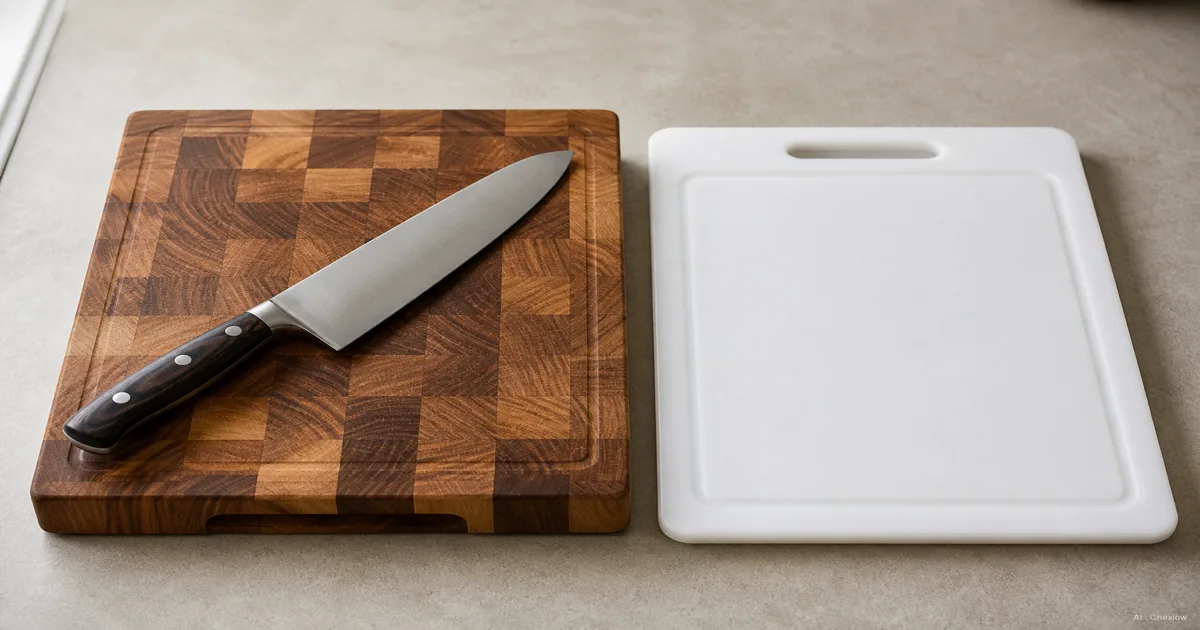

Start with how you clean and what you cut
Before comparing wood species, decide how you will wash the board. If dishwasher cleaning is essential, look for explicit permission in the product instructions. John Boos, for example, says its wooden boards must not go in the dishwasher. John Boos care instructions
- Choose plastic when a dishwasher-compatible board fits your routine. Check the particular product rather than assuming every plastic board qualifies.
- Choose wood when you prefer it and can accommodate its washing, drying and maintenance instructions.
- Plan two boards if you handle raw animal foods: keep their board separate from the one used for bread, salad and cooked food. Both boards can be plastic; buying one of each material is not the goal.
The separation advice comes from University of Illinois Extension. For a first kitchen, our practical priority is enough boards to separate those tasks before spending extra on elaborate wood construction.
Preparing ingredients ahead? The next purchase may be a container: compare glass and plastic food-storage containers around how you will use them.
Check the fit before choosing extra features
Measure the preparation area, washing space and storage spot. For a dishwasher-compatible board, check that it fits the rack as well. A board that covers the counter but is awkward to wash is a poor match for your kitchen.
- Stability: inspect the feet or other intended means of keeping the board in place.
- Usable area: check the cutting space inside any juice groove, not just the outside dimensions.
- Handling: consider whether you can comfortably lift, turn, wash and put away the board.
The OXO Good Grips Prep Cutting Board illustrates features worth checking: dishwasher compatibility, nonslip feet and a runoff groove. Those are specifications of that product, not promises about every plastic board.
Decide whether wood construction matters to you
Edge grain uses lengthwise pieces of wood; end grain presents the cut ends. John Boos explains the construction difference. For a first purchase, treat end grain as an optional preference after size and cleaning requirements are settled, not a requirement for a usable kitchen.
Check your knife maker’s advice too. Shun recommends medium-soft wooden cutting surfaces for its knives and discourages hard surfaces such as glass, granite and ceramic. That guidance does not establish that every wooden board is better than every plastic board.
If your existing knife is already struggling to cut, choosing a board is only part of the question. Read about when to use a honing rod or a whetstone before buying maintenance equipment.
Know what you will maintain and when you will replace it
After raw meat, wash the board with hot, soapy water and sanitize it, following the board’s care instructions. Illinois Extension distinguishes that task from simply putting the board away after use.
Use a sanitizer suitable for food-contact surfaces. Follow its dilution, contact-time and rinsing instructions; never mix cleaning chemicals. Cleaning and sanitizing are separate steps. University of Minnesota Extension
For wood that requires oiling, buy the treatment specified by its maker. John Boos permits food-grade mineral oil and advises against cooking oils. Oil is maintenance, not a replacement for cleaning; follow the board’s instructions rather than an invented calendar. John Boos FAQ
Replace a board when excessive wear or grooves prevent effective cleaning, regardless of material. Judge its condition rather than assigning every board the same lifespan. University of Arizona Extension
Sources
- University of Illinois Extension: cutting boards
- University of Minnesota Extension: sanitizing food-contact surfaces
- University of Arizona Extension: cutting-board guidance
Come è stata costruita questa guida
AI wrote this guide for Chexlow using university Extension food-safety guidance and product or care documentation from John Boos, OXO and Shun. The first-purchase recommendations are editorial judgments about cleaning, space and food separation, not results from hands-on product testing.
Curato dal team Chexlow · Le immagini sono illustrazioni generate dall’IA