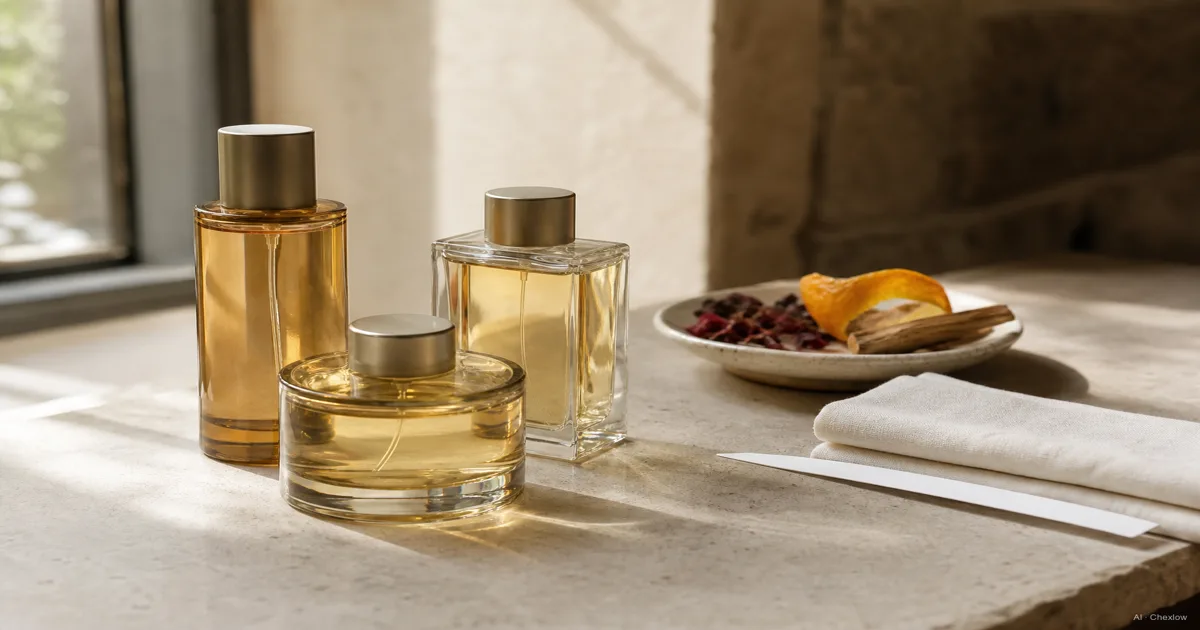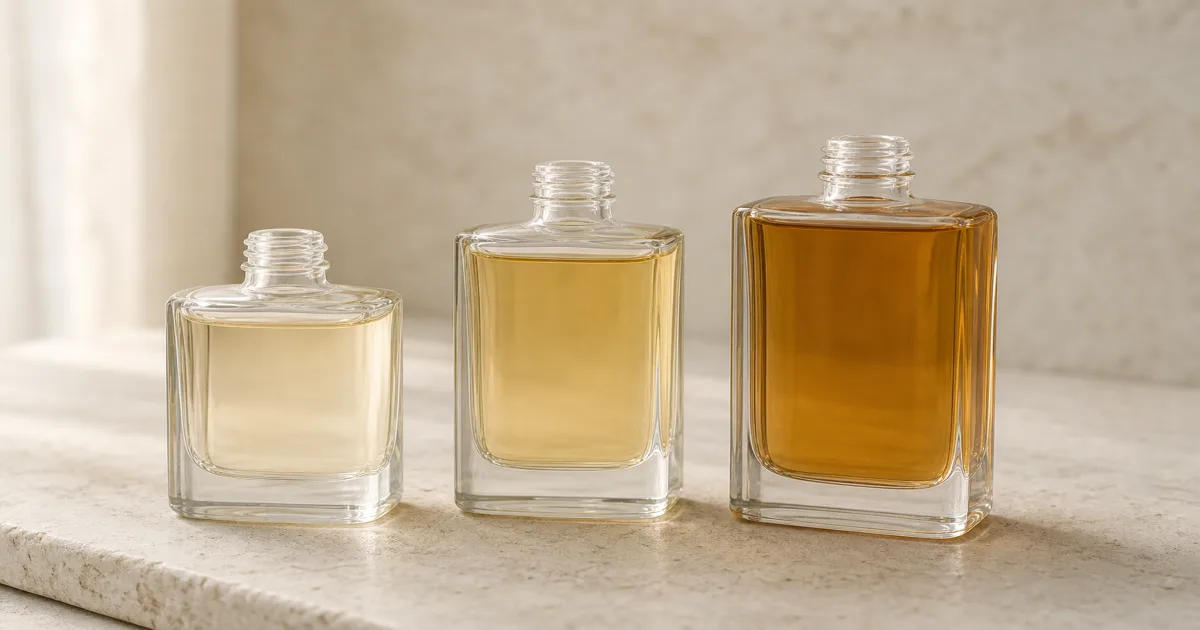
You find a scent you like, and then there are three bottles. One says Eau de Toilette, one says Eau de Parfum, and one just says Parfum. The prices climb as the letters change, and the listing rarely tells you why.
Those labels are not marketing flourishes. They are a rough shorthand for how much fragrance oil is dissolved in the alcohol base, and that single number quietly decides how long the scent stays on you, how far it drifts off your skin, and sometimes how it smells from the opening spray to the last trace hours later.
Get the concentration wrong and a fragrance you love can feel weak by lunch, or so loud at a desk that you regret it. Read the letters correctly and you can match the bottle to your day before you ever spend.
What the letters actually mean, EDT, EDP, EDC, and Parfum decoded
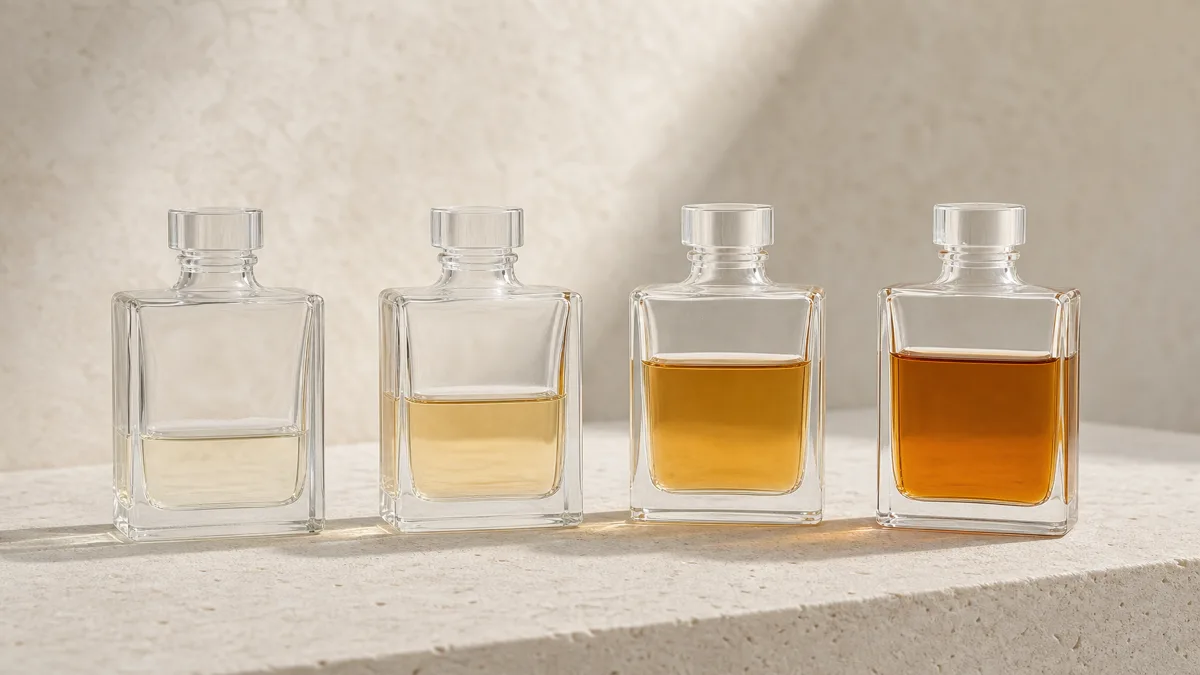
The whole system comes down to one thing: the percentage of fragrance oil in the bottle. Everything else is alcohol and a little water. These tiers are an industry convention rather than a legal definition, so the exact bands shift a little brand to brand, but the order holds everywhere.
Eau de Cologne (EDC) sits at the light end, roughly 2 to 5% oil. It lasts about one to two hours and is the classic splash-and-refresh formula, historically built around bright citrus and herbs. It is made to be reapplied, not to last all day.
Eau de Toilette (EDT) carries about 5 to 15% oil and lasts roughly three to six hours. The higher share of alcohol gives it an immediate, lifted burst when you first spray, which is part of why EDT feels so fresh and easy. It is the daytime, warm-weather, casual workhorse.
Eau de Parfum (EDP) steps up to about 15 to 20% oil and runs roughly six to eight hours. This is the most versatile tier, rich enough for evening but not overwhelming for the office, which is why so many modern signature scents are released as EDP first.
Parfum, also called Extrait de Parfum, is the dense one, around 20 to 40% oil, lasting anywhere from eight to a full twenty-four-plus hours on skin. It is the longest-wearing and usually the most expensive, often sold in smaller bottles because you need so little.
One thing worth knowing before you assume the priciest bottle is simply the best: these tiers describe oil load, not quality, and not even loudness. That last part trips up almost everyone.
Longevity vs projection, why stronger does not always mean louder
Here is the counterintuitive part. More oil makes a fragrance last longer, but it does not automatically make it carry further. Longevity and projection are two different things (Longevity vs Sillage vs Projection, WhatScent).
Projection is how far the scent pushes off your skin into the air around you. Sillage is the trail it leaves as you move. Longevity is simply how many hours you can still smell it.
A Parfum can actually feel more intimate, closer to the skin, than an EDT of the same fragrance. Because the oil ratio is so high, it diffuses slowly and quietly, hugging you rather than filling a room. Meanwhile an EDT, with all that alcohol flashing off fast, can throw scent outward more aggressively in the first hour even though it fades sooner (Perfume Longevity Compared, Scento).
So the real question is not "which is strongest" but "do I want a quiet cloud that lasts, or a bright opening that announces itself." A Parfum is a long, close companion. An EDT is a loud, short hello.
There is one more wrinkle. The same fragrance often does not smell identical across concentrations. Brands frequently rebalance the formula rather than simply diluting it, and EDP versions in particular tend to emphasize the heart and base notes more, so they can read deeper and warmer than the lighter, brighter EDT of the same name (EDT vs EDP vs Parfum, Ombre Bliss). Always test the actual concentration you plan to buy.
Choosing by season and occasion
Temperature changes how a fragrance behaves, which means the right concentration shifts with the season.
Heat speeds up evaporation. In hot, humid weather a dense Parfum or a heavy EDP can bloom too fast and feel overpowering, while a lighter EDT stays comfortable and reads as fresh rather than cloying. Summer is EDT and EDC weather.
Cool air does the opposite. Lower temperatures slow evaporation, so the deeper notes in an EDP or Parfum unfold gradually and last beautifully through an autumn or winter day. Those richer, warmer concentrations were practically made for cold weather.
Occasion matters just as much as the calendar. For a long workday where you sit close to people, a moderate EDT or a light EDP keeps you present without dominating the room. For an evening out, dinner, a date, a night where you want the scent to stay with you, an EDP or a Parfum earns its keep. Match the projection to how close the people around you will be.
Skin type and application tips that actually extend wear
The bottle is only half the story. How your skin holds scent, and how you apply it, can swing longevity dramatically.
Oily or well-moisturized skin holds fragrance molecules longer, improving both how long it lasts and how much it projects, regardless of the tier. Dry skin lets scent evaporate faster across every concentration, which is why the same EDP can last all day on one person and fade by afternoon on another. A simple fix: apply unscented moisturizer first, then spray. The fragrance has something to cling to.
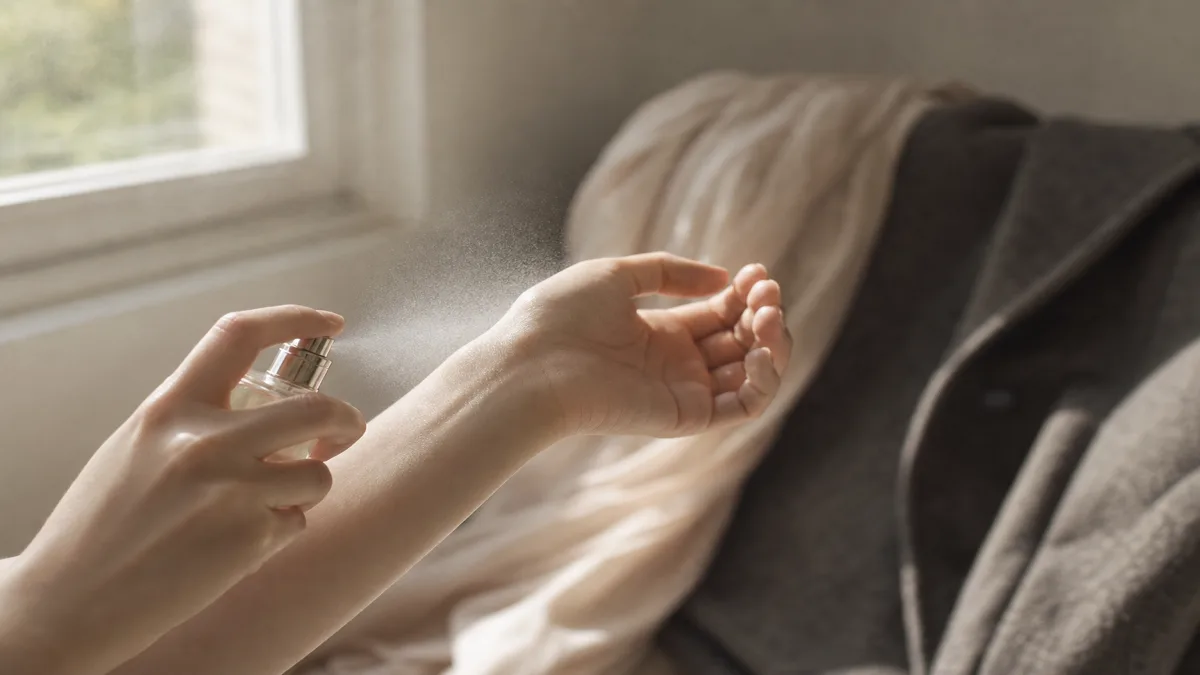
Where you spray matters too. Pulse points, the neck, the inner wrists, behind the knees, the inner elbows, sit close to the surface where body heat helps diffuse the scent steadily through the day.
And one common mistake to drop: do not rub your wrists together after spraying. The friction and heat break down the fragrance molecules, especially the delicate top notes, and you end up shortening the very wear you were hoping to extend (Perfume Longevity Compared, Scento). Spray, then let it dry on its own, or pat gently if you must.
A quick read on how to stretch any concentration:
- Moisturize first. A clean, hydrated base holds scent far longer than dry skin, no matter the tier.
- Aim for pulse points. Neck, inner wrists, behind the knees, inner elbows, where warmth keeps the scent diffusing.
- Never rub. Rubbing wrists crushes the top notes and shortens the wear. Let it dry naturally.
- Match the tier to the day. Light EDT for hot and casual, EDP for versatile all-rounders, Parfum when you want a quiet scent that lasts.
Is Parfum worth the price premium?
This is where the numbers and the feel pull in different directions.
On paper, Parfum looks like the obvious upgrade: the most oil, the longest wear, often eight to twenty-four hours from a single application. If you want a scent to stay with you from morning into the night without a single re-spray, that is exactly what the extra oil buys.
But more is not automatically better for everyone. Because Parfum sits so close to the skin, it rewards people who like an intimate, personal scent and frustrates anyone hoping to fill a room. If you actually want noticeable projection in the first few hours, a well-made EDP often delivers a better balance of presence and longevity for less money. And the EDP is frequently the version a brand tunes most carefully, since it is the modern default.
It also helps to remember that the concentration tiers are convention, not regulation. The IFRA, the International Fragrance Association, sets the safety limits for how ingredients can be used, most recently through the IFRA 51st Amendment updated in 2023, but it does not define the EDT, EDP, and Parfum bands themselves (IFRA Standards, International Fragrance Association). So "Parfum" on a label is a promise about oil load, not a certified grade of quality.
The honest answer: Parfum is worth it if you specifically want maximum longevity and a close, intimate wear, and you have tested that exact version on your own skin. If you want everyday versatility and projection that announces itself a little, an EDP is usually the smarter spend, and an EDT is the easy, fresh choice for warm days and casual hours.
Sources
- EDT vs EDP vs Parfum, Longevity, Concentration and How to Choose, Ombre Bliss — concentration bands, reformulation across tiers, choosing guidance
- Perfume Longevity, EDT, EDP, Parfum Compared, Scento — wear times, projection behavior, application mistakes
- IFRA Standards, International Fragrance Association — safety standards and the 51st Amendment, why tiers are convention not regulation
- Longevity vs Sillage vs Projection, WhatScent — the difference between lasting, trailing, and carrying
- EDT vs EDP vs Parfum, The Real Difference, Premiere Peau — what the price premium actually pays for
- Fragrance Concentration Guide, Friday Charm — oil percentages and tier definitions
Come è stata costruita questa guida
This piece started from a question almost every fragrance shopper runs into: the same scent shows up as an Eau de Toilette, an Eau de Parfum, and a Parfum at climbing prices, and it is hard to know what the letters actually buy. We cross-checked the concentration bands and wear behavior across fragrance references, including Ombre Bliss and Friday Charm on oil percentages and reformulation, Scento on longevity and application, WhatScent on the difference between projection and sillage, and the International Fragrance Association on safety standards and why the tiers are convention rather than regulation. The focus is on reading EDT, EDP, and Parfum for what they are and matching a concentration to your day, not on perfumery chemistry. The selection lens sits on Chexlow's fragrance catalog across these concentrations.
Curato dal team Chexlow · Le immagini sono illustrazioni generate dall’IA