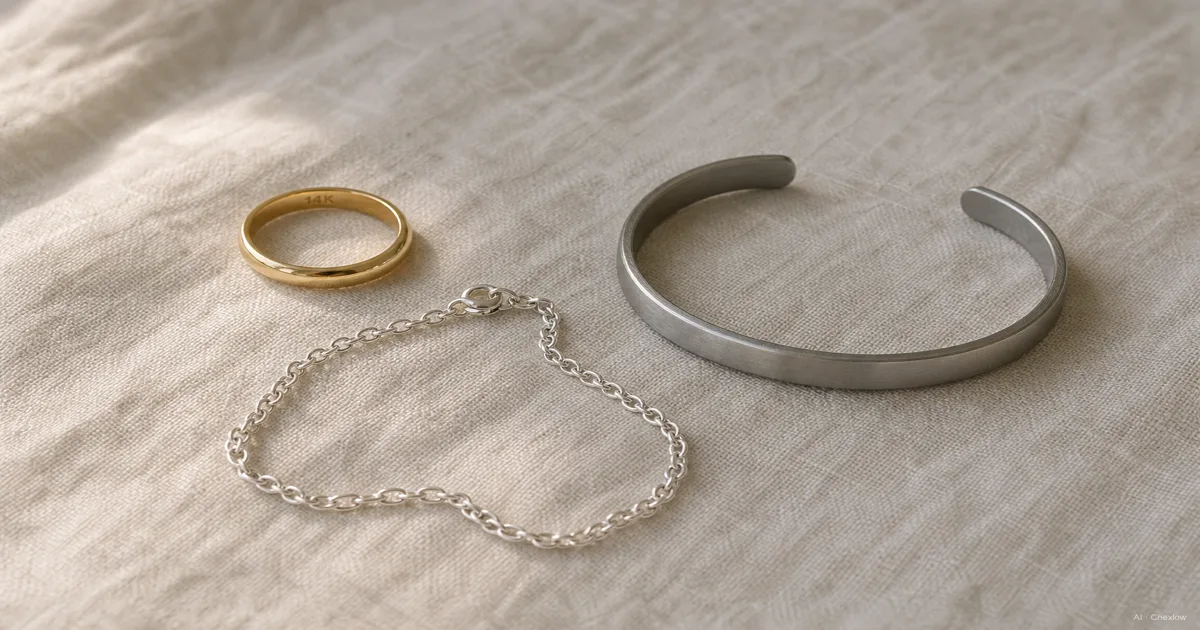
A gold ring, a silver chain, and a stainless steel bracelet sitting on the same tray can look almost the same in a product photo and cost ten times apart. The image rarely tells you which metal you are looking at, and the listing often just says "jewelry" or "fashion accessory."
The metal decides nearly everything that matters once you actually wear the piece: whether it tarnishes, whether it bothers sensitive skin, whether you can keep it on in the shower, and whether the price you paid leaves anything behind in a few years.
There are three metals you will run into again and again for everyday rings, earrings, bracelets, and necklaces. Once you can read the stamps, the same tray suddenly makes a lot more sense.
What each metal actually is, gold karats, silver 925, and 316L stainless explained
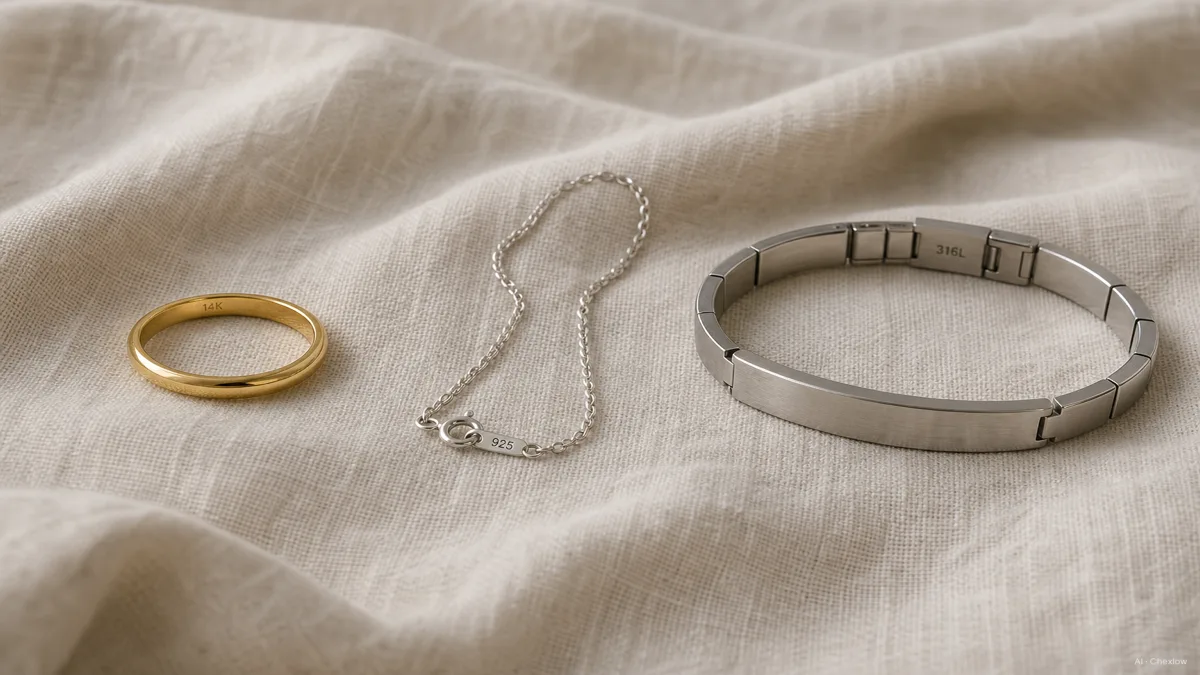
Gold purity is measured in karats. Pure gold is 24K, but pure gold is soft, so almost all jewelry mixes it with other metals for strength. The number tells you the ratio: 10K is 41.7% gold, 14K is 58.5%, 18K is 75%, and 24K is 99.9% (Gold Karat Explained, Brilliant Earth). Higher karat means a richer, warmer color, but also a softer piece that scratches and bends more easily.
Sterling silver is 92.5% pure silver mixed with 7.5% of another metal, usually copper, and that is exactly what the "925" stamp means. The copper gives the soft silver enough backbone to hold a shape. The trade-off is that silver reacts with air, moisture, and the sulfur in everyday life, so it tarnishes and goes dull over time (Sterling Silver Guide, Navarra Jewelers).
316L stainless steel is a different animal entirely. It is an alloy of iron with 16 to 18% chromium, 10 to 14% nickel, and a few percent molybdenum. The "L" means low carbon, which makes it easier to weld and kinder to skin. This is surgical-grade steel, the same family used for implants and orthopedic pins (316L Stainless Steel, Precision Ground Bars).
So the stamps actually map to three very different promises. Gold is a precious metal sold by purity. Silver is a precious metal too, but cheaper and brighter. Stainless steel is an industrial alloy that happens to look like jewelry and survive almost anything.
Durability and tarnish, how long will each metal look new
Here is where the three split apart in daily life.
Stainless steel barely changes. Its corrosion resistance comes from an invisible chromium oxide layer on the surface that re-forms the instant it is scratched, which is the same property that keeps it from rusting or leaching metal (Stainless Steel Properties, Blake Bros). You can wear it in the shower, the pool, the ocean, and the sauna and it will not care. It picks up fine surface scratches over years, and that is about it.
Solid gold rarely tarnishes either, especially at higher karats, because gold itself does not react with air. What it does pick up is surface scratches and soft dings, since the metal is malleable. A well-worn gold ring at five years looks like it has been loved, not damaged.
Sterling silver is the high-maintenance one. The bright white luster is gorgeous out of the box, but exposure to air and moisture darkens it, and chemicals speed that up. The good news is that silver tarnish is fully reversible. A polishing cloth or a mild silver cleaner brings the shine right back (Silver vs Stainless Steel, JAXXON). It just needs the attention.
One more note for anyone who lives an active life. Gold-plated jewelry, which is a thin gold layer over a base metal, is the fragile exception. Chlorine, salt water, and sweat strip the plating fast, and once it wears through you are looking at the cheap metal underneath.
Sensitive skin and allergies, which metals are safe to wear daily
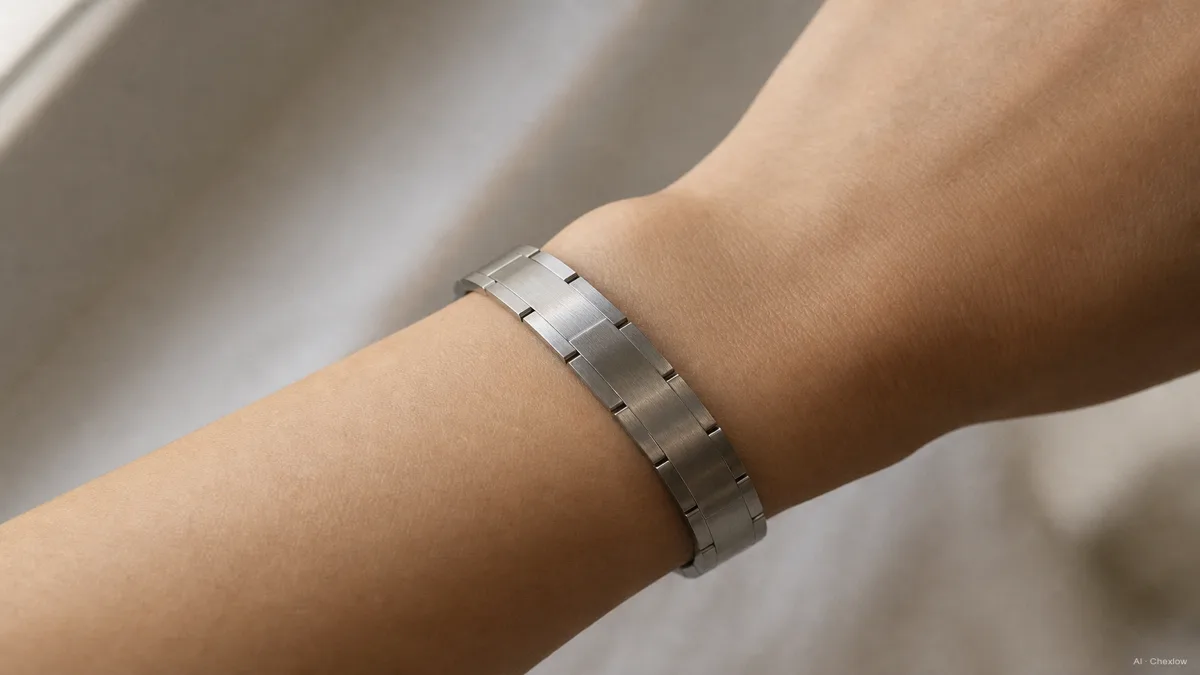
If your skin reacts to jewelry, the usual culprit is nickel, and this is where the three metals separate hard.
316L stainless steel is the safe bet for most sensitive skin. Even though it contains nickel in the alloy, the metal is locked in so tightly that it releases nickel ions far below the EU REACH safety limit of 0.5 micrograms per square centimeter per week (316L Hypoallergenic, Precision Ground Bars). It is the same grade trusted for surgical implants, which is a strong vote of confidence.
Gold gets safer as the karat goes up. 18K gold is mostly gold with little room for problem alloys, so it is gentle on most skin. 14K can contain nickel in its alloy mix, and 10K, with the most non-gold metal in it, carries the highest reaction risk of the gold family (Hypoallergenic Metals, Q Evon Fine Jewelry).
Sterling silver is the surprise. People assume "precious metal" means safe, but the 7.5% copper in 925 silver is not truly hypoallergenic for everyone, and a meaningful share of sensitive wearers do react to it.
The simple read: if your ears or wrists flare up easily, 316L stainless steel or 18K gold are your safest daily metals, and sterling silver is worth a cautious trial rather than a blind buy.
Price vs value, everyday affordability vs long-term worth
This is the trade nobody puts on the label.
Stainless steel is the affordability champion. For a piece that looks equivalent, it runs roughly 10 to 50 times cheaper than solid gold (Stainless Steel vs Gold, The Steel Shop). The catch is that it has no resale or intrinsic value. When you are done with it, it is worth nothing on the metal market. That is fine for a piece you wear hard and replace.
Gold sits at the opposite end. You pay a lot up front, but you are buying a material that holds intrinsic value, can be resold, and in the case of an heirloom piece, can outlive you. 14K is the workhorse most people in the US choose for everyday rings and earrings because it balances durability and gold content, while 18K is the choice for luxury and heirloom pieces where richer color matters more than ruggedness (Gold Karat Guide, Brilliant Earth).
Silver lands in the middle, and it is having a real moment. Through 2025, silver jewelry has surged, driven by younger buyers and by its affordability when budgets are tight. Mixed-metal layering, gold and silver worn together, is one of the dominant looks right now (Jewelry Trends 2025, Jewel360). Silver gives you a precious-metal feel without the precious-metal price.
How to care for each metal, and which needs the least maintenance
A quick care read, from lowest effort to highest.
- Stainless steel. Soap and water. That is the whole routine. Wear it everywhere, wipe it down occasionally, and forget about it.
- Solid gold. Rarely tarnishes, so a gentle clean now and then keeps it bright. Higher-karat gold is softer, so treat it a little more carefully to avoid scratches and dings.
- Gold-plated. Keep it away from chlorine, salt water, and sweat, and take it off before the shower or the gym. The plating is thin and wears through with rough use.
- Sterling silver. Keep it dry, store it sealed away from air to slow tarnish, and bring the shine back with a polishing cloth or a mild silver cleaner when it dulls.
One real-world signal worth knowing: about 48% of buyers check for certification before a high-value jewelry purchase, which is why the metal stamps themselves, 925, 14K, 316L, matter so much (Jewelry Trends 2025, Jewel360). A clear stamp is the first honest thing a piece tells you about itself.
Put it together and the choice gets simple. Want something you never have to think about? Stainless steel. Want a bright white look on a budget and you do not mind the occasional polish? Sterling silver. Want lasting color and real value, and you are picking a piece to keep? Gold, with the karat set by your skin and your budget.
Sources
- Gold Karat Explained, Brilliant Earth — 10K, 14K, 18K, 24K purity and everyday karat choice
- Stainless Steel vs Gold, Silver and Plated, The Steel Shop — durability, price ratio, and resale value
- Silver vs Stainless Steel Jewelry, JAXXON — tarnish, daily wear, and reversibility
- Is 316L Stainless Steel Hypoallergenic, Precision Ground Bars — alloy makeup, nickel release, surgical-grade use
- 8 Jewelry Consumer Trends in 2025, Jewel360 — silver resurgence, mixed-metal layering, certification behavior
Come è stata costruita questa guida
This piece started from a recurring shopper question: a gold, a silver, and a stainless steel version of nearly the same ring or chain can sit side by side at very different prices, and it is hard to know what you are actually paying for. We cross-checked the metal definitions and trade-offs across jeweler and industry references, including Brilliant Earth's gold karat guide, Precision Ground Bars on 316L's alloy and nickel behavior, JAXXON and The Steel Shop on tarnish and value, and Jewel360's 2025 trend data. The focus is on how to read the 14K, 925, and 316L stamps and match a metal to how you live, not on workshop-level metallurgy. The selection lens sits on Chexlow's jewelry catalog across all three metals.
Curato dal team Chexlow · Le immagini sono illustrazioni generate dall’IA