Start with this bottle and this load
Keep the detergent packaging beside you. Find its dosing instructions, the load size they refer to and any concentration information. When you change detergent or concentration, read the new instructions instead of carrying over the old cap line.
Check that the detergent and wash programme suit the clothes. For a wool sweater whose washing method is still unclear, start with the wool sweater washing guide before calculating a dose.
Use the amount of laundry going into this wash, not automatically the machine's maximum capacity. Also check the programme limit: Ariel explains that delicate fibres and faster cycles require smaller loads. A small quick wash is not a full-capacity cotton load.
Write down the label's relevant load band and soil category. If it gives no instruction for your situation, ask the detergent maker rather than assuming that half the laundry always means half the detergent.
Find your water hardness, then choose the label entry
Bosch identifies laundry amount, soiling and water hardness as the dosing variables. It points to your local water company or a water hardness tester for the hardness information.
Look up the value for your supply area and keep its unit with it. Match it to the ranges on your detergent packaging. If the report and label use different units, ask the supplier or detergent maker to clarify the match rather than comparing the numbers directly.
If suitable local information is unavailable, a water hardness test kit is a supporting option. Check that its reported units and range let you interpret the detergent label; there is no need to buy a tester when the information you already have answers the question.
Now select the entry where your load, soil level and hardness meet. Bosch's online millilitre table is explicitly an example for a 4–5 kg load, so do not use its figures as the dose for an unrelated detergent.
Measure the selected dose, not the cap's capacity
Read the markings on the measuring device supplied with that product. Ariel Washing Gel, for example, has dosing markings inside its cap. That does not make a brimful cap, or another bottle's cap, the correct measure.
If the supplied measure is missing or unreadable, a detergent measuring cup with the units and graduations you need can help. Reuse a suitable measure you already have. A millilitre scale does not directly measure a dose specified in grams.
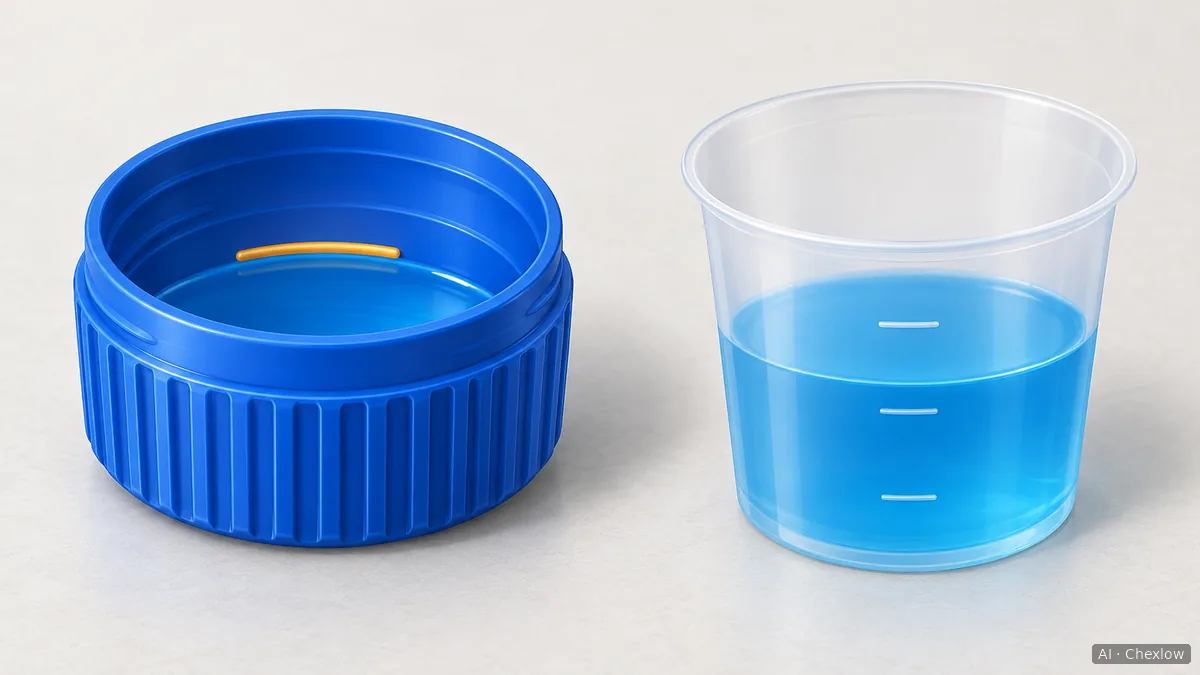
For an arithmetic example only, imagine that your label specifies 40 ml for the selected conditions and explicitly says to add 10 ml for your larger load. The total is 50 ml, not 40 ml plus another capful. These invented numbers demonstrate addition; they are not a dose recommendation. If the label instead gives a separate larger-load entry, use that entry without adding an extra allowance again.
Keep the product name, selected label entry and measured amount together in a short note. Recheck them when the detergent, load or water supply changes. Follow the product and machine instructions for where the detergent goes; Ariel's cap-in-drum instructions apply to the gel described on that page, not every measuring cup. The same page also excludes that gel from hand washing.
Check automatic dosing before adding anything by hand
With automatic dispensing, check your model's permitted detergent and concentration setting before adding a manual dose. Whirlpool's Top Load Load & Go guidance specifies HE liquid detergent and the correct concentration setting. HE means high-efficiency detergent; the requirement here belongs to the documented system.
That guidance tells users to disable Load & Go before using a single measured dose. Do not transfer its button sequence or detergent permissions to another dispenser; use your model's manual.
If the result disappoints, check the recorded dose, load and settings before changing the amount. Too little detergent can impair cleaning, while overloading can leave too little water to dissolve it. White residue alone does not settle which happened. Whirlpool also warns that excess detergent can cause excessive suds and rinsing or draining problems.
For persistent dispensing problems, follow the model's troubleshooting instructions or contact support. Leaking or damaged equipment needs assessment, not another dose experiment.
Come è stata costruita questa guida
Written by AI for Chexlow using official Bosch, Ariel and Whirlpool guidance. This guide turns their dosing variables into a label-reading and measuring routine for an existing washer, while keeping product-specific instructions separate. It does not report original product testing; the numerical example is illustrative.
Curato dal team Chexlow · Le immagini sono illustrazioni generate dall’IA