
Decide what you need before choosing an oil
Write down why you want a supplement. “I want to review my diet” and “I need treatment for high triglycerides” call for different next steps. Evidence about eating seafood cannot simply be transferred to capsules, and prescription omega-3 products differ from ordinary supplements. For treatment, take the question to your clinician. NCCIH
EPA and DHA are two omega-3 fatty acids. The US intake recommendations summarized by NIH establish amounts for ALA, another omega-3, rather than EPA and DHA. That is why this guide does not assign everyone a daily dose. NIH consumer guide
Before starting either oil, seek advice if you have a fish or shellfish allergy, take medicines affecting clotting, are pregnant or breastfeeding, or are buying for a child. Switching marine sources is not a way to establish allergy safety yourself. NCCIH safety guidance
If the unresolved question is whether to buy broad nutritional coverage or a targeted supplement, start with multivitamins versus single supplements. That is a separate decision from choosing an omega-3 source.
Compare the amount you get, then the cost
Put the two labels side by side. Supplement Facts gives ingredient amounts per serving, so check how many capsules make that serving. NIH label guidance
Copy four numbers for each bottle: EPA per serving, DHA per serving, servings per bottle and bottle price. Do not substitute the front-label oil weight for the EPA-plus-DHA total.
- Add. EPA plus DHA gives the combined amount per serving.
- Scale. Multiply by servings per bottle, then divide milligrams by 1,000 to get grams.
- Compare. Divide the bottle price by those grams. Use the same currency and the same inclusion of delivery costs for both bottles.
For a made-up label calculation, 60 capsules at two capsules per serving means 30 servings. If each serving contains 180 mg EPA and 120 mg DHA, the bottle contains 30 × 300 mg = 9,000 mg, or 9 g. Divide its price by 9. These are arithmetic inputs, not a product offer or a suggested dose.
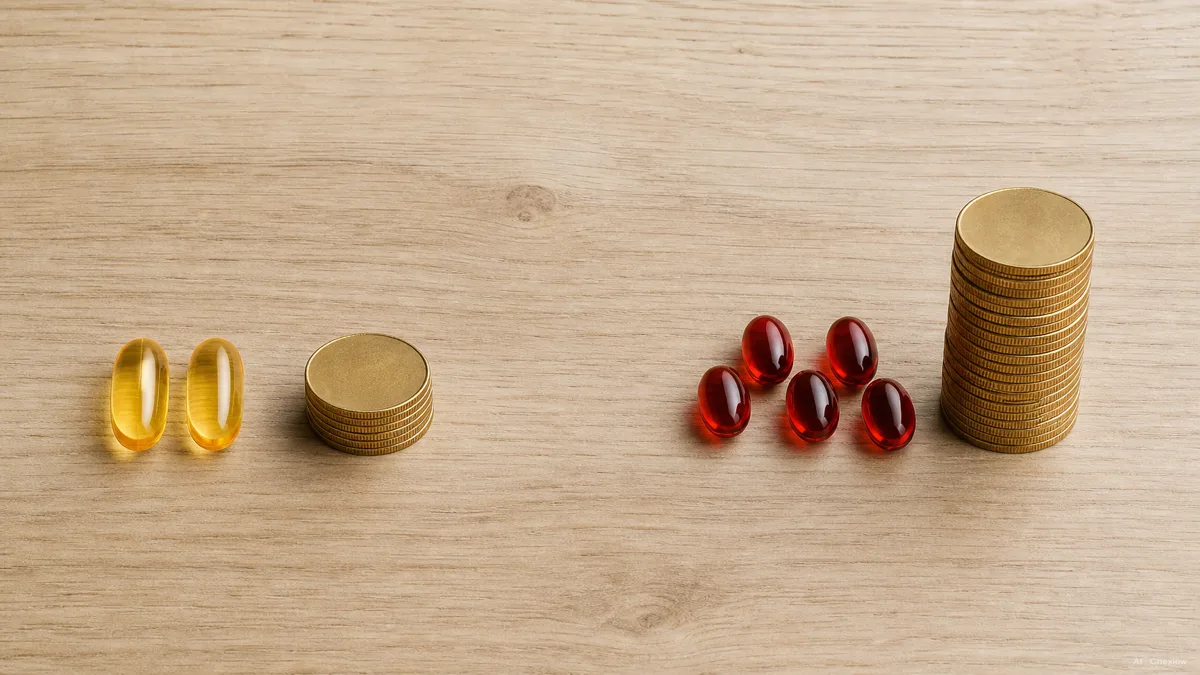
The illustration shows a possible capsule-and-cost trade-off. Two fish-oil capsules do not universally equal five krill capsules; calculate from the actual labels.
A lower cost per gram is useful only after the product fits your needs. Also record the capsule count for the intended serving: a cheap bottle is less convenient if its serving is more than you want to swallow.
Decide whether krill's claims justify paying more
Both oils supply EPA and DHA; krill is a crustacean. The comparison is between sources, not a basic and premium grade. Cleveland Clinic
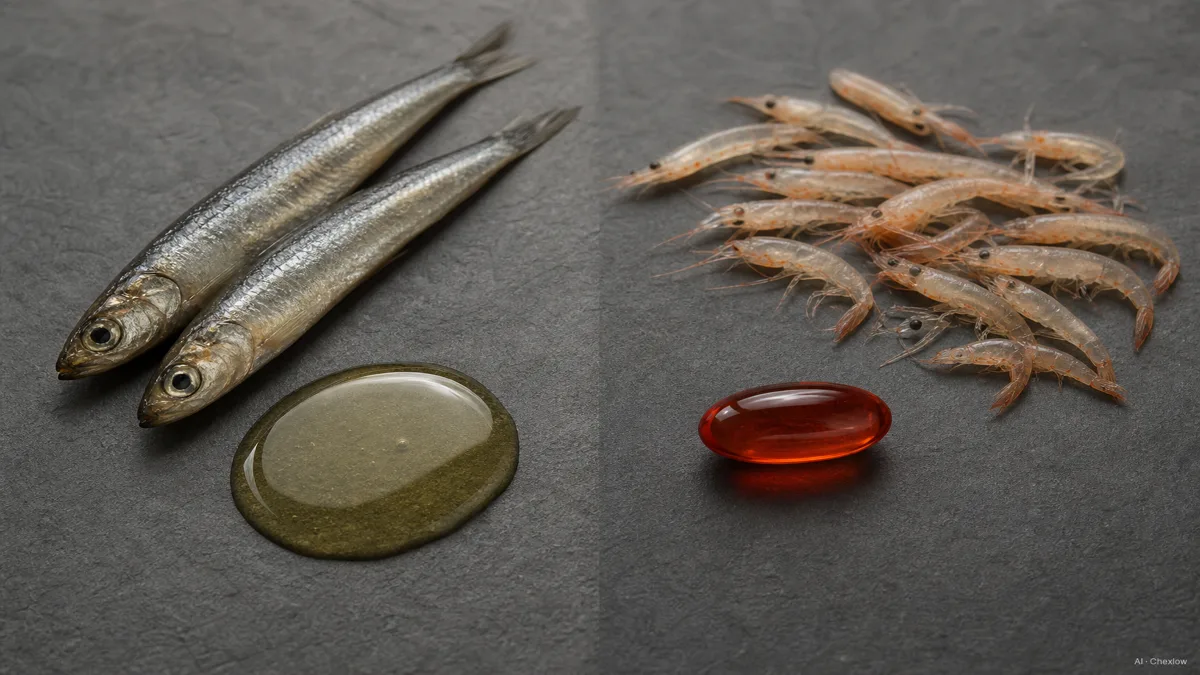
“Bioavailability” means how readily a substance becomes available to the body. NIH reports mixed findings on whether krill's phospholipid form has higher bioavailability than fish oil. NIH evidence review
For a first purchase, do not convert “better absorbed” into an assumed dose discount. Compare the stated amounts without inventing a multiplier. A claim on the front of a bottle is not enough reason to accept less EPA and DHA for more money.
Nor is krill a guaranteed answer to fishy aftertaste or an upset stomach; both can still occur with krill oil. Cleveland Clinic If a product causes problems, discuss the product and serving with a pharmacist or clinician instead of buying another large bottle on a promise of comfort.
Make the final choice from two complete labels
Check any independent quality seal and what it covers. Such seals do not prove that a supplement is safe or effective for you. NIH quality guidance
Then make a conditional choice:
- Choose fish oil if its labeled EPA and DHA, serving size and quality information fit your needs at a lower calculated cost.
- Choose krill oil if the specific product fits your agreed intake and your preferences well enough to justify its calculated cost. You do not need to pretend it has proven superior absorption.
- Buy neither yet if the purpose, suitable intake, allergy question or ingredient amounts remain unclear. Photograph both labels and ask what amount, if any, makes sense for you.
Avoid treating a large bottle as the default bargain before you know whether the product suits you. For the bottle you choose, check its date and storage instructions before paying, then follow its directions and any individual advice you have received.
Sources
- NIH: omega-3 consumer guidance
- NIH: omega-3 evidence review
- NCCIH: omega-3 supplements
- NCCIH: consultation and safety
- NIH: supplement labels and quality
- Cleveland Clinic: krill oil
Come è stata costruita questa guida
This guide was written by the Chexlow AI editor using NIH and NCCIH guidance and Cleveland Clinic's discussion of krill oil. It focuses on comparing labels, costs and claims for a first purchase, not prescribing a dose. The calculation is hypothetical; no products were tested for this article.
Curato dal team Chexlow · Le immagini sono illustrazioni generate dall’IA