Look at the thread before reaching for a tool
Lay the garment down and inspect the affected area from both sides without pulling the protruding thread. For this initial check, separate three situations:
- A long loop still attached at both ends. Treat it as a snag to assess, not excess thread to trim.
- Small fuzzy balls on the surface. These may be pills. Woolmark describes wool pilling as fuzzy balls formed through rubbing during wear.
- Broken ends, a hole or stitches coming apart. Leave the area alone and move to repair assessment. If you cannot tell what you are seeing, take this route too.
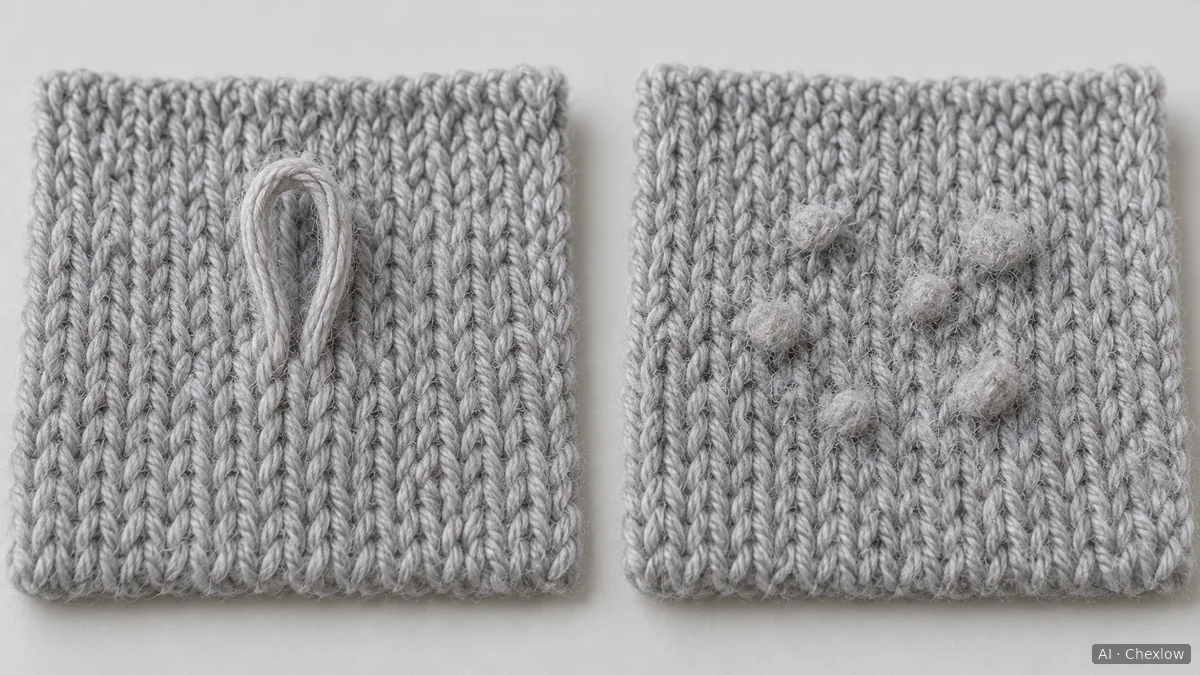
The illustration compares an intact pulled loop with surface pills; it does not identify the condition of your garment. Do not run a shaver or comb over a suspected snag to make it disappear. If inspection instead shows only pills or loose lint on otherwise intact fabric, continue with choosing between a fabric shaver and a lint roller.
Match the method to the garment before buying anything
An intact loop is a reason to check the garment maker's repair advice, not automatic permission to insert a needle. Establish whether the item is knitted or woven and whether the advice covers that construction. If you cannot identify it, or cannot reach the reverse without opening a lining, ask the maker or a repair specialist first.
For knitted jumpers, Oliver Bonas describes using a blunt needle or crochet hook to coax the exposed yarn towards the inside and redistribute excess along the stitch row on both sides of the snag. Its warning is clear: avoid enlarging the hole and do not cut the thread. Pulling hard on the loop is not the same operation.
A blunt yarn needle is one supporting option when that method suits the knit. Use a suitable tool you already own; check that its thickness can pass through the existing spaces without force. If following the yarn or moving it gently is difficult, stop rather than improvise.
A dedicated snag-repair needle works differently. Prym describes its Snag wizard as a 0.8 mm tool with a spiral-like ribbed end instead of an eye. Its method inserts the tool beside the affected thread in fabric or knitwear and turns it to draw the thread to the reverse. That describes this tool's mechanism, not compatibility with every garment or every snag-repair needle. Check the chosen tool's instructions before considering it; the two tools are alternatives, not a required kit.
For a woven shirt or dress, do not simply transfer the jumper method. Azazie's small-snag guidance for its dresses describes gently moving the fabric on either side outward to guide the thread back into the weave. The movement concerns the surrounding fabric, not yanking the protruding thread. Ask your own garment maker whether that approach applies before stretching an unfamiliar fabric.
Stop when the problem is more than an intact loop
This beginner guide stops at broken yarn, holes, stitches coming apart, resistance to gentle movement or distortion that remains. This is an editorial boundary for home attempts, not a claim that the garment cannot be repaired. Azazie likewise directs readers who still need help after its small-snag steps to customer service.
Before contacting the maker or a clothing repair specialist, prepare:
- A close photograph of the front and reverse, plus one showing where the damage sits on the garment.
- The composition and care-label information.
- A short account of what caught the fabric and anything already tried, including cutting or pulling.
Ask whether the yarn can be repositioned or whether the area needs structural repair, and what visible change to expect. Do not assume that hiding a thread on the inside restores damaged fabric.
Until assessed, set the garment aside where the loop will not catch again. Oliver Bonas notes that an exposed loop can snag again and worsen, potentially leaving a hole. Check the bracelet, buckle or other object involved before wearing the garment with it again.
Hoe deze gids is opgebouwd
Written by AI for Chexlow, using Oliver Bonas and Azazie care guidance, Prym's tool description and Woolmark's explanation of pilling. The article focuses on initial assessment and conditional tool use; the stopping points are editorial limits for beginners, not findings from hands-on repair tests.
Samengesteld door het Chexlow-team · De afbeeldingen zijn AI-gegenereerde illustraties