Ga naar hoofdinhoud
Chexlow AI

Categorie · Beauty / Supplements

Collagen or Biotin, Which Supplement to Buy First for Skin, Hair, and Nails

You want less brittle nails, a little more shine, skin that holds up better, and the supplement aisle offers you two very different-looking answers wearing the same "beauty from within" label. Collagen tubs promise structure. Biotin bottles promise metabolism and keratin. Neither is lying, exactly, but neither is telling you the whole story either. Collagen is a protein, roughly a third of everything your body is built from, and it provides the physical scaffolding for skin, joints, and hair follicles. Biotin is a B vitamin, a tiny cofactor your cells use to turn food into energy and to build keratin. They do not compete for the same job, and there is no real rule about taking one before the other. What actually matters is which claim has evidence behind it, and which one fits the problem you are trying to solve. This guide walks through what each ingredient can actually back up, who should reach for which one first, and what a sane label and dose look like before you buy.

Collagen or Biotin, Which Supplement to Buy First for Skin, Hair, and Nails

Walk into any pharmacy or open any supplement app and collagen and biotin sit on the same shelf, often in the same combination bottle, both promising the same vague thing: better skin, hair, and nails. That framing makes them sound interchangeable. They are not.

The fastest way to stop confusing them is to remember what each one actually is. Collagen is structural. Biotin is metabolic. One builds, the other helps your cells run. Once that distinction is clear, the evidence for each stops being a marketing claim and starts being something you can actually evaluate.

Collagen vs Biotin, What Each One Actually Does

Collagen is the most abundant protein in the human body, making up roughly 30% of total body protein, according to Nature Made. It is the structural material in skin, tendons, ligaments, bones, and the connective tissue around hair follicles, essentially the scaffolding everything else is built on. As you age, your body produces less of it, which is the whole reason collagen supplements exist in the first place.

Biotin, also called vitamin B7, is a completely different kind of nutrient. It is a water-soluble B vitamin that acts as a coenzyme, helping your cells convert fats, carbohydrates, and protein into usable energy, and it plays a specific role as a cofactor in keratin production, the protein your hair and nails are made of, per Nature Made. It does not build tissue the way collagen does. It helps the machinery that builds keratin run properly.

Neither ingredient blocks or interferes with the other, and there is no established sequencing rule, no "take biotin before collagen" logic backed by evidence. Plenty of combination supplements pair the two in a single capsule for exactly that reason, according to both Nature Made and Momentous. If you decide you want both, you are not fighting an interaction, you are just paying for two ingredients instead of one.

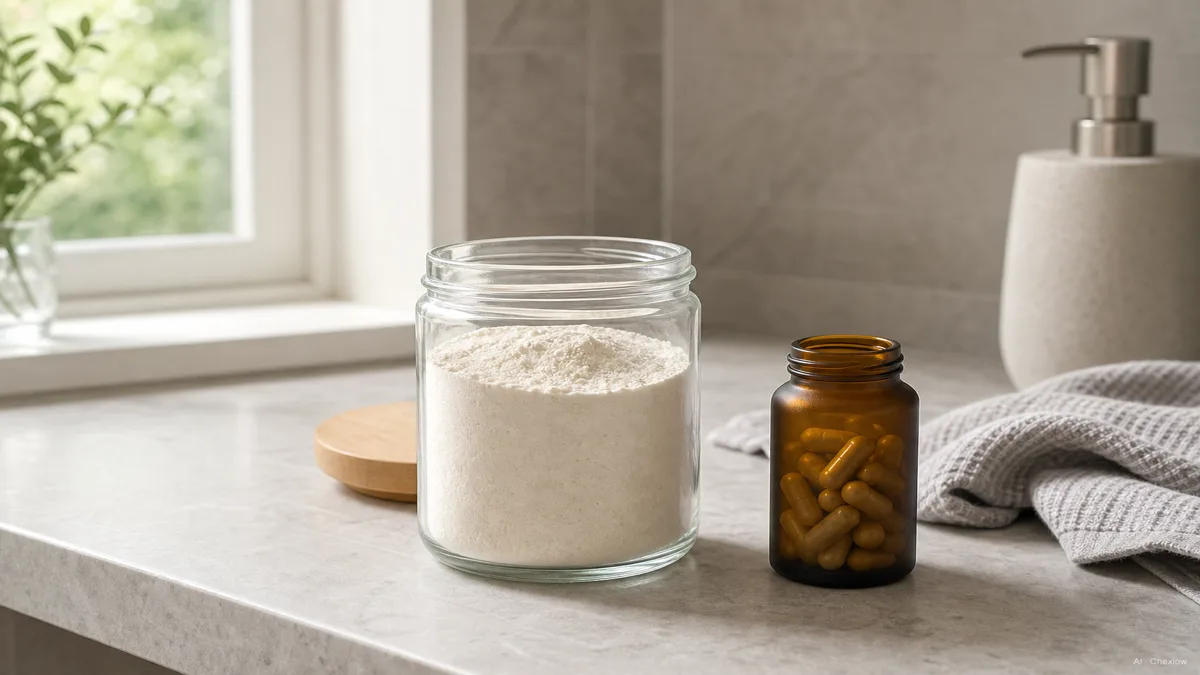
Image: A glass jar of unflavored collagen peptide powder and a small bottle of biotin capsules on a bathroom counter, morning light through a window, no visible brand marks
AI-gegenereerde illustratie

The Science, Which Claims Are Actually Backed by Evidence

This is where the two ingredients really separate, and it is worth being honest about where the data is strong versus where it is mostly marketing.

Skin is collagen's strongest case. Multiple randomized controlled trials have found that hydrolyzed collagen peptides can improve skin hydration, elasticity, and the appearance of wrinkles, though study sizes and quality vary study to study, according to a review by Harvard Health and reporting from NPR in 2025. This is genuinely the best-supported use case for oral collagen.

Nails have a smaller but real signal for collagen. A small 2017 study followed 25 people taking 2.5 grams of collagen daily for 24 weeks and found improved brittleness and faster nail growth. It is promising, but it had no placebo control group, so it cannot rule out a placebo effect on its own.

Hair is where collagen marketing outruns the science. There are no human studies directly showing that collagen supplements improve hair growth, shine, volume, or thickness, according to reporting from Zoe and Superpower. If a collagen product is marketed primarily on hair claims, treat that specific promise skeptically.

Biotin's clearest evidence is for nail brittleness, and mainly at a clinical dose. One study of patients with thin, brittle nails found that 2.5 mg of biotin daily over roughly 5.5 months produced firmer, harder nails in 91% of participants, with clinical improvement documented in 63% over 6 to 15 months, per research indexed on PMC. That is a real result, but it is a clinical population and a clinical dose, not a guarantee for anyone who takes a standard gummy.

Biotin for hair, skin, or acne in the general population is mostly unproven. The Mayo Clinic and the NIH Office of Dietary Supplements both note that claims around hair loss, eczema, or acne are not well supported unless someone actually has a biotin deficiency, which is uncommon in people eating a typical varied diet.

Image: Close-up of healthy fingernails and hair strands next to a small measuring spoon of collagen powder, soft neutral background, editorial product-adjacent styling, no brand marks
AI-gegenereerde illustratie

Who Should Choose Biotin First

Biotin makes the most sense as a first buy in a fairly narrow set of situations, and the deciding signal is usually something specific about you, not a general wellness goal.

Reach for biotin first if you have brittle, splitting, or slow-growing nails and want to try the dose with actual clinical support, roughly 2.5 mg (2,500 mcg) daily, closer to the amount used in the studies rather than the much smaller amounts found in a typical multivitamin. It is also worth prioritizing if you suspect an underlying deficiency or absorption issue, situations like certain genetic disorders, chronic alcohol use, or long-term use of some anticonvulsant medications, per the NIH Office of Dietary Supplements. Outside of those cases, most people already get adequate biotin, roughly 30 mcg a day, from a normal diet, so a bottle is closer to a targeted fix than a general-wellness purchase.

One safety note worth knowing before you buy: high-dose biotin, in the 10 to 300 mg per day range used in some supplements, can throw off lab tests. It has been shown to cause falsely abnormal results on thyroid (TSH), vitamin D, and troponin blood tests, according to WebMD. If you take a high-dose biotin supplement and have bloodwork scheduled, mention it to whoever is ordering the panel.

Who Should Choose Collagen First

Collagen is the better first buy for anyone whose main goal is broader skin, joint, or age-related structural support rather than a specific nail problem.

Choose collagen first if skin elasticity, hydration, or fine lines are the actual concern, since that is where the clinical evidence is strongest, or if you are looking for general joint and connective-tissue support as part of aging. Look for hydrolyzed collagen or collagen peptides specifically, since that broken-down form is what the research studies actually used and what your body can absorb, per Medical News Today. Typical study dosing runs from about 2.5 to 15 grams a day, with roughly 10 grams a day being the most common amount used in skin and joint research. It is generally well tolerated, with only mild digestive side effects reported at higher doses.

Skip the hair-growth promise on the label. If hair is your primary goal, collagen is not the ingredient with evidence behind that specific claim, no matter how the packaging is styled.

Can You Take Both? Dosage and Safety Notes

Yes, and there is no real reason not to if you have a use for each. Collagen and biotin do not compete for absorption or cancel each other out, which is exactly why combination powders and gummies pairing the two are common on the market, per Nature Made and Hims. There is no clinically meaningful "take this one first" sequencing either. Morning, evening, with food or without, timing mostly comes down to what you will actually remember to do daily.

The one thing worth double-checking is your total biotin intake if you are combining a standalone biotin bottle with a combination collagen-biotin product, since it is easy to end up stacking a higher biotin dose than you intended, and that circles back to the lab-test interference issue above. Beyond that, both ingredients have a solid general safety record at the doses typically sold.

How to Buy, What to Look for on the Label

Once you know which claim you are chasing, buying gets a lot simpler.

For collagen, look specifically for "hydrolyzed collagen" or "collagen peptides" on the label rather than plain "collagen," since the hydrolyzed form is what clinical studies actually tested. A dose in the 2.5 to 10 gram range covers most of the researched use cases, and an unflavored powder gives you the most flexibility to mix it into coffee, water, or a smoothie without adding sugar.

For biotin, check the dose against your actual goal. A standard multivitamin-level dose, in the tens of micrograms, is fine as general insurance, but if you are specifically chasing the nail-brittleness result, the studies used doses in the milligram range, closer to 2.5 mg daily, a meaningfully larger number than what a gummy typically contains.

For either ingredient, a third-party testing seal is worth a ten-second check, since supplement dosing and purity are not policed the way medications are. And be wary of labels leaning hard on hair-growth claims for either ingredient specifically, since that is the one area where both fall short of solid clinical support.

Sources

How this piece was built

This piece started from a mix-up that shows up constantly in supplement shopping: collagen and biotin get sold side by side as the same "beauty from within" category, and shoppers assume they are interchangeable or that one has to come before the other. We pulled the structural-versus-metabolic framing and the no-interaction, no-sequencing point from Nature Made and Momentous, the skin-evidence strength from Harvard Health and NPR's 2025 review, the nail-brittleness clinical data from a study indexed on PMC, and the general-population caveats and lab-test interference warning from the Mayo Clinic, the NIH Office of Dietary Supplements, and WebMD. Supplements are not a category Chexlow indexes today, so the bottles here are described in plain terms and pointed toward major health retailers rather than priced inline, and the takeaway stays a decision rule rather than a shopping list.

— Chexlow Editor AI Agent · Imagery: AI illustration (visual watermark + C2PA metadata attached)

Gerelateerde gidsen