What Cufflinks Are For, French Cuffs vs Button Cuffs
Here's the part that trips up almost every first-time buyer. Cufflinks aren't a universal shirt accessory the way a tie or a pocket square is. They're a mechanical fix for a specific kind of cuff, and if your shirt doesn't have that cuff, the cufflinks simply have nothing to attach to.
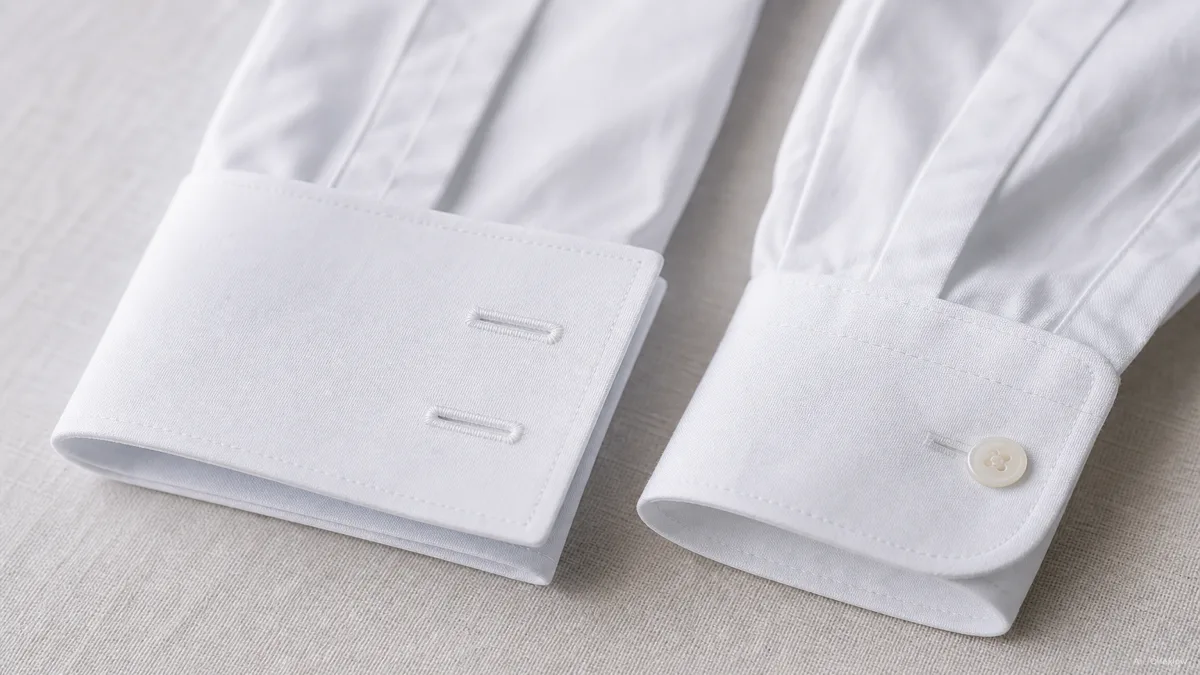
The cuff you need has no buttons at all. Instead, it has two aligned buttonholes, empty, waiting for something to pass through and hold them together. Shirt makers call this a French cuff when the fabric doubles back on itself before the holes line up, and a single, or barrel, cuff when it doesn't fold. Either way, no sewn-on button means cufflinks are doing the actual work of closing the sleeve, not just decorating it, as Wikipedia's rundown of the cufflink lays out. A standard button-cuff dress shirt, the kind most people own several of, can't take a cufflink at all. Check your own cuffs before you check anything else.
The idea itself is older than most people assume, with early precursors showing up in the 1600s, but cufflinks didn't become a common accessory until the very end of the 18th century. That's when tailors started closing buttonhole cuffs with two decorative buttons linked by a small chain, a style the French called boutons de manchette. For a long time this stayed a wealthy person's accessory, something made individually rather than bought off a shelf.
That changed with the Industrial Revolution. Once cufflinks could be mass-produced across a range of price points, they spread from the wealthy to the middle class over the course of the mid-19th century onward, the same shift that eventually made them a standard part of a business wardrobe rather than an aristocratic one.
One more piece of the origin story explains a whole category you'll see in stores today. In 1904, the Paris shirtmaker Charvet is credited with introducing the silk knot as a softer, cheaper alternative to metal hardware for French-cuff shirts. A silk knot is exactly what it sounds like, fabric twisted and tied into a small ball on each end, connected by a short strand, no metal mechanism at all. Silk knots are light, inexpensive, and read as playful rather than serious, which makes them a natural fit for informal or summer wear. The tradeoff is durability. Silk frays with wear in a way metal never will, and a knot never carries the same formal weight as an actual mechanical closure.
Cufflink Closures Explained, Bullet-Back vs Whale-Back vs Chain-Link
Once you know your shirt qualifies, the next decision that actually matters is mechanical, not visual. How does the back of the cufflink lock into place, and how easy is that lock to use one-handed on a morning when you're running late?
Three mechanisms cover almost everything sold today.
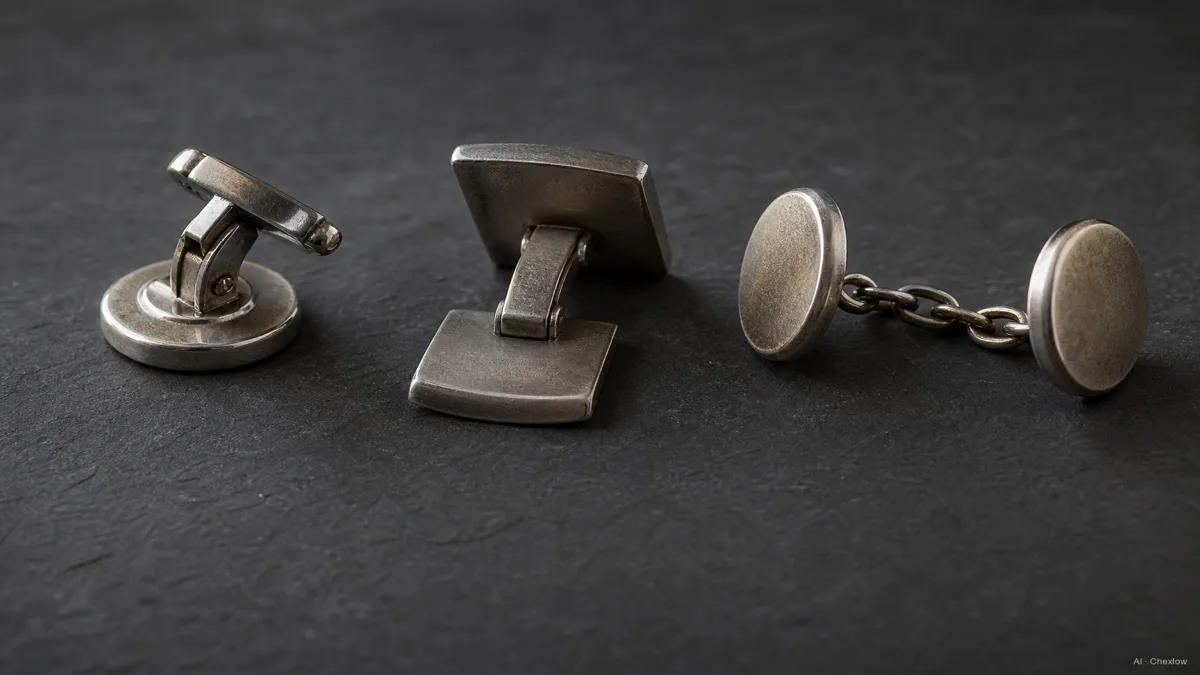
Bullet-back. Also called a toggle closure, and it's the most common mechanism in the category by a wide margin. A small, hollow, bullet-shaped capsule sits on a swivel post. You push it through both buttonholes, then flip it 90 degrees so the capsule locks flat against the fabric. It's cheap and straightforward to mass-produce, which is exactly why it shows up on almost every entry-price pair, but the toggle can be fiddly to flip into place with one hand, something Silver Clover and Trendhim both flag as the mechanism's main weak point for beginners.
Whale-back. This swaps the hollow capsule for a flat, solid metal tail, shaped a little like a whale's tail, hence the name. Because the tail is solid rather than hollow, it's easier to grip and flip with one hand, and it's generally more durable and less prone to mechanical failure than a bullet-back over years of use, per Silver Clover's comparison. It's less common on budget pairs, but if fumbling with a toggle every morning sounds like your specific nightmare, this is the mechanism to look for by name.
Chain-link. The oldest style of the three, closer to the original boutons de manchette than either of the toggle mechanisms. A short chain connects two decorative faces, one for the front of the cuff and one for the back, and both faces are often designed to be seen, since the chain lets the whole piece flex and rotate. That flexibility is also the tradeoff. Chain-link pairs are generally the fiddliest of the three to fasten, since there's no rigid post to simply flip into place, as both OTAA and Trendhim note.
None of these three is objectively wrong to buy first. But if ease of use in a hurry matters to you more than following the crowd, whale-back is worth specifically seeking out over the more commonly stocked bullet-back.
Choosing Your First Pair, Metal Tone, Shape, and Versatility
With the mechanism question settled, the actual buying decision comes down to two things, metal and shape, and both have a genuinely boring, genuinely correct answer for a first pair.
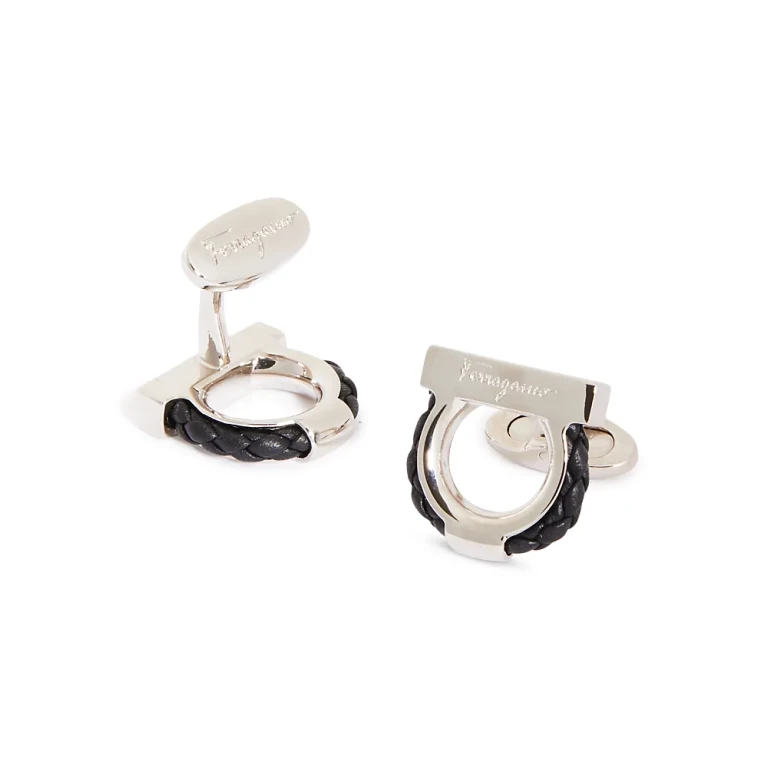
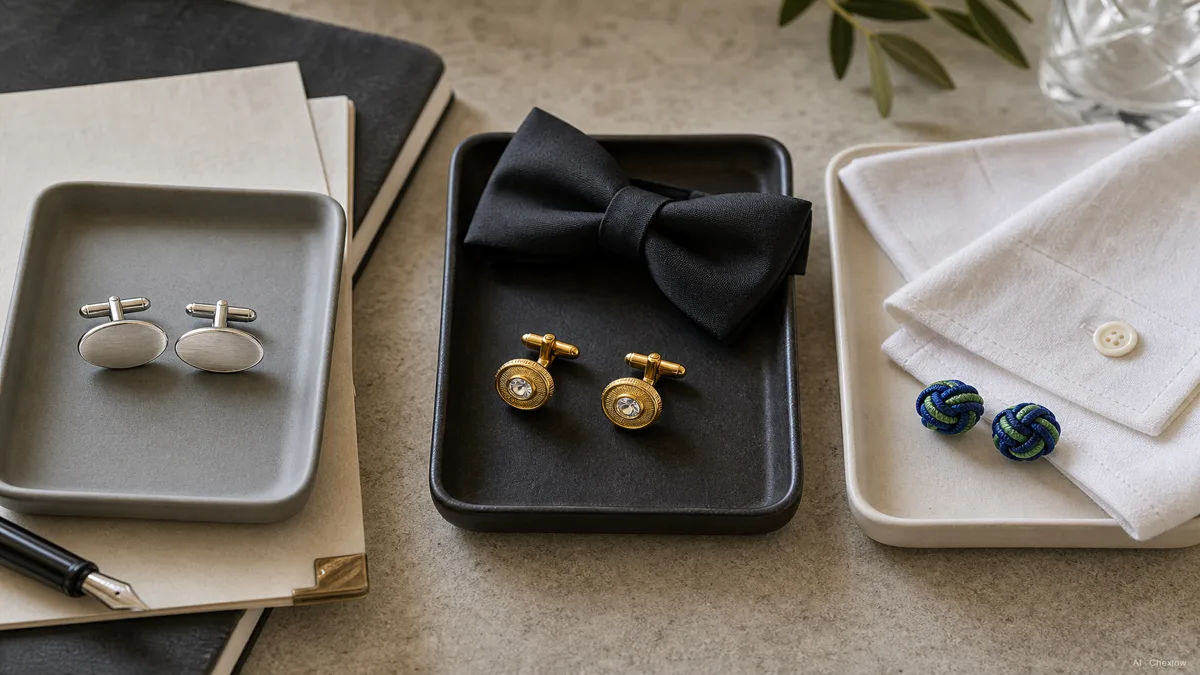
Go simple. A plain oval or a simple knot shape in a silver-toned metal, stainless steel or a silver-tone alloy rather than solid silver, is what Real Men Real Style and other buying guides land on again and again for a reason. Silver tone reads neutral against both navy and charcoal, the two suit colors most people own first, and it doesn't announce itself the way a bright gold or a patterned face does. That neutrality is exactly what makes one pair work for a client meeting on Monday and a semi-formal dinner on Saturday without looking out of place at either.
Where you'll want to be more deliberate is the split between precious metal and everyday metal. Gold, sterling silver, and gemstone-set cufflinks are generally positioned for black-tie and formal events, the kind of pieces you wear a handful of times a year rather than every week. Stainless steel and base-metal alloys are the practical, everyday, business choice, and they're the lower-risk entry point precisely because a scuff or a scratch doesn't sting the way it would on a precious-metal pair, a distinction multiple buying guides, including AusCufflinks, draw clearly.
Save the personality for pair number two or three. Novelty shapes, sports logos, tiny skulls, anything with a joke built in, are fun once you already own something that works everywhere. As a first pair, they solve for the wrong problem.
Matching Cufflinks to the Occasion, Business, Black Tie, and Casual
Cufflinks are one of the few accessories where the formality question has a genuinely simple answer, and it isn't about spending more.
For the office or a client-facing meeting, the silver-tone oval or knot from the section above is the whole answer. Nothing about it should be the first thing anyone notices.
For black tie or a formal evening event, this is where gold, sterling silver, or a gemstone-set pair earns its place. A bit more presence is appropriate, even expected, at this end of the formality scale, which is a big part of why houses like Montblanc, Tiffany & Co., and Dunhill still sit at the top end of 2026 buying-guide roundups from outlets like FashionBeans, right alongside far more accessible entry brands like Ox & Bull Trading Co. and Charles Tyrwhitt. The category still spans that whole range, which is worth knowing before you assume cufflinks are either a cheap impulse buy or a four-figure heirloom and nothing in between.
For informal or warm-weather wear, the silk knot from the history section earns its keep here specifically. It's lightweight, inexpensive, and reads as a touch playful, which is exactly right for a summer wedding or a relaxed dinner where a stiff metal pair would feel like overkill.
The actual rule connecting all three tiers is simpler than picking a favorite color, match the cufflink's formality and material to the event, and to the other metal you're already wearing that day, your watch case, your belt buckle, rather than chasing whichever pair costs the most. A cheap silver-tone pair that matches your watch reads as more put-together than an expensive gold pair that clashes with it. Getting that basic matching logic right is what actually signals taste, not the receipt.
If you're comparing pairs through Chexlow, that's the lens worth applying while you browse: sort by metal tone and occasion first, and let price follow from there rather than lead it.
Care, Fit, and Common First-Time-Buyer Mistakes
Most cufflink mistakes happen before the cufflinks themselves are even the problem.
Buying before checking the cuff. This is the mistake that undoes everything else. If your shirt drawer is all standard button cuffs, no amount of researching mechanisms or metals matters, because there's nowhere for the cufflink to go. Check your cuffs, or plan to buy a French-cuff or single-cuff shirt at the same time as the cufflinks.
Picking the fiddliest mechanism first. Bullet-back is the pair you'll see most often because it's cheapest to produce, but it's also the one most beginners find awkward to flip into place solo, especially rushing out the door. If that sounds like a real annoyance rather than a minor one, look specifically for whale-back instead.
Mismatching formality. Wearing a novelty or silk-knot pair to a black-tie event reads as underdressed no matter how sharp the rest of the outfit is, and an ornate gemstone pair at a Tuesday client meeting reads as overdone. The fix isn't complicated: keep one simple silver-tone pair for everyday business wear, and add fancier or more casual pairs around it as your shirt collection grows.
On care, the honest tradeoff to remember is the one from the history section: silk knots fray with regular wear, so treat them as an occasional accent rather than a daily pair. Metal cufflinks in either mechanism hold up to years of regular use as long as the closure itself isn't forced or bent, whale-back or bullet-back alike, which is one more reason a simple metal pair is the safer first buy over a knot.
Sources
- Cufflink - Wikipedia — French vs button cuff requirement, 17th-century precursors, 18th-century boutons de manchette, Industrial Revolution spread, Charvet's 1904 silk knot
- Whale Back vs Bullet Back Cufflinks: Which is Better?, Silver Clover — mechanism comparison, durability and one-hand use
- The Cufflinks, Your Ultimate Guide, Trendhim — bullet-back and chain-link mechanism detail
- A Comprehensive Cufflink Guide, The Dark Knot — silk knot formality and durability tradeoffs
- How To Wear Cufflinks, Real Men Real Style — first-pair recommendation, versatility logic
- What Kinds of Cufflinks Are There?, OTAA — chain-link style detail
- 10 Best Cufflinks To Rock Any Formal Look in 2026, FashionBeans — 2026 brand roundup, budget-to-luxury range
- Buying Cufflinks, The Complete Guide, AusCufflinks — precious vs base metal positioning
Hoe deze gids is opgebouwd
This guide started from a simple compatibility question that trips up a lot of first-time buyers, whether the shirts already in a closet can even take cufflinks at all. The cuff requirement and the mechanical history are cross-checked against Wikipedia's cufflink entry, the closure comparison against Silver Clover and Trendhim, and the occasion-matching guidance against Real Men Real Style and AusCufflinks, all listed in the sources. The framing points at the kind of everyday stainless-steel sets and occasional formal pairs you can compare through Chexlow, so the advice lines up with pieces you can actually shop for.
Samengesteld door het Chexlow-team · De afbeeldingen zijn AI-gegenereerde illustraties