
Measure the space your dog will actually use
Start with your dog resting naturally, not a breed-weight chart. Bedsure's measuring guide uses nose to tail base, then adds 6–12 inches (about 15–30 cm) as a starting allowance.
Before ordering, check the whole resting footprint, including outstretched legs, against the inner sleeping area. Don't stop at shoulder width. Also measure the floor space where the bed will go.
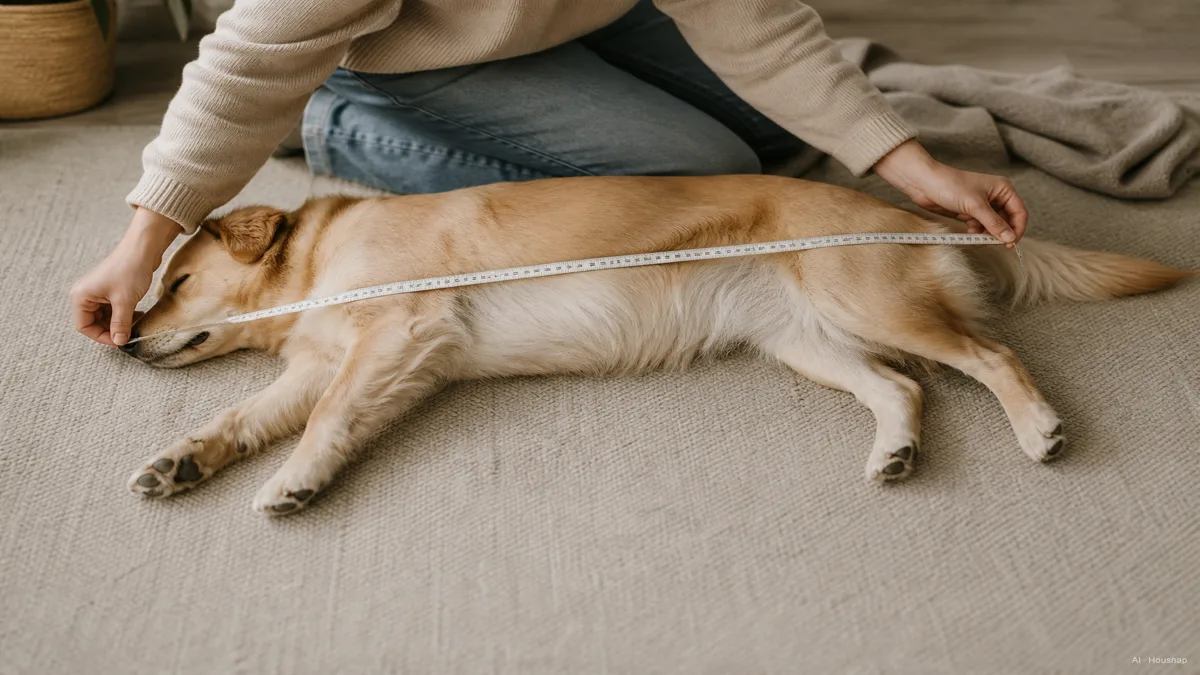
A listing's overall width may include the raised cushions. Casper's specifications, for example, distinguish outside dimensions from sleeping space. If a seller only gives the outside measurement, ask for the inside length and width before picking a size.
Putting the bed inside a crate? Check the fit with the bedding installed: CARE says the dog should still be able to stand, move and stretch. Use the crate sizing guide if you're choosing the crate too.
Choose a shape, then check the way in
Watch several resting positions before deciding that your dog is a “curler” or a “sprawler.” RSPCA guidance pairs flat mattresses with stretching out and sided beds with curling up, while still allowing room for both.
- Mostly stretched out: start your shortlist with a flat mattress.
- Likes leaning against an edge: compare bolster beds, whose raised cushions surround part or all of the sleeping area.
- Does both: look for a generous flat centre with a lower or open entrance.

For a dog with limited mobility, make easy entry a condition of purchase, as the RSPCA advises. Compare the lowest entrance height, not just the tallest rim. Don't choose a deep donut solely because its name promises calm.
Read the foam construction behind the label
Memory foam is a material; orthopedic describes intended support. They aren't competing categories, as Casper's explainer makes clear. Its own dog bed combines memory foam with support foam.
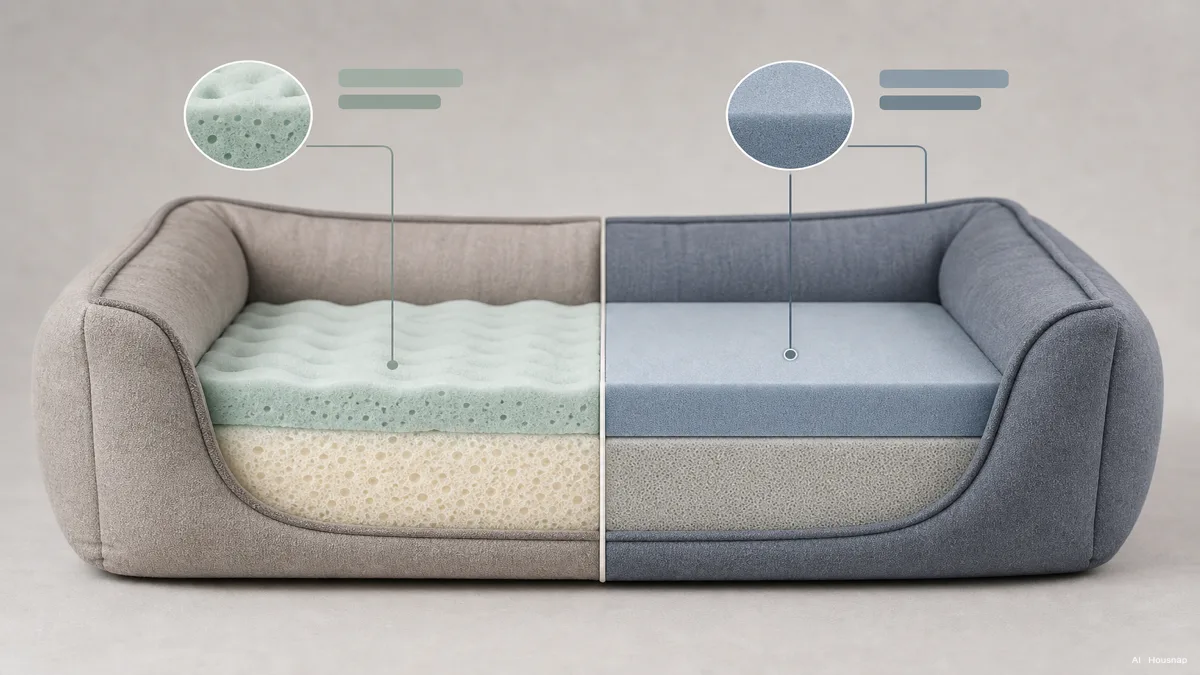
Read this illustration as a comparison of layers, not two exclusive bed types or proof of a medical benefit.
On each candidate, look for the filling material, base thickness and the maker's weight guidance. If the description only says “premium orthopedic,” ask what is inside. Don't infer the base thickness from the total height of a bolstered bed.
For joint problems, CARE recommends supportive bedding and non-slip flooring around it. Include the approach to the bed in your decision. If lying down or standing up appears painful, discuss it with your vet rather than treating a new mattress as the whole solution.
Check cleaning and chewing before you buy
A washable cover and a washable bed are different promises. Casper's care instructions allow washing the cover but do not recommend washing the foam inserts. Read the instructions for the exact bed you're considering.
If toilet accidents are likely, ask what protects the filling and how that layer can be cleaned. For a growing puppy, favour clear dimensions and a manageable cleaning routine over a promise that one purchase will last into adulthood.
When heat and chewing change the shortlist
For a dog that seeks cooler resting places, consider an open or raised design, then check the actual fabric. Kuranda's mesh allows airflow but is not suitable for dogs that dig, scratch or chew. That limitation belongs to that fabric; it isn't a rule for every raised bed.
For a determined chewer, inspect the edges and fastening design as well as the material name. Kuranda encloses fabric edges inside its frame, an example of construction that addresses access to the fabric. Don't treat “ripstop” or a hidden zipper alone as a guarantee against destruction.
Make the final choice
- Ready to compare: keep beds that meet your measured sleeping space, entrance needs and cleaning requirements; compare price only within that shortlist.
- Ask the seller first: pause if inner dimensions, filling or washing instructions are missing.
- After delivery: check that your dog can settle, change position and get up comfortably. Before allowing use, read the seller's return conditions so you know what inspection or trial is permitted.
Sources
- Bedsure: measuring a dog for a bed
- RSPCA: bed size, shape and access
- Casper: memory foam and orthopedic terminology
- Casper: dog bed construction and dimensions
- Casper: cover and foam care
- Kuranda: fabric choices and limitations
- Kuranda: protected fabric edges
- CARE: bedding for dogs with arthritis
Hoe deze gids is opgebouwd
AI wrote this guide for Chexlow using RSPCA and CARE guidance alongside manufacturer sizing, construction and care information from Bedsure, Casper and Kuranda. The buying checklist is an editorial synthesis for a first bed purchase, not a product test or a veterinary assessment.
Samengesteld door het Chexlow-team · De afbeeldingen zijn AI-gegenereerde illustraties