Find the routine for your exact machine
Start with the model number and its steam-wand care instructions. Look for three things: how to finish steaming, how to trigger the purge or rinse, and which parts the owner may clean or remove. A purge is a brief discharge through the wand; its controls and timing belong to the particular machine.
Breville’s general maintenance guidance calls for wiping immediately after texturing milk and purging according to the machine’s instructions. That is a useful starting point, but it does not establish one button sequence for every espresso machine.
This guide covers an attached steam wand and manufacturer-permitted user care. If your machine has a separate milk container or another frothing attachment, find that component’s instructions before applying the same routine.
Wipe the outside and complete the purge
Have a clean, soft damp cloth ready before steaming. Reuse a suitable cloth you already own; a dedicated barista cleaning cloth is only a possible replacement if you need one. Finish steaming as instructed before wiping, keep bare fingers off hot metal, and keep hands and the cloth away from the outlet during any discharge.
Wiping the outside and clearing the inside are separate jobs. For the DeLonghi Dedica Maestro Plus EC950, the manufacturer’s after-use instructions specify a soft damp cloth and returning the wand to its OFF position after each use to start automatic rinsing. On another model, use its own purge or rinse procedure rather than copying that movement.
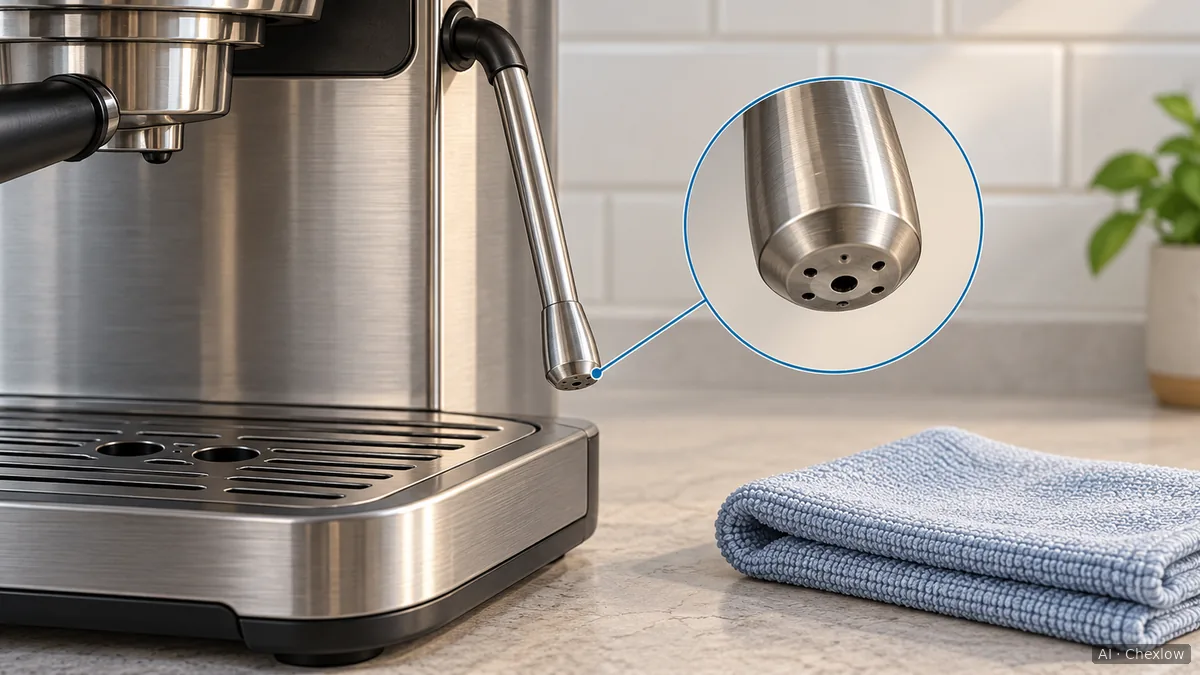
The illustration separates the outer surface from the small outlet holes. It does not show your machine’s controls or an exact replacement tip. Automatic rinsing handles the prescribed internal step; the EC950 instructions still call for wiping milk from the outside.
Clean nozzle holes only after cooling
If residue remains around the outlet or you suspect a blocked hole, move to your model’s nozzle-cleaning instructions. Do not start probing while the wand is hot or discharging. The EC950 guidance specifically requires it to cool enough to handle before using the provided cleaning needle.
The Dedica Maestro EC900 instructions make a useful distinction: wipe after every use, while nozzle-hole cleaning with a cleaning needle is occasional deeper care performed after cooling. That does not create a daily needle-cleaning requirement or a universal weekly schedule.
Use the supplied tool where the instructions specify it. If it is missing, identify the manufacturer’s compatible steam-wand cleaning needle for your exact model before buying; a generic needle listing alone does not establish suitability.
Cleaning the holes is not permission to unscrew the tip. These two FAQs describe hole cleaning, not a tip-removal procedure. Only remove a user-removable tip when your model’s manual explicitly provides that procedure, including its preparation and reassembly steps. If that permission is unclear, leave the tip attached and ask the manufacturer.
Decide whether routine care is enough
After completing the permitted care, follow the manual’s instructions for returning the machine to use. Check whether visible milk residue remains and whether the wand performs its prescribed purge or rinse as expected.
- If the residue is gone and the routine completes normally, return to the after-use wiping and purge routine.
- If residue or a suspected blockage remains, ask support for the next user-care step. Do not escalate to forced tip removal or internal disassembly.
- If you find damage, or cannot establish which parts are user-removable, stop the cleaning attempt and seek manufacturer guidance.
Keep other maintenance separate. Breville distinguishes coffee-path cleaning from descaling; neither process should be substituted for the steam-wand instructions. Before adding a cleaner or soaking a component, obtain an explicit method for your model, including the permitted product and rinse procedure.
Hoe deze gids is opgebouwd
AI wrote this guide for Chexlow using Breville’s maintenance guidance and DeLonghi’s EC950 and EC900 support pages. It separates routine wiping and purging from model-specific nozzle care; it does not report hands-on testing or provide internal repair instructions.
Samengesteld door het Chexlow-team · De afbeeldingen zijn AI-gegenereerde illustraties