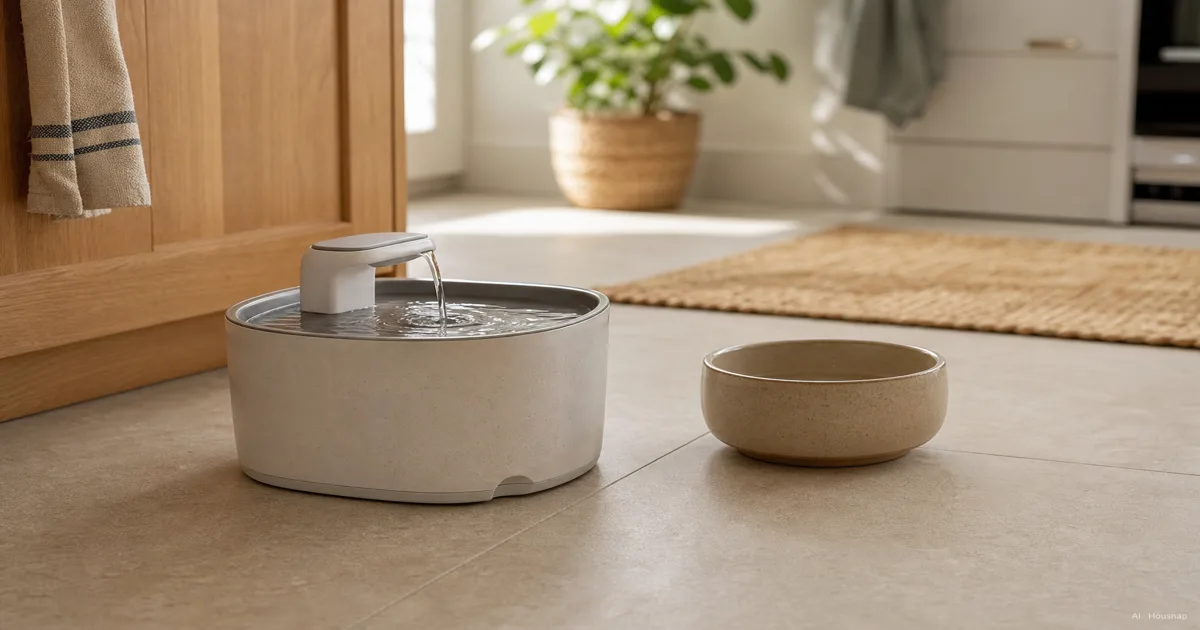
Decide what you want the fountain to change
If your cat already uses a bowl, you do not need to replace it simply to provide moving water. Royal Canin Academy describes individual fountain preferences and notes that food moisture also contributes to fluid intake. (Drinking habits and water intake)
A useful first-buy goal is to offer another drinking option that you can keep clean. If the real question is how meals contribute water, start with choosing between wet and dry cat food.
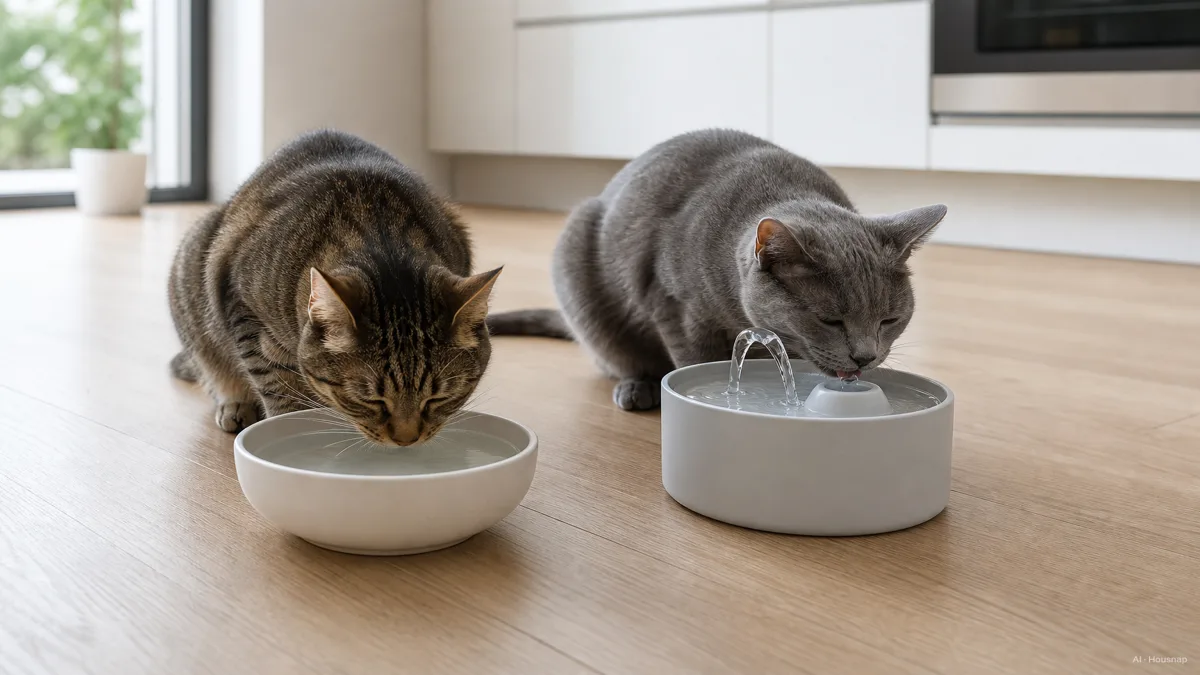
Choose the parts you can actually wash
Before choosing a finish, open the cleaning instructions. Can you reach the reservoir, water channels and pump interior, and put everything back together? Treat that as your first selection test.
- Plastic. The original Catit Flower is plastic. Keep it on the shortlist if its construction suits you; material alone is not a reason to reject it. (Model details)
- Stainless steel. Check what lies underneath the drinking tray. PETLIBRO advises against dishwashing the Dockstream RFID model, whose steel tray assembly includes plastic components. A steel surface does not establish whole-unit dishwasher compatibility. (Cleaning guidance)
- Ceramic. PetSafe lists the Pagoda's non-pump parts as top-rack dishwasher safe; the pump needs separate hand washing. Choose this arrangement only if that remaining work fits your routine. (Pagoda details)
The pump deserves its own check: Catit's Flower cleaning guide calls for disassembly, not just rinsing the outside. If those small parts already look unmanageable, simplify your shortlist. (Pump cleaning)
Match capacity and flow to the place it will live
Compare actual models rather than assuming all small-looking fountains hold little water.
- To try different flows: the original Catit Flower #43742 holds 3 L and offers three flow configurations. It gives you ways to try a stream, bubbling top or gentler flow. (Specifications)
- For more stored water: Drinkwell Platinum holds 168 US fl oz, about 5 L, and has adjustable flow. Check its footprint before choosing the extra capacity. (Specifications)
Do not turn reservoir size into a promise of days without attention. Check the model's minimum water level and power requirements, and arrange another drinking source for interruptions. An open bowl can help: Pagoda retains access to water when power stops. (Open-bowl design)
For a quiet room, look beyond the material label. Catit's stainless Flower manual directs owners with pump noise to clean the pump and restore the water level. Judge the sound after correct setup, then decide whether that location works. (Noise guidance)
Check replacement filters before paying for the fountain
Find the filter that explicitly names your chosen model. For example, Pagoda specifies carbon filter PAC00-13906 and foam filter PAC00-13711; a similar-looking cartridge is not proof of compatibility. (Compatible parts)
Carbon and foam do different jobs: Pagoda's manual assigns taste and odor reduction to carbon, and hair/debris capture to foam. Filter replacement still leaves the bowl and pump to clean. (Filter functions)
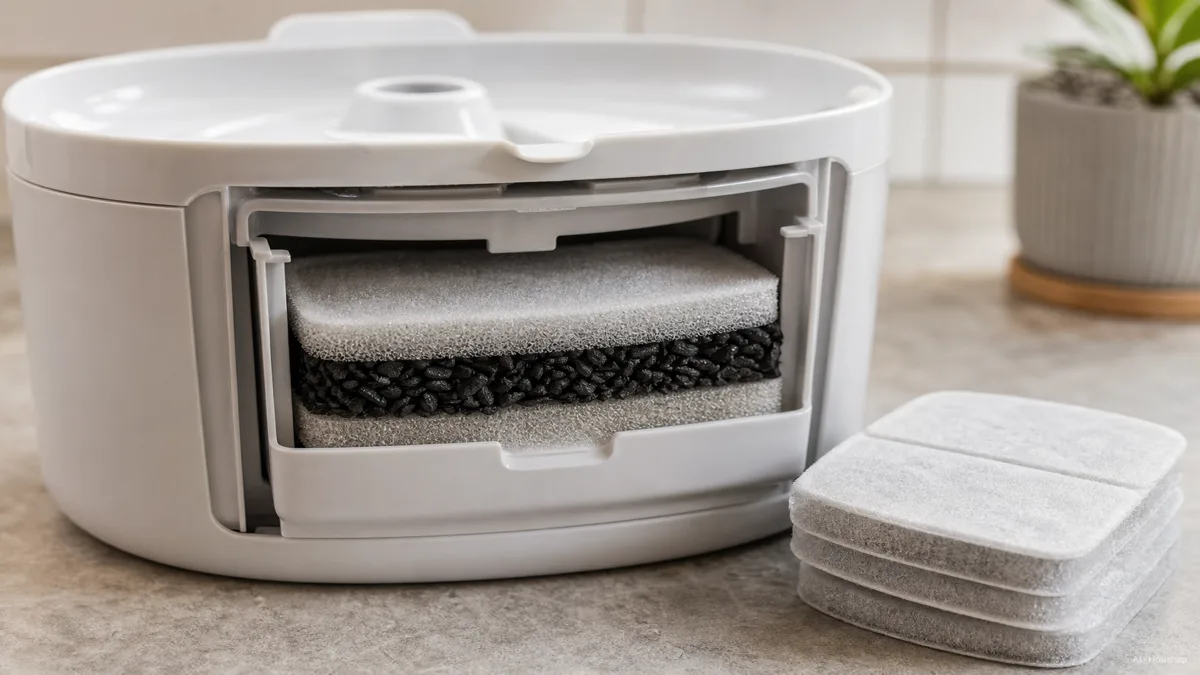
For each filter type, divide the pack price by its filter count and multiply by the expected annual number used under that model's instructions. Add the totals; buying whole packs may require more cash upfront. Compare this alongside the fountain price.
Use the model's replacement instructions, not a universal monthly assumption. Catit's stainless Flower manual also calls for replacement when debris saturates the filter or flow is obstructed. Keep room in the budget for condition-based changes. (Filter guidance)
Introduce it without taking away the familiar bowl
Keep another water source available and let your cat approach voluntarily. Catit recommends starting with the fountain off for a wary cat, then switching on when the cat is not beside it. (Introduction guide)
For an open-bowl model such as Pagoda, PetSafe also suggests letting a cautious pet drink from it unplugged first. Follow the model's setup instructions before running the pump. (Pagoda introduction)
Your decision at the end is practical: does your cat use it, and can you sustain the cleaning? If either answer is no, keeping the familiar bowl is a reasonable outcome. Do not remove that option to force acceptance.
Hoe deze gids is opgebouwd
This guide was written by Chexlow's AI editor using Royal Canin Academy's drinking-behavior overview and Catit, PetSafe and PETLIBRO documentation. The editorial scope covers drinking options, cleaning access and compatible consumables. It is a document-based buying guide, not a hands-on product test.
Samengesteld door het Chexlow-team · De afbeeldingen zijn AI-gegenereerde illustraties