


Check your scalp and lengths separately
Before shopping, write down two things: what bothers your scalp between washes, and what bothers the lengths after drying. “Oily roots, tangled ends” is a more useful shopping brief than choosing between oily hair and dry hair.
Flakes do not automatically mean a dry scalp. Dandruff can also accompany oily skin; severe or persistent dandruff deserves dermatology advice. A dandruff shampoo has its own directions, including how long to leave it on. Do not treat it as interchangeable with an ordinary cleansing shampoo. AAD dandruff guidance
Narrow the shelf to one starting formula
DermNet distinguishes everyday, oily-hair, dry-hair, and deep-cleansing formulas. Use those purposes to make a shortlist:
- Oily roots. Compare ordinary oily-hair formulas with less conditioning. If you wash frequently, also consider a mild everyday shampoo.
- Dry lengths, curls, or chemically treated hair. Look for a gentle, conditioning formula intended for your hair’s needs.
- Fine hair. Do not assume fine means oily. Choose the cleansing category from your scalp observations, then compare the finish.
- Oily roots with dry ends. Choose the cleanser for the roots and plan separate conditioning for the lengths.
Clarifying means deep cleansing. Keep it as a candidate for buildup, rather than automatically choosing it as your everyday first bottle. Follow the product’s directions.
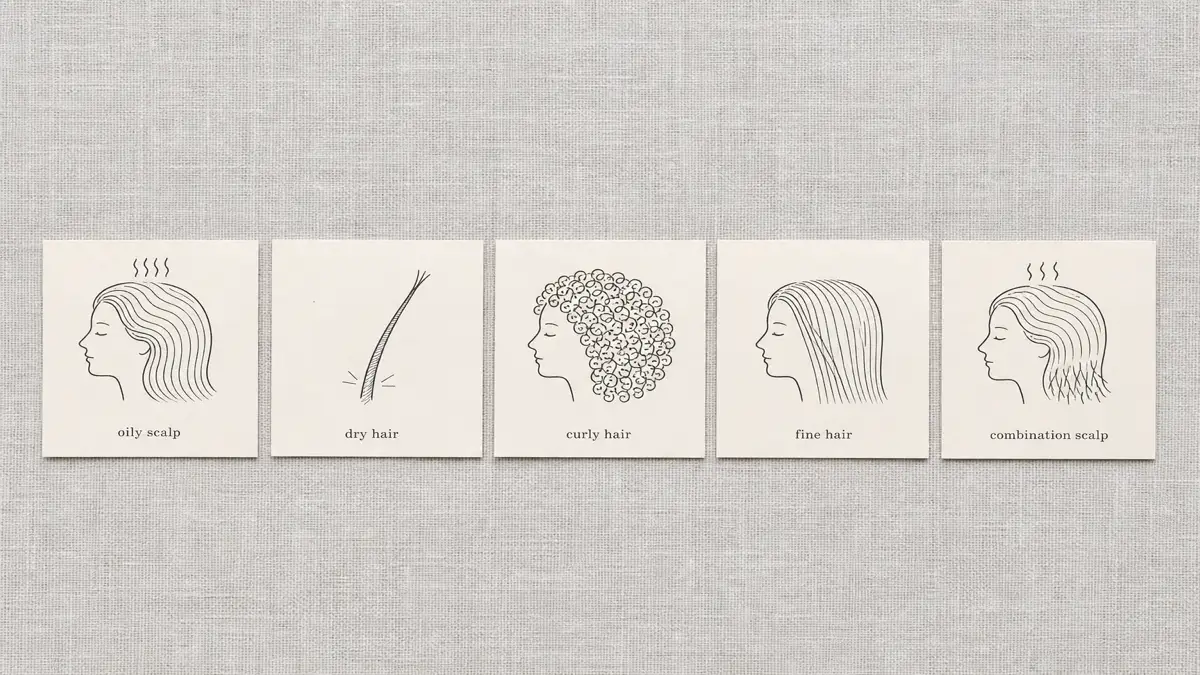
The five illustrated profiles can overlap; they are shopping prompts, not diagnoses.
Use the label to compare, not to declare a winner
“Sulfate-free” is one filter, not a complete assessment of a formula. Research describes several factors affecting the result, including cleanser concentration, conditioning ingredients, and pH. The same paper says further research is needed to establish the best pH range. Shampoo formulation and pH research
The practical decision is to compare bottles intended for the same job. Check the intended hair type and usage instructions before paying more for a single free-from claim. If your current shampoo is comfortable and cleans adequately, that claim alone is not a reason to replace it.

Give conditioner its own job
Focus shampoo on your scalp. After rinsing, use conditioner on the ends of fine or straight hair, or through the lengths of dry or curly hair. This follows AAD hair-care guidance.
A rinse-out conditioner belongs here as a companion to cleansing. If you already have one that suits you, keep it while trying the new shampoo. If you are deciding between a regular conditioner and an intensive product, compare conditioner and treatment before adding another bottle.
Judge the result and choose your next move
For the first purchase, choose a manageable bottle size and avoid changing several products together. After each wash, note scalp comfort, remaining greasiness, and how the lengths feel. This is a practical comparison method, not a prescribed adjustment period.
- Comfortable scalp and acceptable finish. Keep the formula; there is no need to keep upgrading.
- Clean roots but disappointing ends. Revisit conditioning before buying a stronger cleanser.
- New itching or a rash. Stop using the suspected product. Rinse thoroughly, and seek dermatology advice if the cause is unclear. Do not push through a reaction as “adjustment.” AAD guidance on itchy scalps
Need a temporary refresh between washes? Dry shampoo absorbs oil but does not replace washing with shampoo and water. AAD explains the distinction. Explore whether dry shampoo fits your routine only after choosing your regular cleanser.
Sources
Hoe deze gids is opgebouwd
AI wrote this guide for Chexlow using American Academy of Dermatology guidance, DermNet’s shampoo overview, and published research on shampoo formulation and pH. The editorial scope is choosing and assessing an everyday shampoo, with scalp symptoms kept separate from cosmetic preferences. It does not report product testing or a new human review.
Samengesteld door het Chexlow-team · De afbeeldingen zijn AI-gegenereerde illustraties