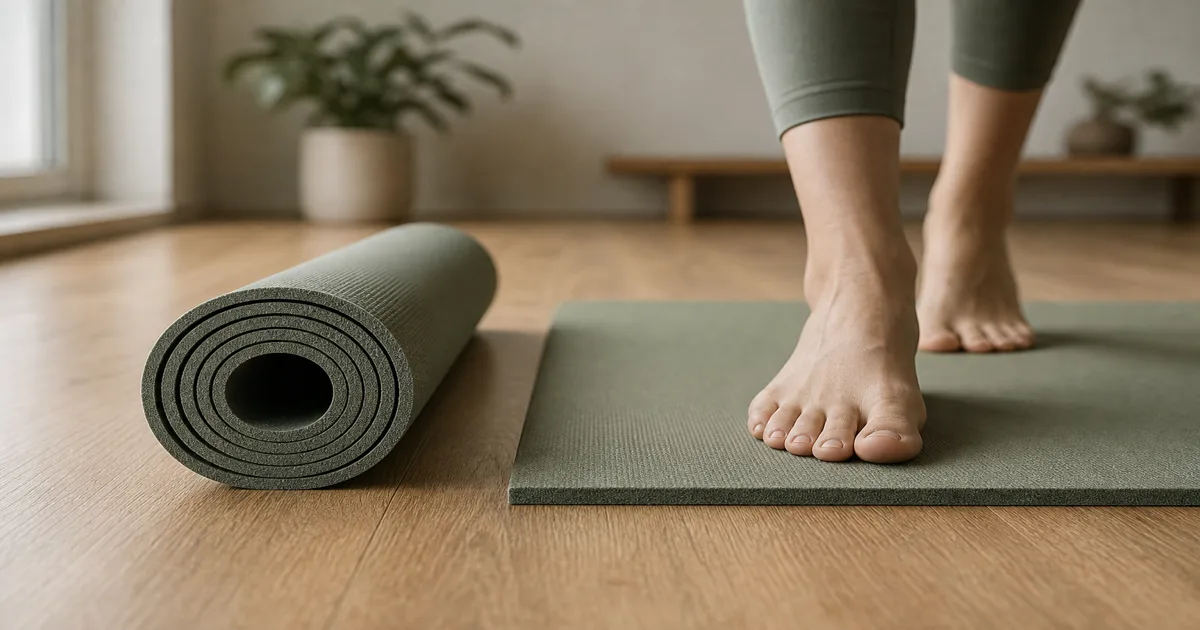
Most people buy their first yoga mat the same way. They search, sort by price, see that the 6mm version costs about the same as the 4mm, and grab the thicker one because more cushion sounds like a kindness to the knees. Then the first balancing pose arrives and the mat wobbles, the foot sinks, and the whole thing feels less stable than the bare floor would have been.
Thicker is not automatically better. Getting the first mat right is mostly about matching two specs to how you actually move.
What thickness should a first-time buyer choose?
Thickness is the number everyone fixates on, and it is worth understanding before you let it decide for you.
The industry standard sits at 4mm. It gives your knees and wrists enough padding for kneeling and plank work, without lifting you so far off the ground that balance poses get shaky (Yoga Design Lab). For a first mat, 4mm is the safe default and the one most studios hand you.
Here is the quick breakdown by millimetre.
3mm. Firm, stable, close to the floor. Great for standing and balancing work, but thin enough that sensitive knees will feel a hard floor underneath.
4mm. The all-rounder. Enough cushion for joints, enough firmness for balance. If you are not sure, this is the one.
5mm. A touch more give for the knees while staying stable. Yoga Journal's 2026 guide names a 5mm mat as its best budget pick, which tells you this range is very liveable (Yoga Journal).
6mm. Noticeably cushioned, kinder to cranky joints, but you start to feel the trade-off in standing poses. Going thicker than 6mm can cause real wobble in Tree Pose and Warrior III (Yune Yoga).
The bigger thing nobody tells beginners: density matters more than the millimetre count. A dense natural-rubber mat at 4mm protects your joints and holds you steadier than a cheap foam mat at 8mm. Low-density mats "bottom out" under the knee even when the label says 6mm, meaning your knee compresses the foam all the way to the floor (HTS Yoga). So a thin, dense mat can out-cushion a thick, soft one. Read density, not just thickness.
Practice style nudges the number too. For flowing Vinyasa or Ashtanga, 4 to 6mm keeps the stability you need for transitions and arm balances. For Yin or restorative work, where you hold floor poses for minutes at a time, 8 to 10mm earns its keep (Yune Yoga). For a first general-purpose mat, you are almost certainly in the 4 to 5mm window.
TPE vs PU — what the materials actually mean for grip, durability, and cleaning
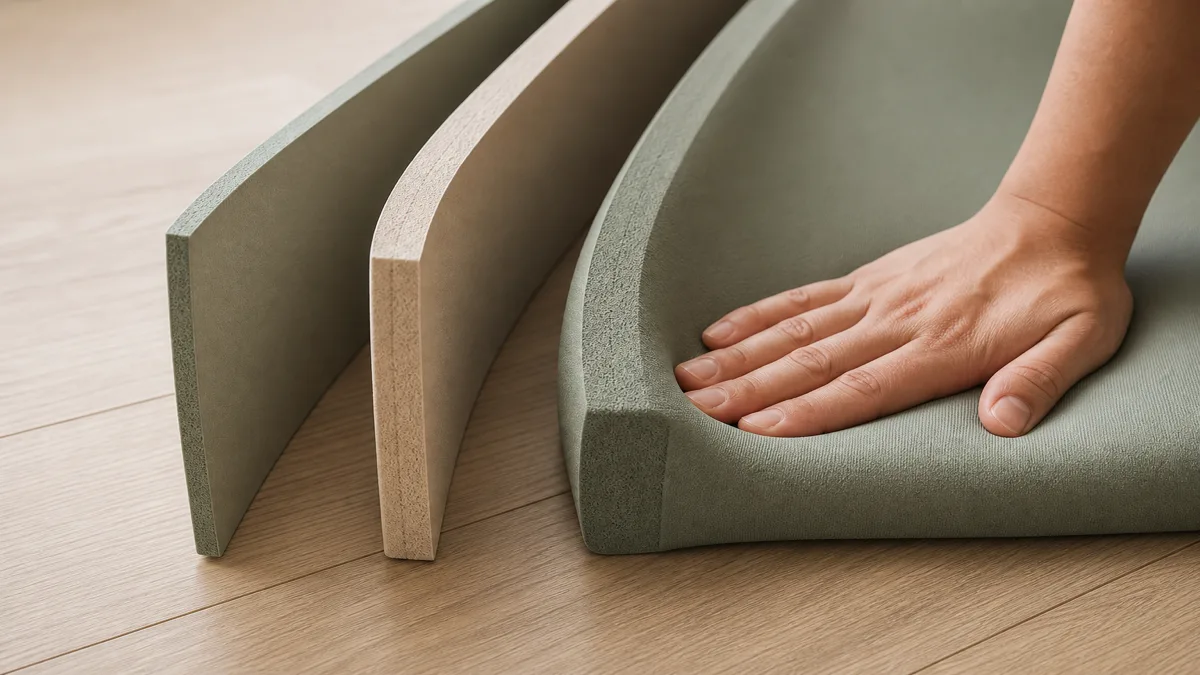
Thickness is only half the decision. The material under the label letters changes how the mat grips, how long it lasts, and how much cleaning it asks of you.
TPE stands for thermoplastic elastomer. It is the lightest mid-range option, weighing roughly 30 to 50% less than PVC or rubber, which makes it the natural pick for commuters and studio-hoppers (MOWIN Yoga). It is the affordable end of the shelf and a sensible first mat for someone still deciding whether the habit will stick.
The catch is grip and upkeep. TPE has an open-cell structure that absorbs moisture over time, which means it needs frequent, thorough cleaning to keep bacteria from settling in (HTS Yoga). If you sweat a lot, a TPE mat can get slick before it gets grippy.
PU stands for polyurethane, and it solves exactly that problem from the opposite direction. A PU mat is built as a polyurethane top layer bonded to a natural-rubber or foam base. The headline feature is a sweat-activated surface: grip actually increases as you sweat, which is why PU is the benchmark material for hot yoga and high-sweat Vinyasa (HTS Yoga).
PU also wears better. The polyurethane surface resists abrasion, oils, and chemicals, giving it a longer life than TPE under heavy daily use, and OEKO-TEX-certified PU and rubber combinations are widely available (MOWIN Yoga). The trade-off is price. Premium PU and rubber mats retail in the 80 to 180 dollar range and up, while a TPE mat typically lands far lower.
One detail that cuts through the spec war: grip is defined by the material and the surface, not by thickness. Wirecutter's long-standing pick is a natural-rubber mat at 5mm, chosen for moisture absorption and sustained traction rather than for being thick (Wirecutter summary). If you take one thing from this section, take that.
Eco claims decoded — is TPE really greener than PU?
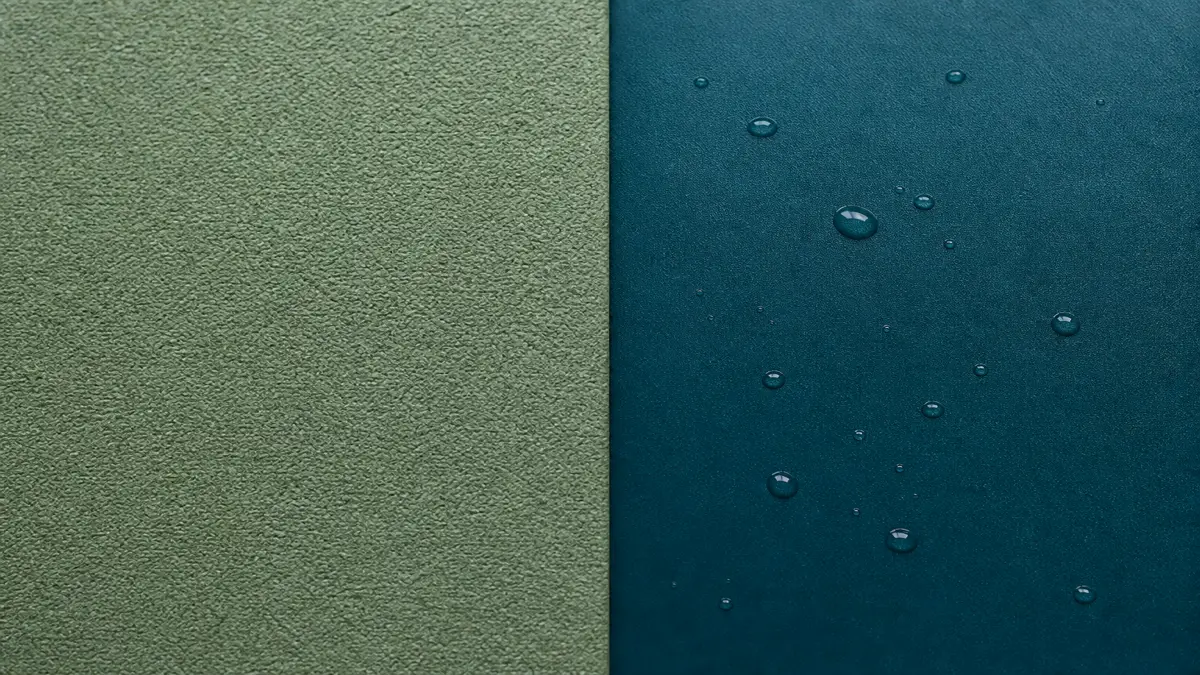
"Eco-friendly" is on almost every yoga mat box, so it helps to know what is actually being claimed.
TPE has a genuine environmental case. It is thermoplastic, which means it is technically recyclable, and it is free of the chlorine compounds and heavy metals found in PVC (Wavar). On paper, that is a cleaner profile than older plastic mats.
The honest caveat is that recyclability is conditional. Whether a TPE mat actually gets recycled depends on your local facilities and on whether the mat mixes layers and inks that recycling streams can separate (Disrupt Sports). "Recyclable" on the label is not the same as "will be recycled where you live."
PU is not the villain here either. PU mats are usually built on a natural-rubber base, which is a renewable material, and the OEKO-TEX certification you will see on better PU and rubber mats tests the finished textile for harmful substances. So the cleaner read is not "TPE good, PU bad." It is that TPE leans lighter and more recyclable in principle, while a certified PU and rubber mat leans toward longevity and a tested-safe surface. A mat that lasts five years can be the greener choice over two mats that each last two.
Weight and portability — how thickness affects carry-to-studio practicality
If you practise at home, weight barely matters. If you carry your mat to a studio, it matters a lot, and thickness is the main driver.
The rough ladder looks like this. Travel mats run 1.5 to 2mm and weigh about 0.5 to 1.2kg, thin enough to fold into a bag but with almost no cushion (HTS Yoga weight guide). Standard home mats at 4 to 5mm weigh roughly 1.6 to 2.3kg, the sweet spot for most people. Thick cushioned mats at 6mm and above can push past 3kg, which is a real consideration when you are walking or cycling to class with it slung over your shoulder.
This is where material doubles back into the decision. A TPE mat at a given thickness weighs noticeably less than a rubber-based PU mat of the same thickness, so if your practice involves a commute, TPE's weight advantage is a concrete benefit rather than a marketing line. A heavy mat is a mat you leave at home, and the best mat is the one you actually bring.
Quick decision matrix — match your practice style and budget to the right spec
Pull the threads together and the choices collapse into a few clean recommendations. Treat these as starting points, not rules.
Brand-new, mixed or unsure practice, careful budget. A 4 to 5mm TPE mat. Light enough to carry, cushioned enough for knees, cheap enough that you are not over-committing before the habit forms. Just plan to clean it often.
Hot yoga or sweaty Vinyasa. A PU or PU-and-rubber mat, 4 to 5mm. The sweat-activated grip is the whole point, and a TPE mat will betray you the moment your palms get damp.
Sensitive knees, gentler or restorative practice. Lean to 6mm, and prioritise a dense mat over a soft thick one. If you do long floor holds, 8mm and up is reasonable, accepting the wobble trade-off in standing poses.
Frequent commuter. Stay at 4 to 5mm and favour TPE for the weight saving, unless you sweat heavily, in which case carry the extra weight of PU for the grip.
Buying once, want it to last. A certified PU and rubber mat at 4 to 5mm. Higher upfront cost, longer life, better grip, easier to keep clean.
One last note: the best yoga mat is the one that matches the practice you actually do, not the one with the most impressive spec sheet. A dense 4mm mat that grips when your hands sweat is worth more than an 8mm cushion that slides out from under you in Warrior III.
Sources
- HTS Yoga — Yoga mat thickness comparison 3mm vs 4mm vs 5mm vs 6mm — thickness breakdown, density, and weight guidance.
- HTS Yoga — Rubber vs TPE vs PU vs PVC buyer guide — material grip, durability, and cleaning differences.
- Yoga Design Lab — How thick should a yoga mat be for beginners — beginner thickness range and balance trade-offs.
- Yune Yoga — Finding the best thickness for your yoga mat — thickness by practice style, Yin vs Vinyasa.
- MOWIN Yoga — PU, TPE and high-density PVC mats compared — TPE weight, PU construction, and certification.
- Yoga Journal — Best yoga mats of 2026 — budget and hot-yoga picks across the material spectrum.
- REI Expert Advice — How to choose a yoga mat — general selection framework for first-time buyers.