You buy a good pair of leather shoes, you break them in, you even learn to condition them. And then every night you kick them off by the door, they dry out bent into whatever shape they landed in, and a year later you wonder why the toe is cracked and the shape is gone.
Storage is the unglamorous half of shoe care, and it does more quiet work than any cream. None of what follows costs much or takes long. It is mostly about giving the leather what it needs in the hours you are not wearing it: a held shape, dry air, and a break.
A shoe tree does two jobs, and timing matters
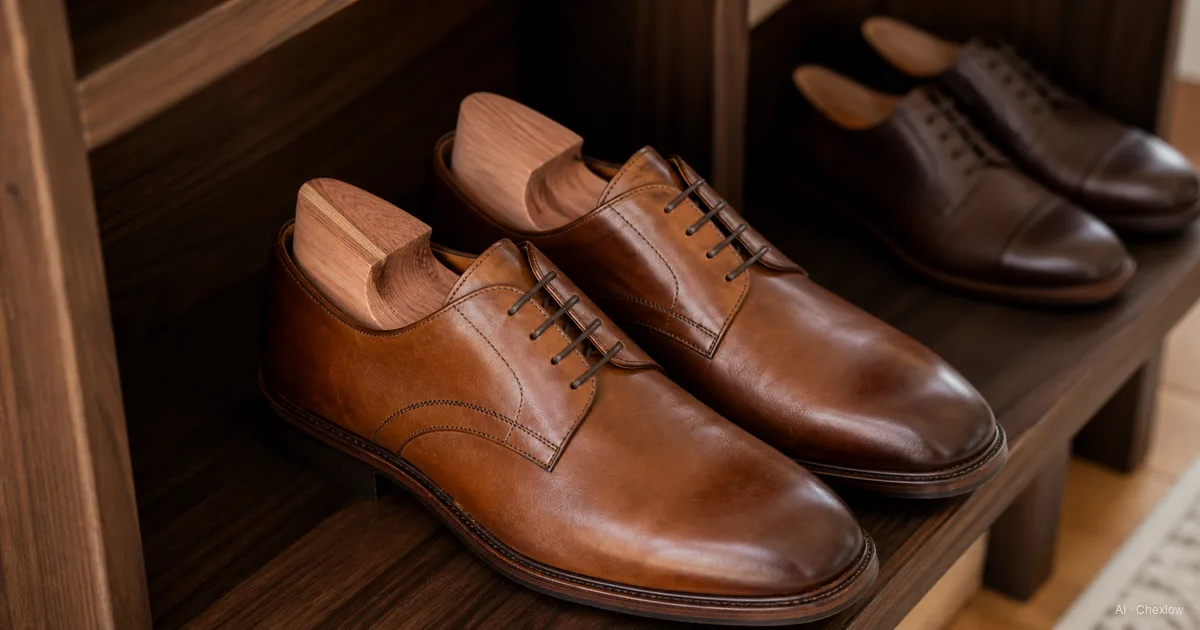
A shoe tree is the single best thing you can put in a leather shoe, and it earns its keep two ways at once.
The first is shape. Leather flexes all day where your foot bends, and if it dries in a folded position, those folds set into permanent creases across the toe. A shoe tree pushes the upper back out to its proper form while the leather is still soft and damp from wear, so it dries smooth instead of crumpled. Over months, that is the difference between a toe that creases gently and one that cracks along a hard fold.
The second is moisture. Your foot puts a surprising amount of sweat into a shoe over a day, and that damp is what rots the lining and breaks the leather down from the inside (Shoe tree, Wikipedia)). This is why cedar matters. Unfinished cedar wood pulls moisture out of the leather and lining as it dries, and it keeps the inside smelling clean while it does it. A plastic tree holds the shape but does nothing for the damp, so cedar is worth the small extra.
Timing is the part people miss. Put the tree in within an hour or two of taking the shoe off, while it is still warm and the leather is at its most workable. Wait until the next morning and the shape has already started to set and the moisture has already soaked in. The tree is most useful in exactly the window most people ignore.
One small thing on cedar trees over time. They stop smelling and absorbing as well after a year or two because the surface seals up with oils. A light sanding with fine sandpaper opens the wood back up and brings the scent and the absorbency back, which is a nicer trick than buying new ones.

Rotation is the cheapest way to make shoes last
Here is the rule that does the most work for the least money: do not wear the same leather shoes two days in a row.
The reason is the same damp from the section above. A shoe needs a full day, roughly twenty-four hours, to dry out properly after a wear. Wear it again the next morning and you are putting your foot back into leather that never fully dried, so the moisture never clears and the breakdown speeds up. Give it a rest day and it dries, recovers its shape, and the cedar finishes its work.
Two pairs worn on alternating days do not each last twice as long by some neat formula, but the direction is consistent and well established. Trade groups for shoe repairers put the gain from rotating pairs in the rough range of a third more serviceable life compared with wearing one pair into the ground (John White, the role of shoe trees and rotation). Three pairs is even kinder, and it also means a soaked pair from a rainy day can take two or three days to dry without leaving you short.
So if you are deciding between one expensive pair and two mid-priced ones for daily wear, the two will very often outlast the one. Not because they are better made, but because each gets a rest. That is a genuinely useful thing to know before you spend, and it changes the maths on what good footwear actually costs over time.
Damp, heat, and where you actually keep them
Where a shoe lives between wears matters as much as the tree inside it.
The two enemies are damp and heat, and they pull in opposite directions. Damp brings mold and rot. Heat dries the leather out until it stiffens and cracks. So the shelf you want is cool, dry, out of direct sun, and with a little air moving around it. A dark closet with no airflow traps the moisture your foot left behind. A spot right next to a radiator or in a sunny window bakes the oils out of the leather. Neither is where good shoes should sit.
Mold is the one that surprises people, because it does not need dirt to grow, just damp and still air. In a humid climate or a closed cupboard, the sweat in the lining is enough to start it, and it shows up as a grey or white bloom inside the shoe and on the upper. A cedar tree and an open shelf prevent most of it by keeping the inside dry and the air moving. If you live somewhere genuinely humid, leaving shoes to breathe in the open for a few hours after a wear, before they go anywhere enclosed, is worth the habit.
One thing not to do, ever, is store leather in a sealed plastic box or bag for the long term. It feels protective and it is the opposite. Sealed plastic traps whatever moisture is already inside with the shoe and turns the box into a small humid chamber, which is close to ideal conditions for mold. Leather needs to breathe even while it sits. If you want shoes covered, a cloth dust bag or the original box with the lid left a little ajar lets air through while keeping dust off.
Putting shoes away for a season
Boots in summer, light shoes in winter, anything you are not reaching for over the next few months needs a bit more than a shove to the back of the closet.
Clean them first. This is the one place where the care routine and storage overlap, and it matters because dirt and salt left on the leather will keep working on it for the whole time it sits. Brush off the surface, deal with any salt or stains, and if the leather is dry, condition it and let it fully absorb before you put it away. A shoe stored dirty comes out worse than it went in; a shoe stored clean comes out ready to wear.
Then put trees in and box them properly. Shoe trees during long storage are not optional, because months of sitting is exactly when a shape slumps or a toe curls if nothing is holding it. Use the original box or a breathable bag, keep the lid slightly open for air, and store it somewhere with stable temperature, not an attic that swings hot and cold or a basement that runs damp. A silica gel packet or two in the box helps in humid homes.
And check on them once in a while. Long storage is where small problems become permanent ones unnoticed. A glance every month or so, a sniff for any musty smell, catches mold or a setting crease while it is still fixable rather than after it has set for half a year.
The storage habits that quietly ruin good shoes
Most shoes that die young are killed by a handful of small, repeated storage habits. They are all easy to drop once you see them.
Putting a wet shoe straight into a closet is the worst of them. A pair that got rained on or sweated through needs to dry slowly in open air first, stuffed with paper or sitting on a tree, away from heat. Seal that damp into a dark space and you have started mold and locked in the bent shape at the same time.
Drying a soaked shoe fast with heat is the close second. A radiator, a heater vent, a hairdryer, they all feel like a shortcut and they all do real harm. Heat pulls the oils out of leather far faster than they should go, and the shoe comes out stiff, shrunken, and prone to cracking (Conservation and restoration of leather objects, Wikipedia). Slow and cool always wins. If a shoe is properly soaked, paper inside to hold the shape and pull moisture, changed once when it gets damp, dried over a day or two at room temperature.
The quieter habits add up too. Stacking shoes on top of each other crushes the upper of the one underneath and sets creases that did not need to be there. Tossing them in a pile by the door means they dry in whatever shape they landed in. Skipping the tree on the days you are tired is the one that catches everyone, because the damage from a single skipped night is invisible, and the damage from a hundred of them is a ruined toe. The trick is to make the tree automatic, the same motion as taking the shoe off, so tired-you does not get a vote.
So before you buy
If you are weighing up a leather pair right now, storage is worth carrying into the decision, because it changes what the shoe really costs and how long it really lasts.
First, budget for a shoe tree the same way you budget for the shoes. A cedar tree is a small, one-time cost that protects a much larger one, and for a pair you intend to keep for years it is not really optional. When you compare two pairs, factor the tree into the cheaper-feeling one too. It closes more of the gap than people expect.
Second, think about rotation before you commit to a single hero pair. If these are going to be your everyday shoes, a second pair to alternate with will very likely make both of them outlast one worn daily, and that reframes the choice from one expensive shoe to two you can rest. For a shoe you will wear hard and often, that rest day is doing more than any product you could put on the leather.
And when you are comparing pairs side by side, a small tell: a shoe with a structured heel counter and a firm toe box holds its shape in storage far better than a soft, unstructured one. Press gently at the heel and the toe. The pair that springs back is the one a tree and a dry shelf will keep looking good for years; the one that stays dented is the one that will slump no matter how carefully you store it.
Sources
- Shoe tree, Wikipedia) for what a shoe tree does, why cedar is used, and why inserting it soon after wear matters most.
- Conservation and restoration of leather objects, Wikipedia for why trapped damp and direct heat damage leather, and why slow, cool drying preserves it.
- Leather Working Group, leather types overview for how full-grain leather holds and recovers its shape compared with coated leather.
- John White, the role of shoe trees and rotation for the serviceable-life gain from rotating pairs and resting shoes between wears.