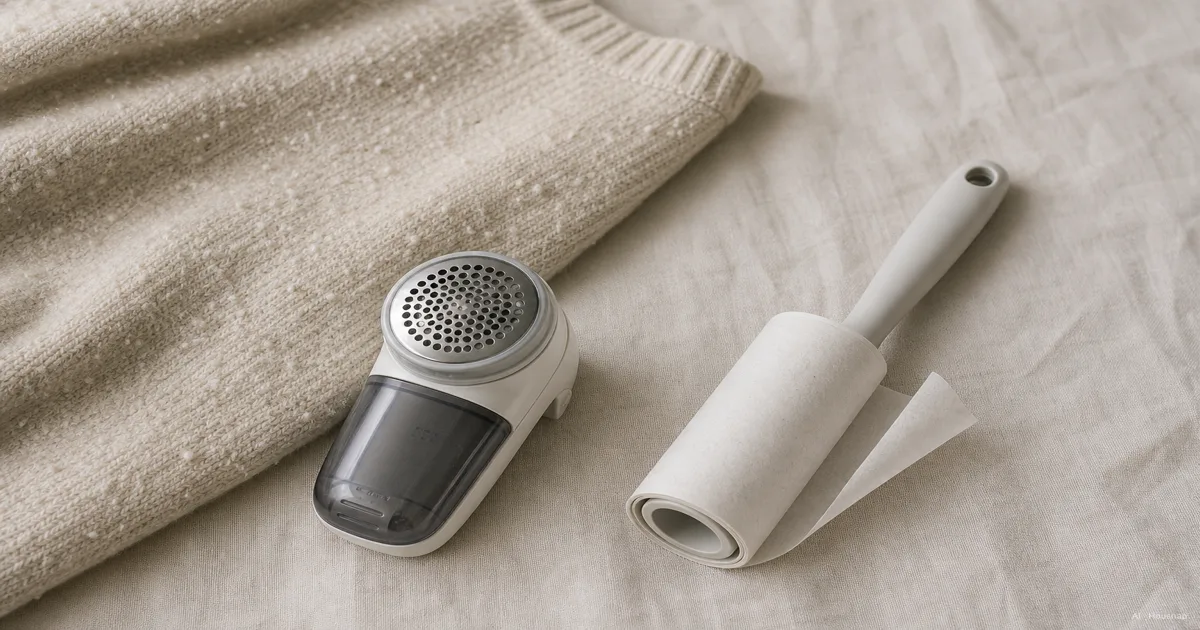
Look at the fabric before choosing the tool
Start with the garment you actually want to wear. Are you seeing stray hairs, or little balls forming on the fabric?
- Loose hair and lint: choose an adhesive roller. 3M describes its roller as a tool for collecting hair, lint and debris.
- Attached pills: consider a fabric shaver. Woolmark lists shavers as a pilling-removal option; a sticky roller is not the tool to buy for that job.
- Both: buy for the problem bothering you most first. A second tool makes sense only when the remaining problem needs it.
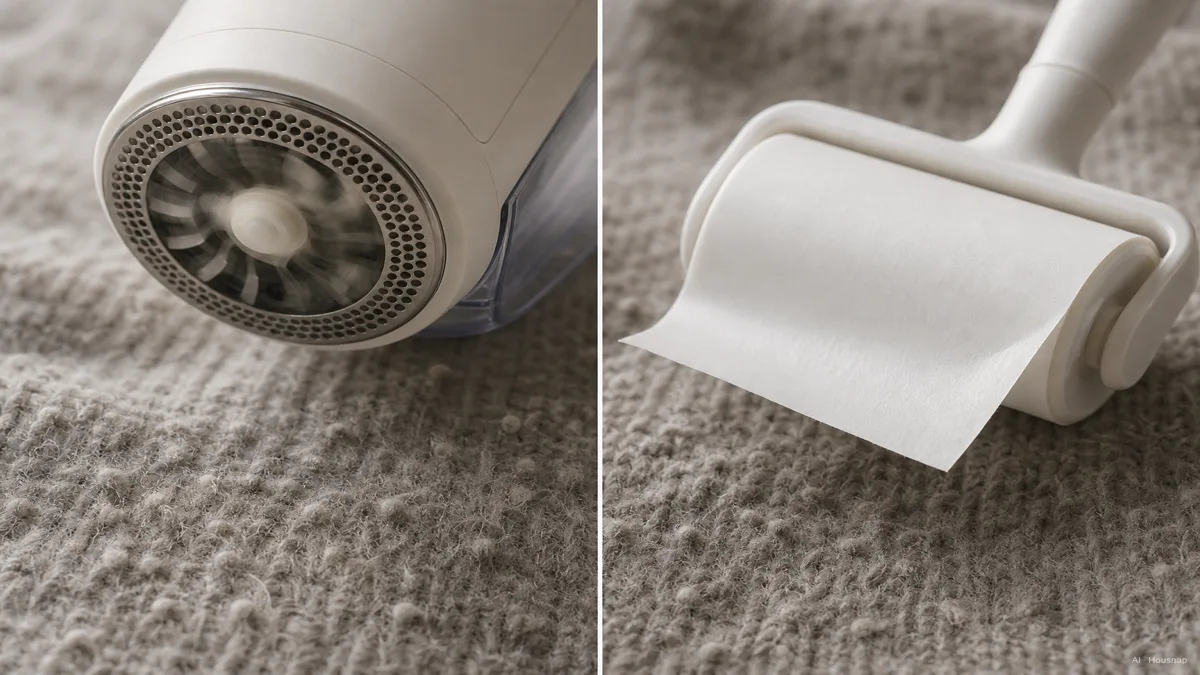
The illustration compares the two mechanisms, not the performance of particular models. Do not treat a thread sticking out of a seam as loose lint to pull away.
Check what you will need after the first use
For a roller, check the compatible refill before buying the handle. IKEA specifies BÄSTIS refills for BÄSTIS rollers; a similar-looking roll is not proof of fit. Compare refill cost per sheet, then consider how many sheets your own cleanup uses. There is no useful universal annual cost.
Refills belong with this choice: they keep the roller usable when the original roll is finished. Buy replacements that explicitly name your handle or system.
For a shaver, look for clear fabric restrictions, power requirements and cleaning instructions. Treat these as purchase criteria, not a blade-count contest. Pilo No.2, for example, is rechargeable according to its manual; the word “handheld” does not mean unpowered.
Cleaning access matters too. Philips says lint buildup can reduce GC026/00 performance. Before replacing an apparently ineffective shaver, switch it off and follow its cleaning instructions; check how the bin empties and whether the supplied brush reaches the specified parts.
Make the first use a small trial
Read the garment guidance and your chosen tool's instructions before treating the whole piece. If suitability is unclear, ask the garment maker before proceeding.
For shaving, use these starting checks:
- Prepare: take the garment off and spread it flat. Philips advises smoothing GC026/00's working surface and avoiding buttons, zippers, embroidery and loose threads.
- Try: test a hidden spot without pressing. Steamery's Pilo No.2 manual warns that pressure can damage fabric. Stop if the fabric catches or changes in a way you did not intend.
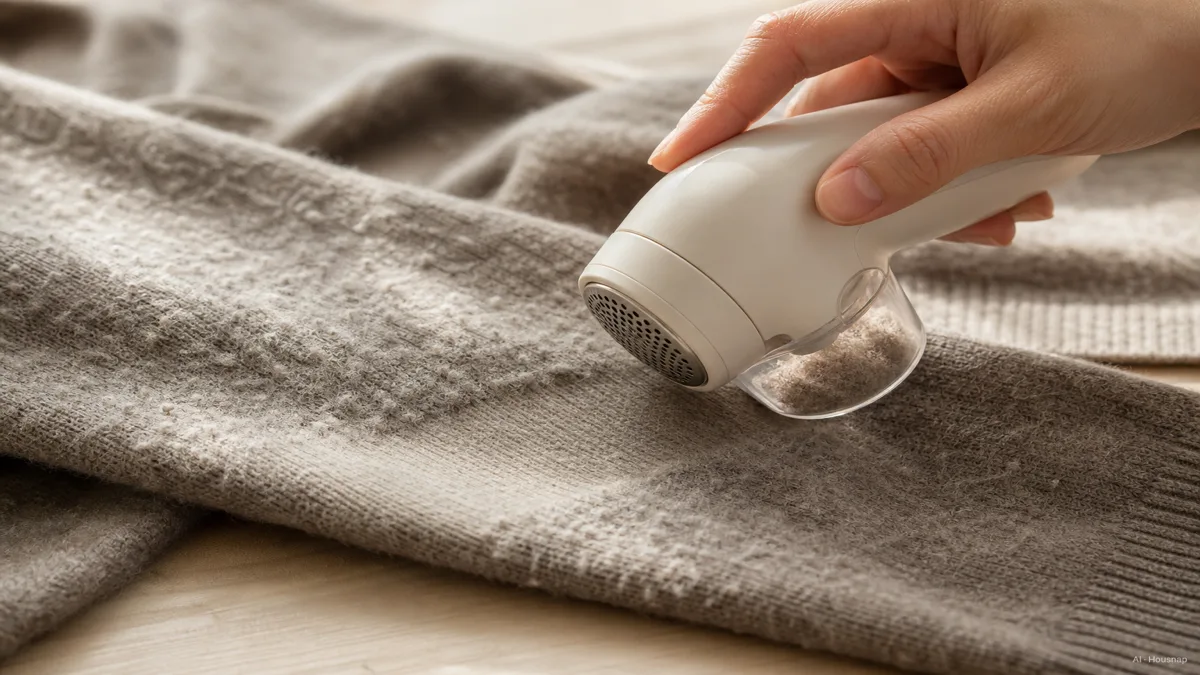
This is an illustration of shaving and collection, not a guarantee of a damage-free result. A guard does not make every garment suitable.
If the item is a wool sweater, the next question is how to care for it between uses, rather than which tool to buy next. Continue with washing, drying and storing wool and merino sweaters.
Como este guia foi construído
AI wrote this guide for Chexlow using Woolmark guidance, Steamery's manual, Philips support pages and IKEA and 3M product documentation. It compares tool purposes and ownership checks; the buying priorities are editorial judgments, not hands-on product test results.
Editado pela equipe Chexlow · As imagens são ilustrações geradas por IA