What defines a monk strap — the buckle, the absence of laces
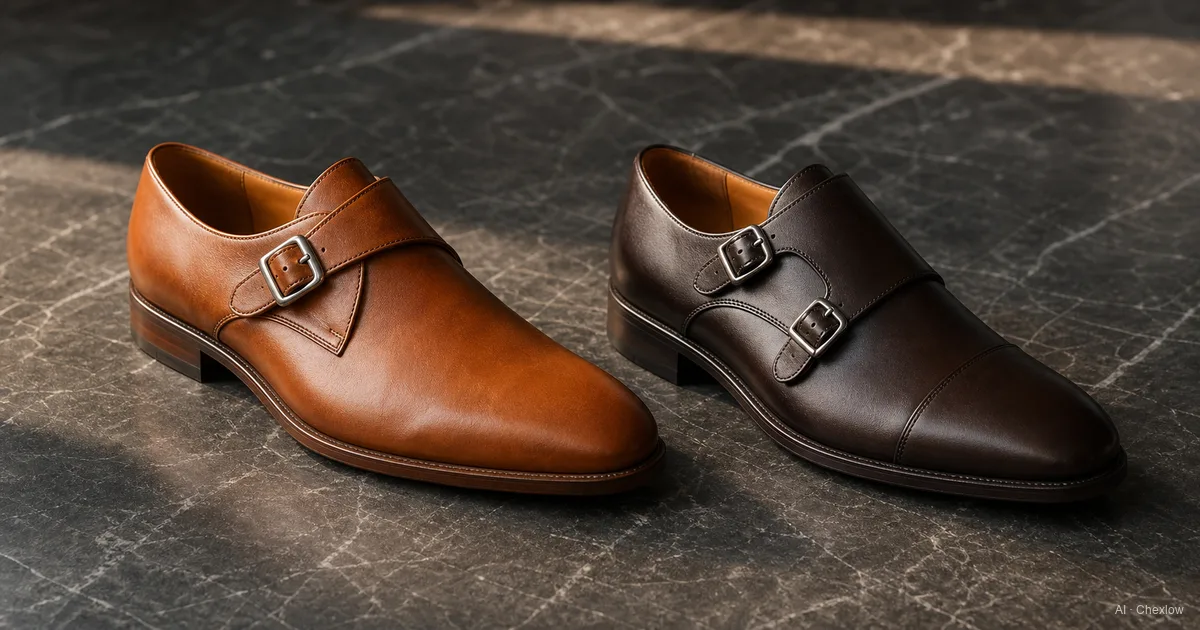
A monk strap shoe is built on a standard dress shoe last with one critical difference in the closure: instead of eyelet holes and laces, the top of the shoe has a strap or straps that pass over the instep and fasten with a metal buckle on the lateral (outside) side of the foot. The name comes from the plain, unembellished style of footwear traditionally associated with monastic dress in medieval Europe, though the contemporary monk strap is anything but ascetic in execution — buckle hardware, strap width, and toe detailing have become major design variables.
The closure mechanics affect fit in ways that are distinct from lace-up shoes. With a lace-up shoe, you can distribute adjustment across multiple eyelets to create a custom tension gradient from toe to throat. A monk strap adjusts at a single buckle (or two, on a double monk). This means that fit depends heavily on the strap's natural resting position matching your instep height. If the buckle sits notched in at the tightest or loosest hole, the shoe is the wrong size or the wrong last for your foot (Gentleman's Gazette, The Complete Guide to Monk Strap Shoes).
The buckle itself varies: brass, silver-tone steel, and gold-tone options are the most common. The width of the strap (typically 2.5–4 cm) and the number of rivets or decorative stitching on the strap surface are quality signals. A strap that has reinforced edges and clean stitching will hold its shape through years of buckling and unbuckling; a strap cut from thin leather with no edge finishing will curl and crack along its edges within a season.
Single vs. double monk — visual weight and what formality actually means here
The single monk strap has one strap and one buckle crossing the foot horizontally at approximately the point where the tongue of a lace-up shoe would lie. It is visually simpler, tends to read as cleaner and more conservative, and sits more comfortably in strict business formal environments than its double-strap counterpart.
The double monk strap has two straps and two buckles. The visual effect is different: two parallel horizontal lines of leather and hardware create a busier, more fashion-conscious silhouette. In Italian and southern European tailoring culture, the double monk strap is considered the more elegant of the two — it is associated with Neapolitan and Roman shoemaking traditions and reads as a deliberate sartorial choice rather than a compromise (Permanent Style, Double Monk Strap Review). In more conservative UK or US business environments, the double monk can read as slightly louder.
For a first monk strap, the single is the lower-risk choice — it works in more professional environments without comment and the cleaner profile makes it easier to wear with more looks. The double is a better choice if you have experience with dress shoes and want something that signals a deliberate, informed aesthetic.
Practically, the double monk offers one advantage: two points of adjustment mean the shoe can accommodate more variation in instep height. If you have a notably high or variable instep, the double monk may fit better than the single.
Toe shape — round, almond, and square
The toe shape is the quickest shorthand for how formal or directional a monk strap reads, and it is independent of whether the shoe is single or double.
A round toe is the most traditional and the most conservative. Round-toe dress shoes dominated formal footwear through most of the twentieth century and remain appropriate in traditional business environments. On a monk strap, a round toe in a dark leather reads as conservative and functional — the shoe says "I dressed appropriately" rather than "I dressed with intention."
An almond or oval toe has a slight taper and a gentle elongation, striking a balance between the traditional round and the directional square. This is the current mainstream for dress shoes and looks correct in most business and smart-casual contexts without either extreme of old-fashioned or fashion-forward. For a first monk strap, an almond-toe last is often the most versatile choice.
A square or chisel toe is flat and wide at the tip with a horizontal termination. In the context of a double monk strap, a square toe creates a fashion-forward silhouette that reads clearly as contemporary dress rather than traditional dress. This works well in creative industries, fashion-forward offices, and smart-casual contexts. It is not the right choice for conservative financial or legal environments where traditional formality is expected (Mr. Porter, How to Wear Monk Strap Shoes).
Leather vs. suede — reading the occasion from the upper
The upper material changes the occasion range of a monk strap more decisively than most other variables. This is a general truth about dress shoes, but it is particularly pronounced with monk straps because the shoe's distinctive profile is already doing a lot of the signaling work.
Full-grain leather in black, dark brown, or oxblood works at all levels of dress from business formal to smart casual. The higher the shine (which is a function of polishing, not inherent material quality), the more formal the shoe reads. A lightly conditioned, matte-finished dark leather monk strap in a round or almond toe can work in business formal. The same shoe buffed to a mirror shine reads as even more intentional.
Suede immediately shifts the shoe toward smart casual. No suede shoe, however well-made, reads as appropriate in a strict business formal context. It is not a question of quality — suede is not a cheaper option — but of texture signal. The napped, matte, informal surface of suede communicates "considered but relaxed," which is exactly right for smart casual, wearing with tailored separates without a tie, or contemporary office environments with relaxed dress codes. Suede monk straps are among the most effective smart-casual shoes available (The Rake, Suede Monk Strap Review).
The most versatile first monk strap upper is dark leather in a relatively neutral finish — it can do business formal and smart casual and will not limit your use before you understand the shoe well enough to assess what register you actually need.
Fit considerations — buckle width and instep height
Monk strap fit diverges from standard dress shoe fit in one specific way: the buckle adjustment must end up in the middle of the available range — not at the tightest or loosest hole — for the shoe to fit as intended. A buckle at the end of its range means the shoe is the wrong size, and unlike lace-up shoes, you cannot compensate with adjustment technique.
When trying on a monk strap, put it on the last hole first and assess: the strap should lie flat and taut without pulling the leather on either side of the buckle. Then move to the middle hole. If the shoe is comfortable and the strap lies flat in the middle hole, the size is correct. If the shoe is comfortable only at the end of the tightest range, the shoe is half a size too large. If the shoe is too tight at the loosest hole, it is too small (Cobbler Union, Monk Strap Shoe Sizing Guide).
Instep height matters more with monk straps than with lace-ups because the strap cannot flatten or accommodate a very high instep the way multiple lacing configurations can. If you have a consistently high instep, try both single and double monk straps before committing — the double may give you a more useful range of buckle positions.
Heel slip on a monk strap usually means the toe box is too roomy in length, not that the strap is the wrong adjustment. Try a half size down before adjusting the strap.
When monk straps work — business formal to smart casual range
A monk strap in dark full-grain leather with a round or almond toe, worn with a dark suit, dress shirt, and silk tie is appropriate for business formal and most occasions that require a dress shoe. It is not appropriate for morning dress or black-tie (where an oxford is the correct choice), but it is appropriate for everything below that register including job interviews, formal business meetings, weddings as a guest, and client presentations.
The same shoe worn without a tie, with a blazer and dress trousers, sits at business casual. The monk strap's distinctive silhouette makes this register feel more considered than a similarly colored derby would in the same configuration.
At smart casual — dark denim or chinos, a knit or casual shirt, a sport coat — a dark leather monk strap continues to work if the toe shape is round or almond. Move to suede, a tan or lighter color, or a more directional toe shape (square) and the shoe is firmly in smart casual and should not be pushed toward business formal.
The monk strap does not work at casual weekend register (t-shirts, casual shorts, sneaker situations). It is a dress shoe, and attempting to wear it casually will only look like an error rather than an intentional style.
Care and polish routine for monk strap leather
The care routine for monk strap leather is similar to any dress shoe, with one addition: the strap and buckle hardware need separate attention. The strap, being a narrow piece of leather that flexes at every buckle engagement, is prone to cracking along the fold lines if not conditioned regularly.
The standard routine: brush off surface dust and dirt with a horsehair brush before any product application. Apply a small amount of leather cream conditioner with a cloth, working it into the leather including the strap on both sides. Let it absorb for five minutes. Apply polish in the matching color with a dauber brush, working it into the surface in small circular motions. Let the polish haze for two to three minutes. Buff to the desired shine level with a clean horsehair brush and then a polishing cloth (Saphir, Leather Care Basics).
The buckle hardware should not get cream or polish on it — apply tape or use a small cloth shield when conditioning and polishing near the hardware. Metal polish (Brasso or equivalent) can be used on tarnished brass or silver-tone buckles if they lose their finish over time. The screws or rivets holding the buckle to the strap occasionally loosen; check them every few months and take the shoe to a cobbler if they need tightening or re-anchoring.
Cedar shoe trees inserted after each wear slow moisture absorption into the insole and help the strap retain its shape without over-curving. This is particularly important for monk straps because the strap is a fixed-width piece of leather — unlike a lace, it cannot be replaced easily if it cracks.