Get two measurements for the exact pair
A listing that says only “140 mm” leaves an important question unanswered: how much height is under the front of your foot? Ask for both heel height and forefoot platform height, in the same unit, for the size and version you intend to buy. If the measurement points are unclear, ask the seller to identify them on a side view.
For a concrete specification example, Amina Muaddi lists a 140 mm heel and 40 mm platform for its Dalida Plateau 140 Black Satin. Subtracting those published values gives 100 mm. This example belongs to that black satin version; it does not verify the dimensions of a leopard-print or other variant.
Keep all three numbers in your comparison: heel height, platform height and their difference. A platform measurement by itself cannot tell you the rise from the front of the foot to the heel.
Compare the rise without treating it as an angle
Pleaser’s platform guide calls heel height minus front platform height “effective pitch.” Here, use that calculation as a nominal height difference. Its result is a length, not an angle in degrees, and published exterior dimensions do not map the entire surface supporting your foot.
Even one heel-height category can contain different rises. Pleaser specifies 1.75-inch and 2.25-inch platforms for its six-inch Delight and Aspire ranges respectively. The subtraction gives 4.25 and 3.75 inches. These are examples of why you need both measurements, not recommendations to wear performance shoes for ordinary outings.
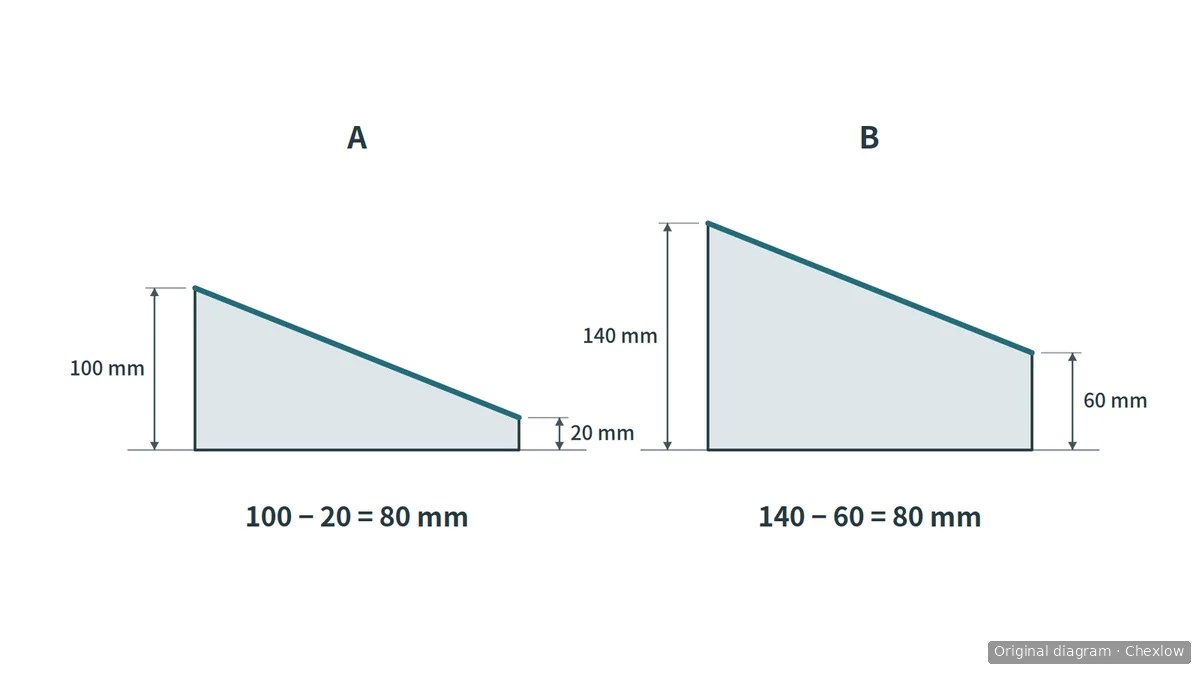
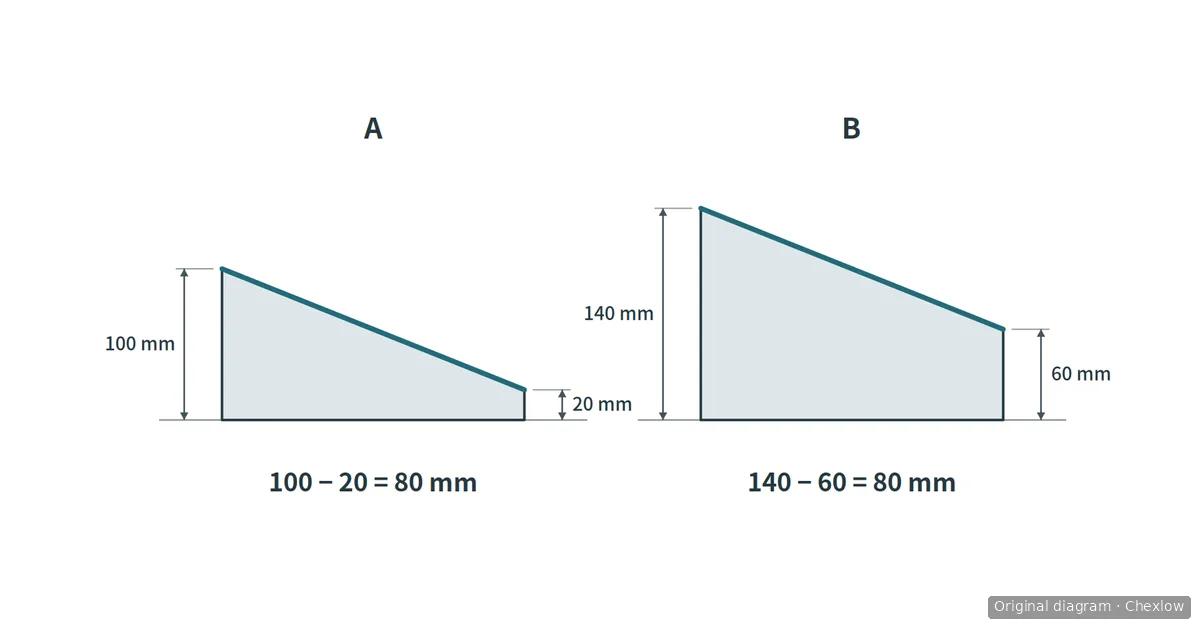
A represents 100 − 20 = 80 mm; B represents 140 − 60 = 80 mm. The drawing deliberately uses the same horizontal span and straight, parallel upper surfaces. B is taller overall, although its front-to-back rise is unchanged. These are invented geometry examples, not measured products or a prediction that two real shoes will feel identical.
Use the difference to narrow candidates. Do not turn “less steep on paper” into “safer,” or assume that an equally thick-looking sole has an equally flat footbed.
Check movement as well as standing height
Bradford District Care NHS guidance recommends trying both shoes, choosing footwear for the activity and expecting a correctly fitting shoe to feel comfortable from the start. It also notes that feet can change in length and width, so recheck your size rather than relying only on an old label.
For platform sandals, use this practical fitting sequence within the seller’s permitted conditions:
- Stand in both shoes. Check toe room and whether your foot sits within the intended supporting area. Adjust any adjustable straps without accepting painful pressure.
- Walk, turn and stop on a clear, level surface. Notice whether your foot slides forward, the shoe feels difficult to keep on, or the front repeatedly catches the floor. Stop if you feel pain or instability.
- Consider the actual route. If the outing involves stairs, kerbs or uneven paving, a brief level-floor fitting does not establish suitability. Do not create an obstacle course to prove that you can manage the pair; compare a lower overall platform if you remain unsure.
A favourable height difference does not cancel a failed movement check. Nor does a successful short fitting establish comfort for an entire event.
Decide whether the extra height earns its place
Keep a candidate only if its dimensions are clear, both shoes fit and you can move comfortably in the permitted trial. If the slope seems acceptable but the overall elevation feels awkward, compare a lower heel and lower front platform. Reducing both can preserve a similar nominal rise while bringing the shoe closer to the ground.
Read the actual seller’s return conditions before trying the shoes. Amina Muaddi’s product page, for example, requires returns to be unworn and in their original packaging with all materials. Do not assume that an outdoor trial is allowed or that another retailer uses the same conditions.
If you decide added height is no longer the priority and need an everyday summer option, continue with choosing between leather sandals and slides. That separate decision addresses shape, intended water use and fit rather than platform height.
Como este guia foi construído
Written by AI for Chexlow, using manufacturer explanations and exact product dimensions alongside NHS footwear guidance. The subtraction examples and fitting sequence are editorial explanations, not original wear tests, individual medical advice or guarantees of comfort.
Original SVG diagrams created for Chexlow