Choose a starting weight for your routine
Before comparing jeans, decide where you will wear them most: a warm commute, a heated office, or time outdoors in cooler weather. Use that situation to choose what to try first.

Weight labels need context. Naked & Famous calls 10–13 oz standard, 14–16 oz midweight, and 17–21 oz heavyweight in its fabric guide. Use the actual number when comparing brands.
These are starting choices for this guide, rather than promises about comfort:
- Heat and easy movement come first. Put an 11–12 oz pair on your shortlist. Compare it against your usual jeans before assuming you need more weight.
- You want one everyday starting point. Try 13–15 oz first. Keep both lighter and heavier candidates open until you have checked them sitting down.
- You specifically want heavy fabric. Try 17 oz or more alongside a lighter pair. Keep the heavier option only if you prefer its feel during ordinary movement.
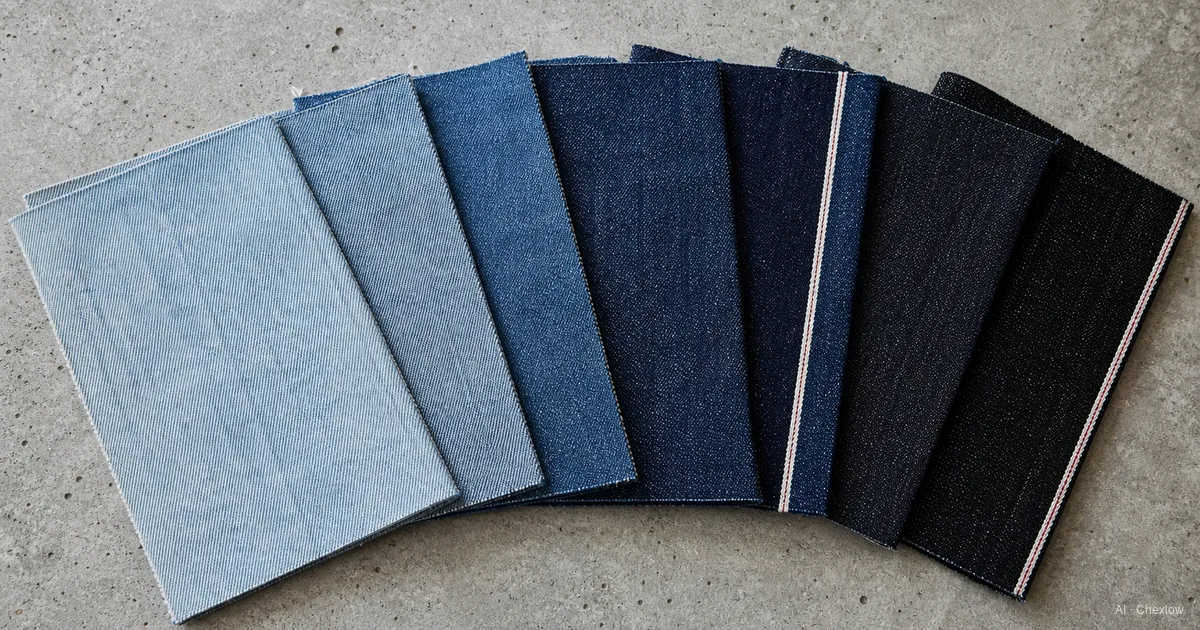
The illustration shows contrasting fabric shapes, not a measured performance comparison. Do not use the way a folded swatch stands up as a quality score.
Read the number as fabric weight
A 14 oz label means one square yard of fabric weighs fourteen ounces, not that the finished jeans do. See the manufacturer’s weight definition.
For each candidate, record the stated ounces and the exact fabric or wash name. If a listing gives only “heavyweight,” ask for the number. If it quotes different weights before and after washing, keep those conditions beside the figures instead of treating them as directly interchangeable.
Use ounces to narrow the search. Check the composition and size chart separately; do not infer stretch, thigh room or a suitable waist size from the weight.
Test the pair sitting down

Weight does not settle the question of stiffness. For example, Iron Heart describes the lower-tension weave and double-twisted weft of its 21 oz IH-777S-21 as producing supple fabric. That is a specific fabric example, not a promise about every heavy pair.
- Sit and bend. Notice pressure behind the knees, across the thighs and at the waistband. If movement feels unacceptable now, try another cut or fabric before buying.
- Compare deliberately. Try a similar cut in another weight where possible. When both cut and fabric change, avoid crediting the whole difference to ounces.
- Buying online. Check garment measurements and return conditions. Ask the seller about the exact fabric’s initial feel if the description is vague.
Do not make the purchase depend on a promised number of weeks until it becomes comfortable. Choose a starting fit and feel you can accept.
Judge fade examples separately
Lightweight denim can develop high-contrast fades too, as Naked & Famous explains in its lightweight-denim article. Extra ounces are not a reason by themselves to reject a lighter pair.
If a worn pair in a photograph attracts you, check whether it is the same fabric as the jeans you are considering. Look for wear and washing information rather than assuming the weight explains the result. Keep the photo as a preference, not a promised outcome.
Want to identify the patterns you like? Read about honeycombs, whiskers and other denim fades before choosing a heavier fabric for its appearance alone.
Confirm the wash state before choosing a size
Sanforization reduces potential shrinkage; one-wash describes a wash treatment. They can coexist: the IH-777S-21 specification lists both. Check the exact pair’s instructions rather than using its weight to guess what washing will change.
Before choosing between your final candidates:
- Confirm the version. Record whether the pair is unwashed or one-washed, and whether it is sanforized.
- Confirm the measurements. Ask whether the size chart describes the pair as sold or after the recommended initial wash or soak.
- Make the choice. Choose the candidate that suits your routine and passes the movement check. If neither does, revisit the cut or weight instead of buying on the strength of the ounce figure.
If the terminology is still unclear, use the guide to raw denim, selvedge, sanforization and one-wash to separate those questions before ordering.
Como este guia foi construído
This guide was written by AI for Chexlow, using Naked & Famous Denim’s fabric explanations and an Iron Heart product specification. It turns those sources into a practical first-purchase comparison; the suggested starting weights are editorial guidance, not results from hands-on testing.
Editado pela equipe Chexlow · As imagens são ilustrações geradas por IA