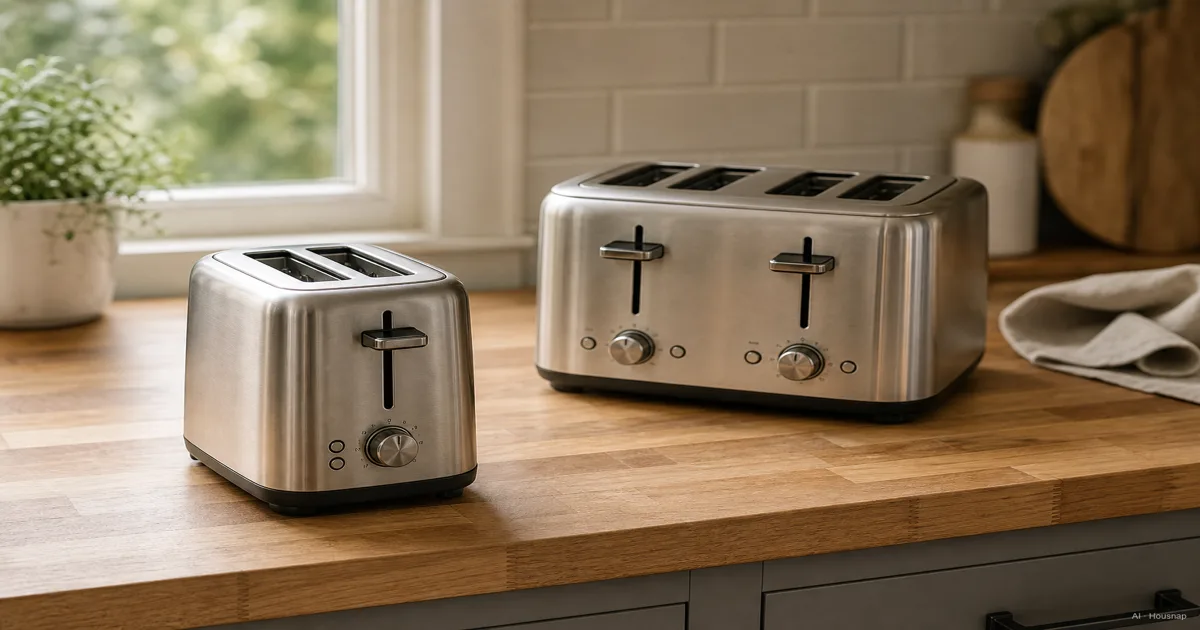
Count the slices you want ready together
Start with an ordinary breakfast, not the number of people living at home. Two people eating two slices each need four slices; four people eating at different times may be happy with two-slice capacity. More capacity means fewer batches, as KitchenAid's buying guide explains; it does not tell you a model's cycle time.
- Choose two-slice capacity when one batch usually covers the people eating now, or you are happy to make another.
- Choose four-slice capacity when a second batch regularly interrupts breakfast. Even a couple can benefit.
- Treat occasional guests separately. Decide whether avoiding their extra batch is worth the space the appliance occupies every day.
These are buying priorities, not household-size rules. Next, check whether your preferred capacity actually fits.
Check both the counter and the bread
Measure the intended spot, then compare the model's width, depth and height. Leave the clearance its manual requires, and check access to the controls and crumb tray. The illustration makes the space trade-off visible; it is not a scale drawing.
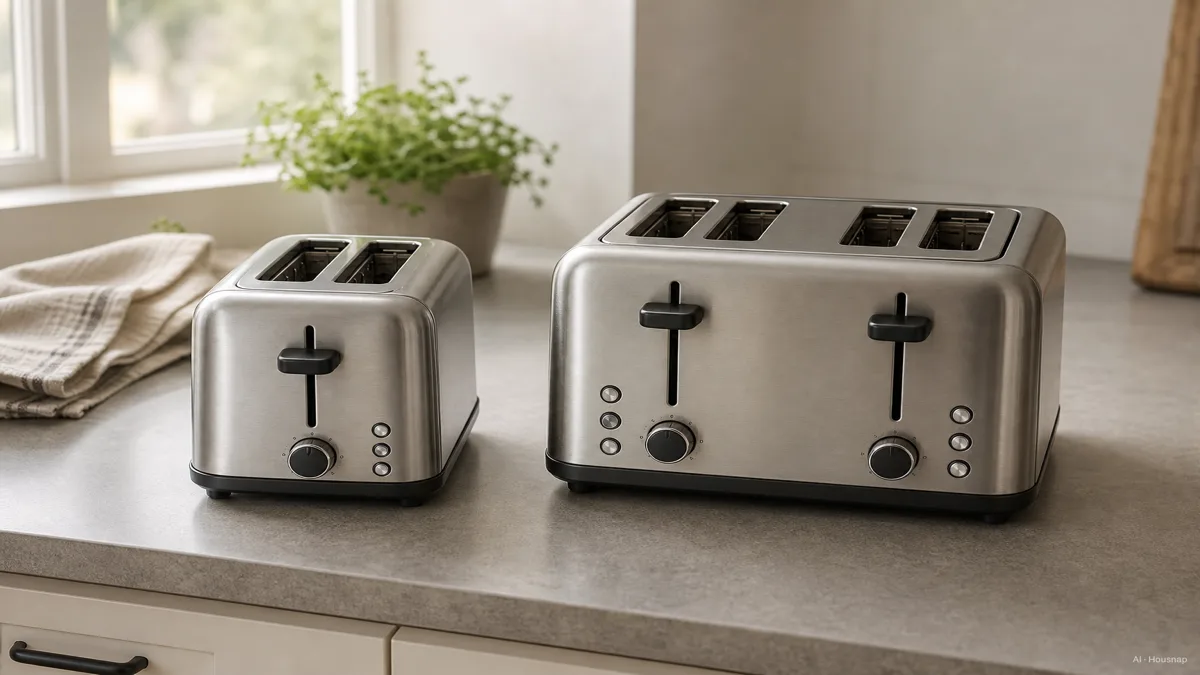
For a concrete reference, Cuisinart lists the CPT-142P1 at 10.8 × 10.7 × 7.2 inches (L × W × H), with 1.5-inch-wide slots. Those are that model's measurements, not a standard for four-slice toasters or a promise that every bagel fits.
Compare the opening's length and usable depth with your usual bread, as well as its width. A long slice and a thick bagel pose different fit questions. Capacity labels need checking too: the Breville Edge Long Slot accommodates four standard slices or two long slices. “Four-slice” does not always mean four separate openings.
Pay for controls you will actually use
If you want different shades at the same time, look for separately controlled pairs of slots. The CPT-142P1 has dual controls; verify the controls on each candidate rather than assuming every four-slice model works that way. Check whether either pair can run on its own if you often make a smaller breakfast.
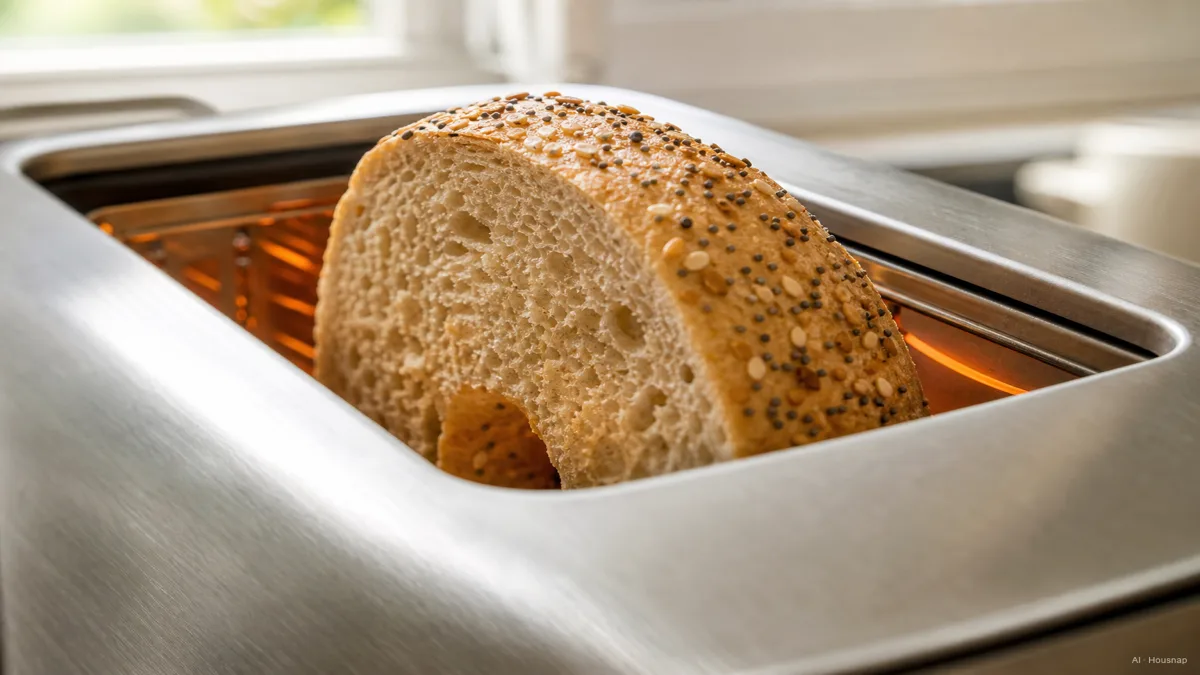
- Bagels. KitchenAid describes a mode that toasts the cut side while warming the back. Follow the model's bagel-position symbol; the illustration below is not a universal loading instruction.
- Frozen bread or cooled toast. Look for the function you need. KitchenAid distinguishes Defrost, for frozen food, from Reheat, for previously toasted food.
- Small slices and cleanup. A high-lift lever and an accessible removable crumb tray are useful details to compare in either size. KitchenAid explains both features.
Shade settings still need adjustment for your bread. KitchenAid notes that moisture, sugar, density and size affect browning. Don't choose a model just because its dial has more numbers.
Make your shortlist, or reconsider the appliance
Keep candidates that meet your usual batch size, fit the counter and accept your bread. Then compare the price of the features you identified. Our priority is paying for a real convenience, such as separate controls, rather than upgrading simply for a higher wattage number. Seek model-specific evidence if speed or even browning is the deciding factor.
Before ordering, check the exact model's local electrical rating, installation instructions and return terms. The manufacturer examples above explain specifications; they are not a tested ranking.
There is one reason to pause the two-versus-four choice: you want to heat bread with toppings or cook other food. KitchenAid's Reheat instructions exclude butter and other toppings. If those are your intended meals, continue with choosing between an air fryer and a toaster oven before buying a larger pop-up toaster.
Como este guia foi construído
Written by Chexlow's AI editor using Cuisinart specifications, Breville's capacity description and KitchenAid buying and operating guidance. This guide turns those sources into a first-purchase comparison of batch size, fit and controls; it does not report hands-on testing or rank current offers.
Editado pela equipe Chexlow · As imagens são ilustrações geradas por IA