Choose how much control you need
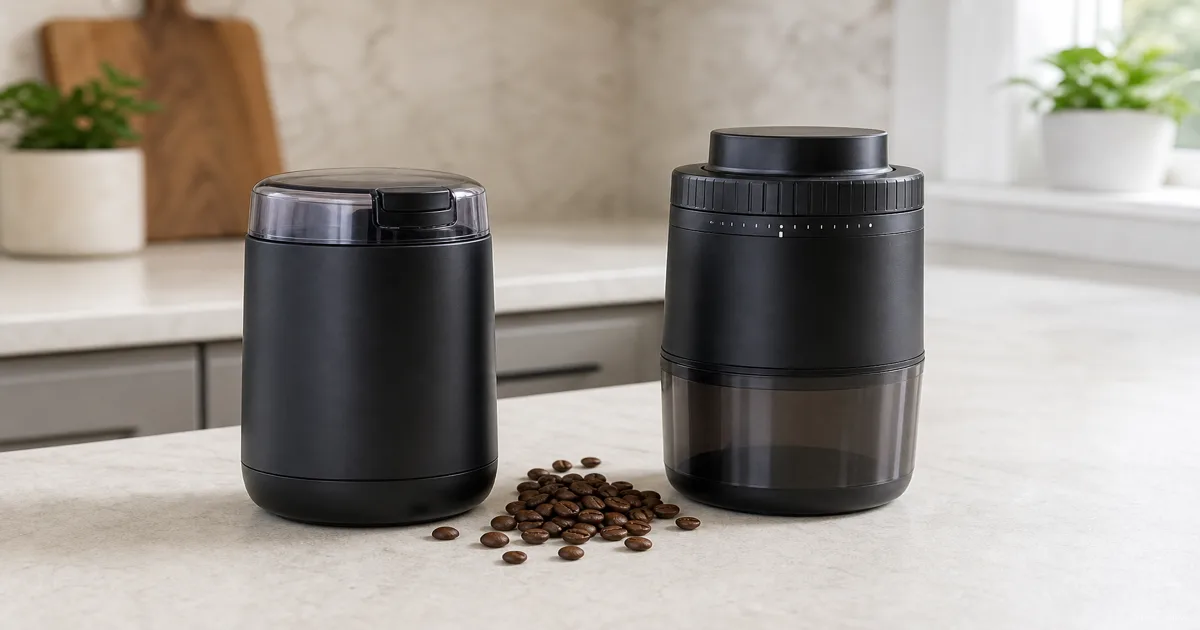
A blade grinder chops beans with a spinning blade; a burr grinder works between two abrasive surfaces. That difference gives burr grinding its useful advantage: adjustable grind size. KitchenAid explains the two mechanisms.
- Choose burr when you want a setting you can return to while refining a recipe.
- Consider blade when simple operation matters more than precise adjustment. Check that its instructions cover your brewer.
- Already happy with a blade grinder? Keep it until you can name the limitation you want an upgrade to solve.
A burr grinder still produces particles of different sizes. What you are buying is more predictable adjustment, not identical grains or a guaranteed flavour. Baratza makes this distinction explicitly.
Match the grinder to your brewer
Start with the coffee you actually make. KitchenAid's grind guide uses coarse for French press, medium for drip and fine for espresso. Treat those as starting descriptions, not settings you can transfer between machines.
For espresso, look for fine adjustments within the espresso range rather than judging by the total setting count. Baratza's espresso guide recommends small changes and explains how different models provide that control. Check the specific model; the word “burr” alone does not establish espresso suitability. KitchenAid also advises against using its blade grinders for extremely fine espresso grinding.
If you only make filter coffee, focus your shortlist there; you need not demand espresso capability. Still choosing the brewer? The first-dripper guide helps you decide which shape and filter you want before narrowing the grinder search.
Check the daily routine before the burr label
Conical versus flat, and steel versus ceramic, describe different things. Baratza lists conical steel, flat steel and flat ceramic options. For a first purchase, put brew compatibility and usability ahead of choosing a winning material or shape.
Before buying, answer these questions:
- Can you read the setting clearly and return to it after changing brewers?
- Does the specified capacity suit your normal batch? Measure the space needed to fill and empty the grinder, too.
- Can you follow the cleaning procedure without an awkward dismantling routine? Check which parts need removing and what cleaning method the manufacturer permits.
For a blade model, find the instructions for your usual batch size and operating time before buying. If those instructions do not cover your intended brewer, ask the manufacturer rather than assuming that running it longer will make it suitable.
Make the first setting useful
Start with your model's suggested setting and a recipe for your brewer. Keep the coffee dose and water amount fixed, note the setting and result, then change one variable. For espresso, Baratza recommends small grind adjustments, retesting and recording the changes.
Do not blame every disappointing cup on the grinder. In espresso, uneven water paths through the grounds, called channeling, also call for checking how you distribute and tamp the coffee. The same Baratza guide addresses that separately.
For pour-over, choose a repeatable recipe with the coffee-to-water ratio guide before changing both the ratio and grind. The useful upgrade is being able to learn from the next cup.
How this guide was built
AI wrote this guide for Chexlow using KitchenAid's official product guidance and Baratza's grinding and brewing guides. It compares control, brew compatibility and daily use; the selection priorities are editorial judgments, not hands-on product test results.
Edited by the Chexlow team · Images are AI-generated illustrations