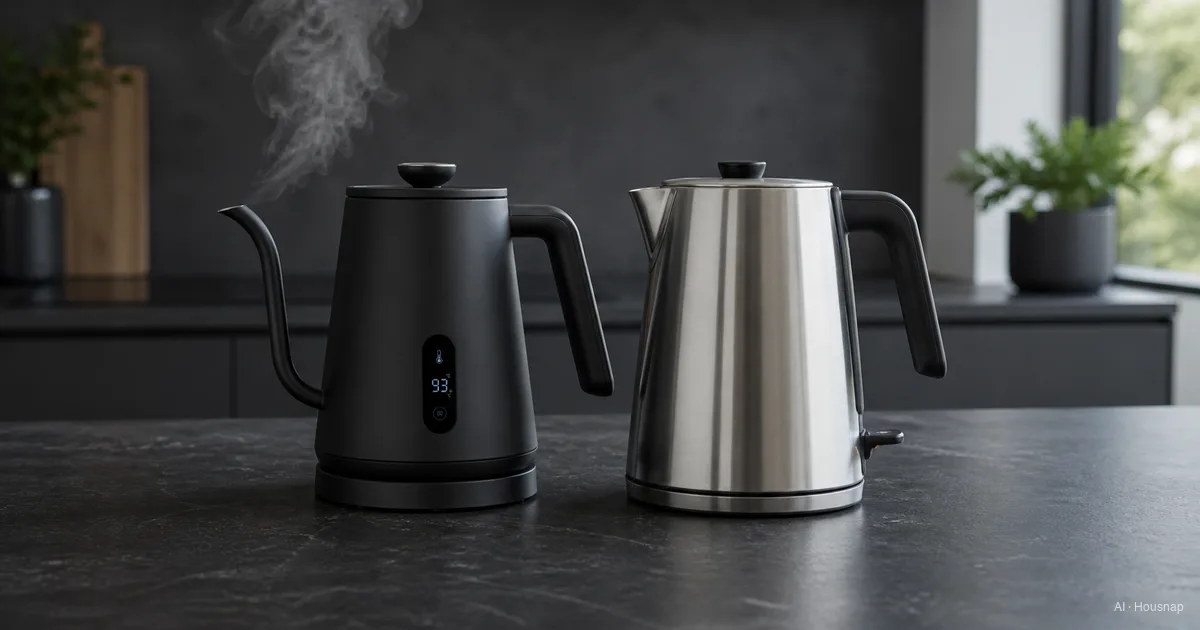

Start with the temperature you actually need
Before comparing buttons, check the instructions on your usual tea or drink. The UK Tea & Infusions Association suggests around 80°C for green tea and 90–98°C for black tea, while directing readers to the packet instructions. Treat those figures as starting points, not a temperature chart for every tea.
- Choose a basic boiling model if your usual preparation calls for freshly boiled water and you do not need a selectable lower temperature.
- Choose temperature control if a lower setting is part of your regular routine. Check that the kettle offers the temperature you need, rather than simply counting its presets.
Temperature control and fast boiling are not mutually exclusive. Bosch lists both on the TWK8633GB. The useful comparison is whether you need temperature selection, followed by how quickly each candidate heats your usual quantity.
If you are buying mainly for hand-poured filter coffee, compare electric gooseneck kettles for pour-over before choosing a general-purpose jug. That guide addresses the separate question of spout shape and pouring control.
Match both fill limits to your usual batch
Measure how much water you normally pour into your cups. Two servings of 300ml require 600ml; four require 1.2L. These are water quantities, not standardized manufacturer cup sizes.
Check the minimum fill as carefully as the maximum. For example, the Breville BKE595 manual specifies 500–1700ml. A kettle with that minimum would not suit heating just 300ml, despite having plenty of capacity.
Then read the small print beneath speed claims. The Russell Hobbs 20462's 45-second claim is for 235ml, not a full kettle. Compare the stated water quantity and test conditions; an unexplained time or wattage alone is not enough to rank two models.
For an imported model, verify its electrical rating, plug and installation instructions for the place where you will use it.
Inspect the inside, lid and pouring position
Do not choose a material from promises of perfect-tasting water alone. Ask what the inner walls, lid underside, water window and filter are made from. A finish description is not a complete list of water-contact materials: Bosch's TWK8611P specifications distinguish the plastic body with stainless steel elements from its stainless steel heating tray.
- Considering stainless steel? Confirm which internal parts are steel, rather than relying on the exterior finish.
- Considering glass? Look for readable fill marks, an accessible opening and clear handling instructions.
- Considering plastic? Read the manufacturer's material information instead of assuming that all plastic kettles perform alike.
Try the empty handle and lid controls if a display model is available. Check whether the water marks face you in your normal pouring hand, and measure the intended base position against the socket and cupboard clearance.
Pay for keep-warm only if you will use the waiting time
Keep-warm deserves priority when you prepare several drinks at intervals. If you pour immediately and finish the water in one sitting, put capacity and handling ahead of it.
Check the holding temperature, duration, restart behavior after lifting the jug and how to turn the function off. As a specific example, Breville's IQ Kettle lists a 20-minute hold at the selected temperature and a cordless jug with a 360-degree base. Those are features to verify on each candidate, not assumptions about every temperature-control kettle.
Check maintenance before making the final choice
Download the exact model's manual before buying. Look for accessible cleaning instructions and a filter you can remove or replace if the design uses one. Philips explains that excessive scale can affect performance. Use the appliance instructions and an approved descaler's directions for the method, concentration and rinsing; do not transfer a vinegar recipe from another model.
Also check what the kettle is intended to heat. The BKE595, for example, is specified for drinking-quality water only in its manual. Heating water for a meal does not mean cooking the food inside the kettle.
Your shortlist should now answer four questions:
- Temperature: Does it provide the settings your drinks require?
- Quantity: Is your usual batch between its minimum and maximum marks?
- Daily use: Can you comfortably fill, lift, pour and place it in your kitchen?
- Upkeep: Are the cleaning method and any replacement filter clearly documented?
Choose among models that meet those needs first. Extra presets and longer holding times should solve a routine you already have.
Sources
- UK Tea & Infusions Association, brewing guidance.
- Bosch TWK8633GB, temperature control and rapid boiling.
- Breville BKE595 manual, fill limits and intended use.
- Russell Hobbs 20462, the quantity behind its boiling-time claim.
- Bosch TWK8611P, component materials.
- Breville IQ Kettle, holding function and base.
- Philips kettle support, scale and descaling guidance.
How this guide was built
Written by AI for Chexlow, using manufacturer specifications and instructions alongside UK Tea & Infusions Association guidance. The buying criteria focus on everyday electric-kettle use; named models illustrate specific features rather than a tested ranking or current availability.
Edited by the Chexlow team · Images are AI-generated illustrations