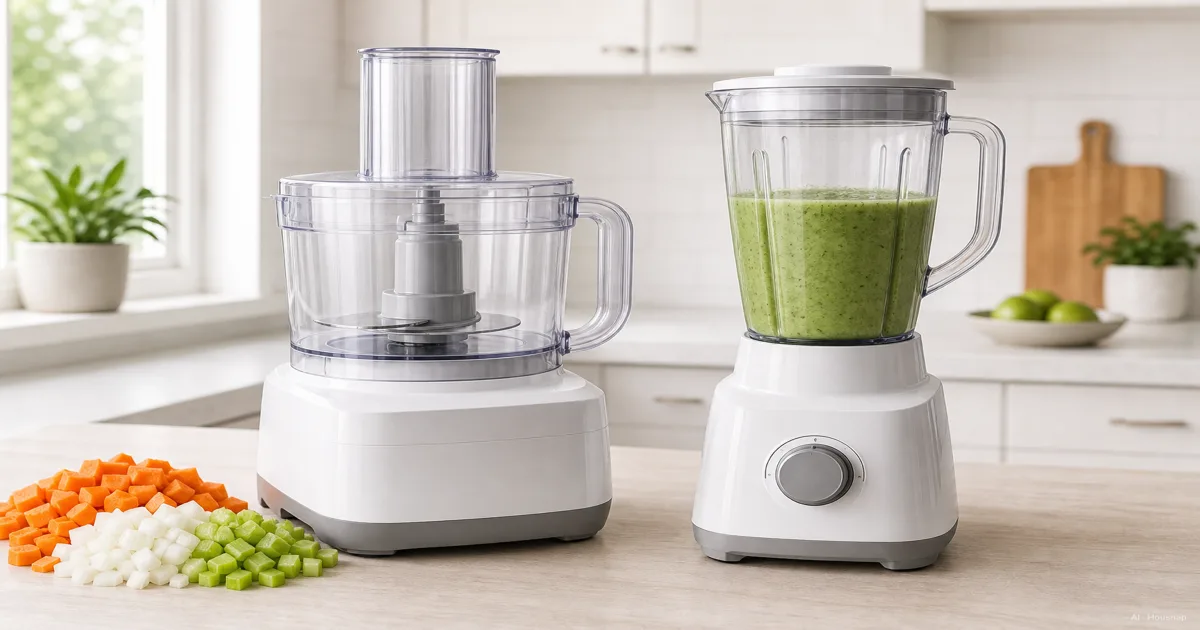


Choose the job you want to stop doing by hand
Write down three things you already make and circle the task you most want help with. Choose for that task before comparing accessory counts.
- Chopped ingredients and sliced vegetables. Start with food processors; make slicing or shredding discs a requirement if those are the jobs you want.
- Smoothies and smooth soups. Start with countertop blenders. Those are among their core uses in KitchenAid’s comparison.
- An occasional small prep job. Keep the knife for now if setting up and washing a machine feels like more work than the task itself.
For a mixed routine, decide which compromise you would rather keep: chopping by hand or going without a dedicated smoothie machine. You do not have to buy both immediately.
Check the overlap before buying a second machine
Hummus alone does not settle this comparison. Vitamix publishes a blender hummus recipe that uses a tamper. If you already own a blender, look for a manufacturer recipe suited to its container before assuming you need another appliance.
Nor is chopping vegetables impossible in a blender: KitchenAid describes small-batch chopping. That does not make it a substitute for a slicing disc. Specify the result you want: chopped onion, intact cucumber slices or a smooth dip.
When a recipe needs a tamper, check that the correct one is supplied or compatible. Do not buy a generic stick based on appearance.
Choose a mini chopper or a processor with the right discs
For small amounts of herbs and dips, a mini chopper is worth considering. The Cuisinart DLC-2A illustrates the format: a 24-ounce bowl, a reversible Chop/Grind blade and short pulses for texture control. Pulse means brief bursts rather than continuous running.
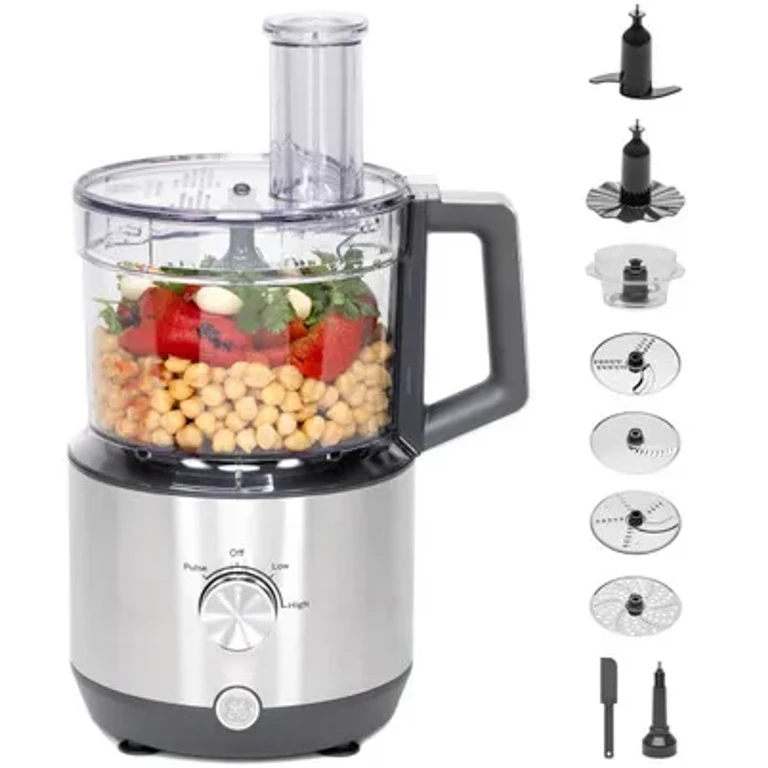
If your aim is slicing vegetables or shredding cheese, inspect the included discs before choosing by bowl size. The Cuisinart FP-7 provides a contrasting example: a seven-cup bowl, slicing/shredding discs and a universal blade also specified for dough.
These are examples of different equipment, not a requirement to buy either model. Do not start with a mini merely because you are a beginner if discs are the reason you wanted a processor.
Check your batch, kitchen space and soup plans
Before paying, open the candidate’s manual and match it to one real recipe.
- Batch size. Check the permitted amount for the job. For liquids, use the marked limit or manual; KitchenAid warns that overfilling can cause leakage.
- Storage and washing. Measure your shelf and counter space, then check which parts need washing and where the discs will live.
- Hot soup. Verify the exact container’s instructions. Vitamix prohibits hot blending in its unvented 20-ounce container; a brand name alone does not establish suitability.
If soup is the main reason you are shopping, the next question is whether an immersion or countertop blender fits your routine. Make that choice before committing to a jug machine.
How this guide was built
AI wrote this guide for Chexlow using KitchenAid’s comparison and product help, Cuisinart’s product specifications, and Vitamix’s recipe and owner guidance. The editorial focus is choosing a first appliance by task and equipment; this is not a hands-on product test.
Edited by the Chexlow team · Images are AI-generated illustrations