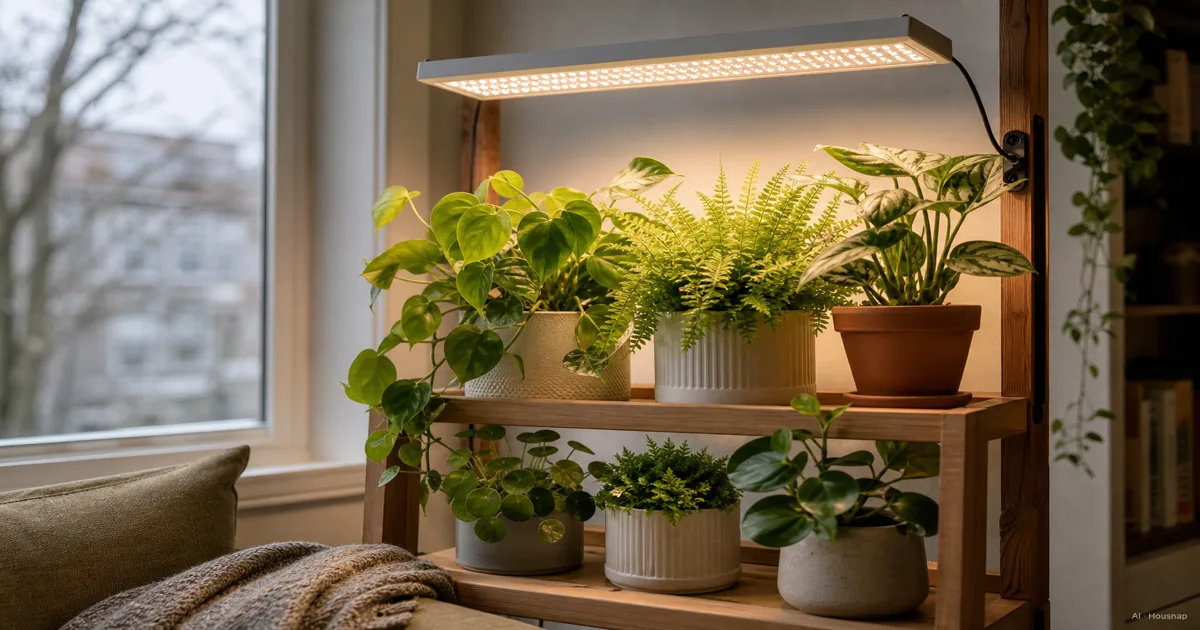
Start with the plant and the place
Before comparing lamps, write down the plant, whether you want foliage or flowers, and where it will live. Light requirements change with species and growth stage: a young pepper plant and one carrying fruit do not need the same daily amount. UNH Extension explains the difference.
Use available daylight first. A brighter suitable position may remove the need to buy a lamp; a dark corner or weak winter daylight may justify supplemental lighting. That is the starting point in the RHS guidance.
If you have not chosen a plant yet, compare houseplants suited to lower light before sizing the light. Choosing the plant and choosing its lighting are connected decisions.
Compare light at leaf height, not the biggest number
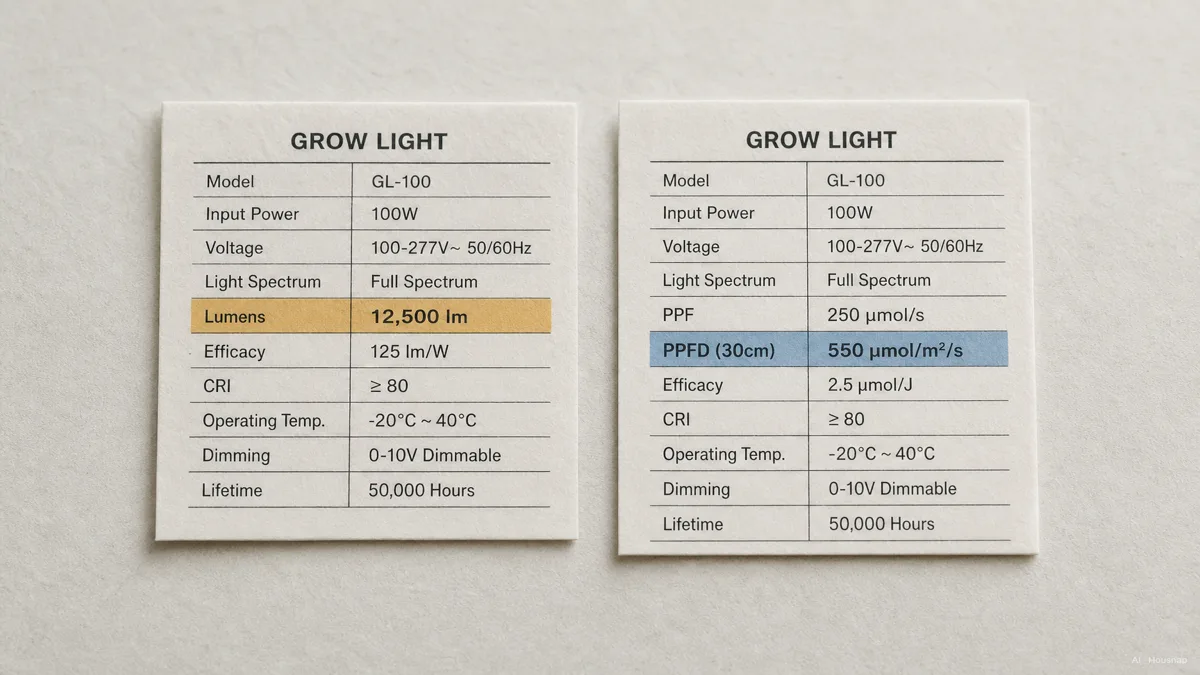
The abbreviations describe different things:
- PAR is the conventional 400–700 nm wavelength range used for photosynthetic-light measurements. It is a range, not a brightness rating. Apogee’s technical manual defines it.
- PPF, in μmol/s, describes the fixture’s total PAR photon output each second.
- PPFD, in μmol/m²/s, describes the photons arriving at a surface each second. Look for measurements at plant height across the growing area, including its edges, rather than a single central reading. Fluence explains both measurements.
Watts describe power use; lumens describe light weighted for human vision. Neither directly establishes the light reaching your plants. Iowa State explains these limitations.
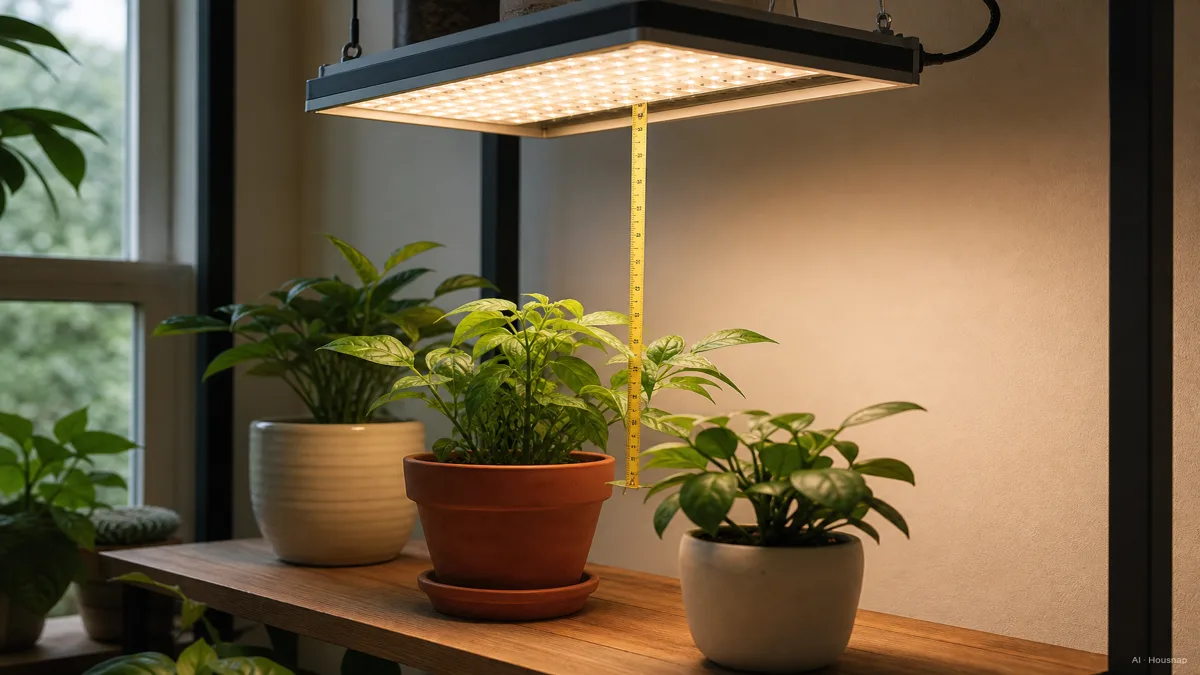
For each candidate, record the measured distance, covered width and depth, output setting, and PPFD distribution. If one light is measured closer than another, their headline numbers are not a fair comparison. Missing data is a reason to ask the supplier, not proof that the lamp cannot grow plants.
Choose the shape first, then the light color
Use these as a shortlist, then check each candidate’s measured coverage:
- One pot. Consider an adjustable single-head fixture that can aim at the whole plant.
- A row of pots. Start with a linear grow light that fits the shelf.
- A wider group. Compare panels or multiple bars using the outer plants’ positions, not just the center pot.
For a shared living space, a white or balanced LED is a sensible default. The University of Minnesota describes white or balanced light as suitable for most plants at different growth stages.
That does not make “full spectrum” a guarantee of adequate output. Keep a red/blue candidate if its documented performance and appearance suit your setup; do not assume its color makes it exclusively a flowering light. Choose the format and spectrum together with the coverage evidence.
Check that the recommended installation fits
Measure from the planned light position to the top leaves, leaving room to adjust as the plant grows. Follow the chosen fixture’s instructions. Iowa State’s setup guide recommends adjustable positioning and installation according to the product directions.
There is no useful universal shopping rule that turns wattage into a hanging distance. A lamp is a poor fit if its documented setup will not fit your shelf, even when its output looks impressive.
Before ordering, check the mounting method, included hardware, cable reach, required power supply and permitted operating environment in that model’s manual. For a shelf above watered pots, check the instructions for moisture exposure rather than assuming every grow light is splash-resistant.
Set the daily light amount and make the purchase decision
PPFD does not increase because you leave a lamp on longer. The accumulated daily amount is DLI, measured in mol/m²/day. For a constant lamp output, DLI = PPFD × hours × 0.0036. At 100 μmol/m²/s for 14 hours, the lamp contributes 5.04 mol/m²/day; daylight is additional. This is an arithmetic example, not a target for every plant. Virginia Tech explains the calculation.
For foliage houseplants, Minnesota suggests 12–14 total hours of light daily as general guidance. Count daylight and lamp exposure together without counting overlapping hours twice. Flowering plants can have specific day-length requirements, so check the species before extending the schedule. See Minnesota’s duration guidance.
Use the built-in scheduler if it meets that plan. Otherwise, consider a compatible plug-in timer; automatic switching is its job, not correcting an unsuitable light. A timer is also recommended in the SunLite Garden manufacturer instructions. Confirm your particular lamp can resume operation when the timer restores power.
- Ready to buy. You know the plant’s requirement, have usable coverage data at an achievable height, and have accounted for mounting and scheduling.
- Ask before buying. The listing gives only a central PPFD peak, no measurement distance, or unclear installation instructions.
- Reduce the scope. If the complete setup exceeds your budget, illuminate a smaller plant area rather than accepting undocumented coverage.
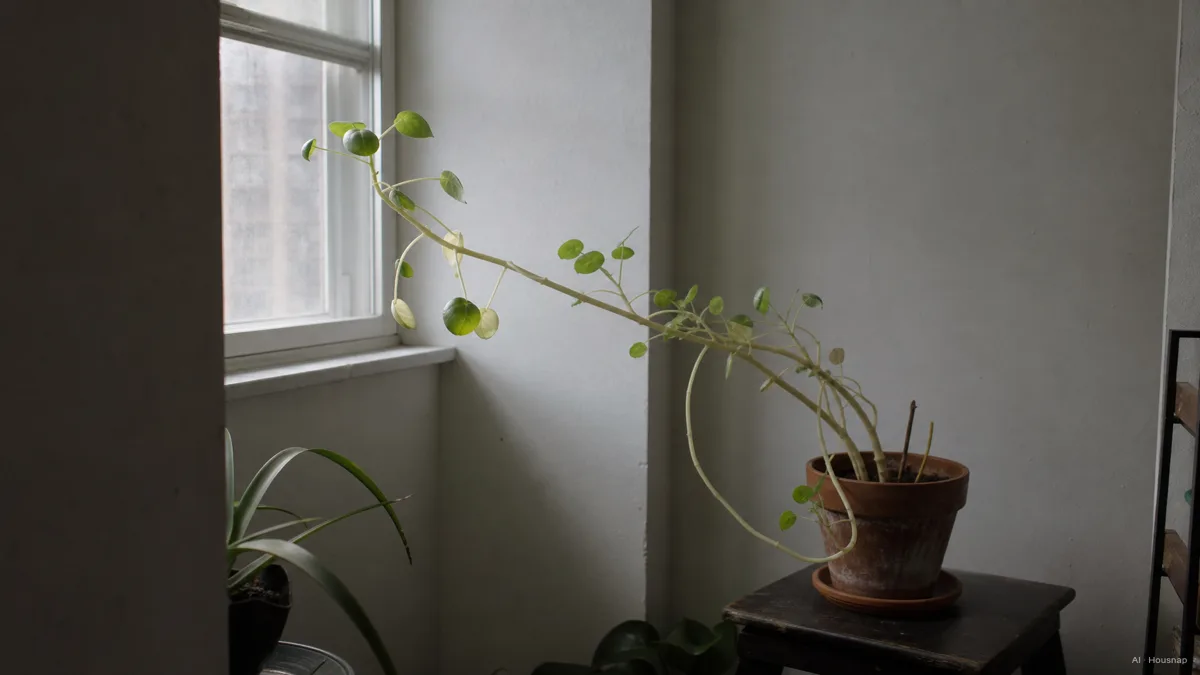
After installation, assess new growth. Extra light cannot shorten a stem that has already stretched, as UNH Extension notes.
How this guide was built
This guide was written by AI for Chexlow, using horticultural guidance from university extension services and the RHS, technical lighting definitions from Fluence and Apogee, and manufacturer instructions for timer use. It focuses on selecting and planning a first home grow-light setup; the format shortlist is an editorial aid, not a report of product testing.
Edited by the Chexlow team · Images are AI-generated illustrations