Choose the measurement before the thermometer
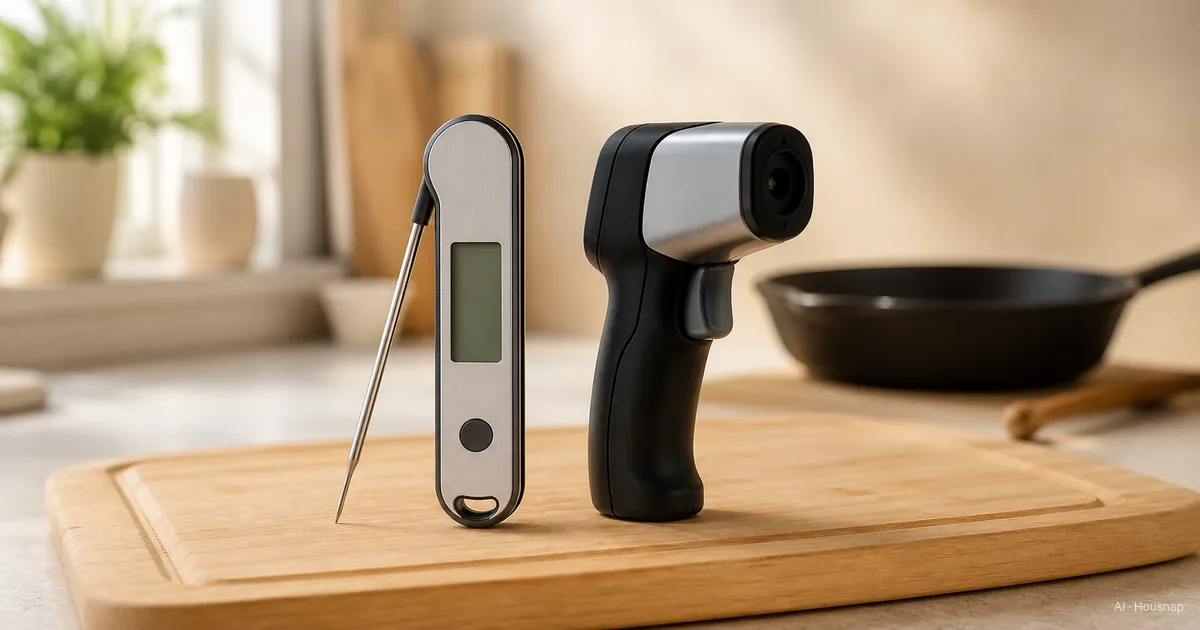
A probe goes into food; infrared reads its surface. If your question is whether chicken is cooked through, buy the probe first. If you already have that covered and want surface readings, infrared is a separate buying option. ThermoWorks explains this distinction.
Need a reading throughout cooking? Look for equipment explicitly designed to stay in place. An instant-read label alone does not establish that capability. ThermoWorks’ usage guidance distinguishes heat-resistant probes from housings that must stay cool.
Compare the specifications your cooking needs
Use these checks to narrow the shortlist:
- Accuracy and range. Find the stated error at your intended cooking temperatures. Displaying decimal places does not establish accuracy.
- Response time. Compare time to a usable reading, not how frequently the screen updates. ThermoWorks’ measurement guide explains the difference.
- Probe fit. Check the required insertion depth against the foods you cook, rather than imposing one minimum shaft length on every kitchen. USDA’s thermometer guide explains sensor placement.
Sugar work does not automatically require another thermometer. ThermoWorks uses an instant-read probe for periodic caramel measurements. Check range and suitability first; if continuous monitoring is your priority, investigate a compatible leave-in setup such as those described in its alarm-thermometer guidance.
Check whether infrared suits the surface
Shiny metal can produce misleading infrared readings. Check the instrument’s emissivity setting, which accounts for how a surface emits infrared energy, and its distance-to-spot instructions. The measured area grows with distance; it is not simply the laser dot. See ThermoWorks’ infrared guidance.
Before buying, name the actual surface you want to measure. “For the kitchen” is not enough to settle compatibility.
Make the probe easy to use and clean
Place the sensing area in the thickest part, avoiding bone, fat and gristle. For thin food, approach from the side; check irregular pieces in several places. Follow the model’s insertion instructions. USDA explains placement.
Do not lift food with the measuring probe. If handling food is the next obstacle, compare kitchen tongs by tip and length.
Read the cleaning instructions before choosing. For example, the IP67-rated Thermapen ONE still prohibits dishwashing and being left in an oven or on a hot surface. Its manual also warns against lifting meat with the probe. Those are model-specific limits, not contradictions in the rating. Thermapen ONE instructions.
Check the new probe before relying on it
Pack a cup with ice, add water just below the ice level and wait one to two minutes. Stir with the probe, clear of the walls and bottom. Compare the reading with 0°C and the model’s tolerance. Ice-bath method.
If it remains outside specification, follow the maker’s adjustment or service instructions. A check at one temperature does not establish the same correction everywhere: accuracy can vary across the range. ThermoWorks explains range-dependent accuracy.
How this guide was built
This guide was written by AI for Chexlow, using USDA thermometer guidance and ThermoWorks documentation on measurement, instrument care and accuracy checks. It focuses on choosing a first cooking thermometer; named products illustrate documented limits rather than results from hands-on testing.
Edited by the Chexlow team · Images are AI-generated illustrations