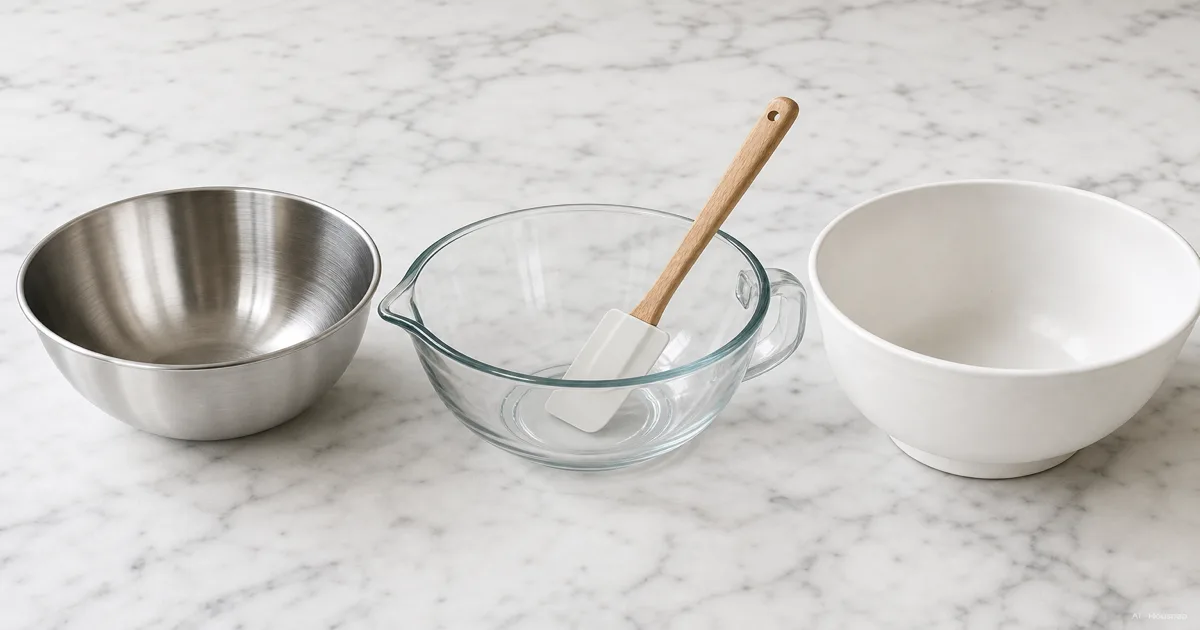
Choose around the task you repeat
Think about the last recipe you made, not an imaginary kitchen that needs every kind of bowl.
- Lifting and tilting while mixing. Start with stainless steel. KitchenAid describes its bowls as lightweight and suitable for chilling before cream or cold-butter work.
- Watching ingredients combine. Clear glass lets you see through the sides. If you also want to microwave ingredients in it, check the particular bowl's instructions first.
These are useful differences in KitchenAid's material guide, rather than reasons to buy both automatically.
Ceramic is a real mixing option, too. Le Creuset's stoneware batter bowl is designed for batter and dough, with a handle and pouring spout. Consider this kind of bowl if you want a design you enjoy keeping out, then compare its weight and grip with the other candidates. A decorative serving bowl is not a substitute for a product intended for mixing.
Check heat permissions before choosing glass
“Glass” is not a microwave rating. KitchenAid specifically excludes its metal-banded bowl-lift glass bowls from microwave use in its compatibility guide. Look for explicit permission on the exact bowl, and check any lid separately.
Heat resistance also does not remove the risk of sudden temperature changes. Pyrex's instructions say not to add liquid to hot glass or ceramic ware, put hot ware on wet or cool surfaces, or wash it before it cools. Those constraints matter if your plan is to melt an ingredient and immediately add something cold.
Choose a microwave-approved bowl when that step is central to your recipes. Otherwise, there is no need to make heating capability your deciding feature.
Pick usable space, not a promised batch count
All-Clad's set contains 1.5-, 3- and 5-quart bowls that nest. That is one useful size ladder, not a guarantee that each bowl holds a particular cake or a double batch.
Use your usual recipe to decide:
- Small prep bowl. Prioritize it when you regularly keep one ingredient separate before combining.
- Main mixing bowl. Leave room above the ingredients to stir and fold; do not plan to work at the rim.
- Larger bowl. Buy it for a real larger-volume task, after checking where you will store it.
Compare diameter and depth as well as capacity. Picture your whisk reaching the bottom and your hand holding the rim. If you are buying one bowl, choose it for your most frequent recipe rather than automatically choosing the largest.
Pay for the features you will actually use
A slipping bowl, awkward grip and messy pour are separate problems. Match the feature to the one you have: OXO's mixing set illustrates non-slip bases, handles and spouts.
Also inspect the construction. OXO's stainless set has a plastic exterior around its steel interior. The material named in the title does not describe every component, so read the whole product's care instructions.
Before ordering, check that the bowl fits your cupboard, that you can grip it while pouring, and that the listed washing method suits your routine. If choosing a tool for folding or scraping is the remaining question, compare silicone spatulas and wooden spoons.
For a stand mixer, start with the model number
A matching capacity is not enough. KitchenAid's compatibility guidance separates bowl-lift, tilt-head and mini tilt-head systems; some bowl changes also require different beaters.
Write down your mixer's full model number, find a bowl explicitly listed for it, and confirm the required attachments before choosing the finish. KitchenAid also makes ceramic tilt-head bowls, so ceramic itself is not a reason to rule out a mixer bowl.
If you have not chosen the appliance yet, resolve stand mixer versus hand mixer before buying a dedicated replacement bowl.
Keep useful bowls and buy the missing capability
An existing plastic bowl need not be discarded just because you are buying another material. For meringue, though, King Arthur Baking prefers metal, glass or ceramic because used plastic can retain an oily film that is hard to remove. Its advice makes an exception for new plastic or bowls never used with fatty ingredients; it is not a blanket ban on plastic for baking.
Check condition as well as material. Pyrex says to stop using its chipped, cracked or severely scratched ware.
For a first purchase, make a short list: the task, the needed capacity, heating permission if relevant, and mixer compatibility if relevant. Choose stainless for handling, approved glass for a microwave-based workflow, or a purpose-made ceramic bowl you can comfortably use. Add a set only when you can name a job for its different sizes.
How this guide was built
AI-written for Chexlow, using manufacturer documentation from KitchenAid, Pyrex, All-Clad, OXO and Le Creuset, plus King Arthur Baking's meringue guidance. This guide turns those sources into practical bowl-selection criteria; it does not report hands-on product testing.
Edited by the Chexlow team · Images are AI-generated illustrations