Choose for the job you actually do
- Different pans and lift-out bakes. Parchment can be cut into cake-pan liners or arranged as a sling for lifting cooled brownies. That flexibility is a practical reason to start with paper. Reynolds’ lining methods show both uses.
- Repeated baking on one tray. A washable mat is worth considering when its size suits your usual pan. Buy one first and see whether you actually prefer using and cleaning it.
- Sticky sugar work. Don’t rule out silicone simply because you make caramel. Silpat’s manufacturer catalogue explicitly lists caramel and taffy among its uses. Follow the confection recipe and the particular mat’s instructions.
You don’t need to replace every sheet of parchment with a mat. Keep paper for jobs that require cutting or folding, even if a mat becomes your regular tray liner.
For cookies, try the recipe before changing the liner
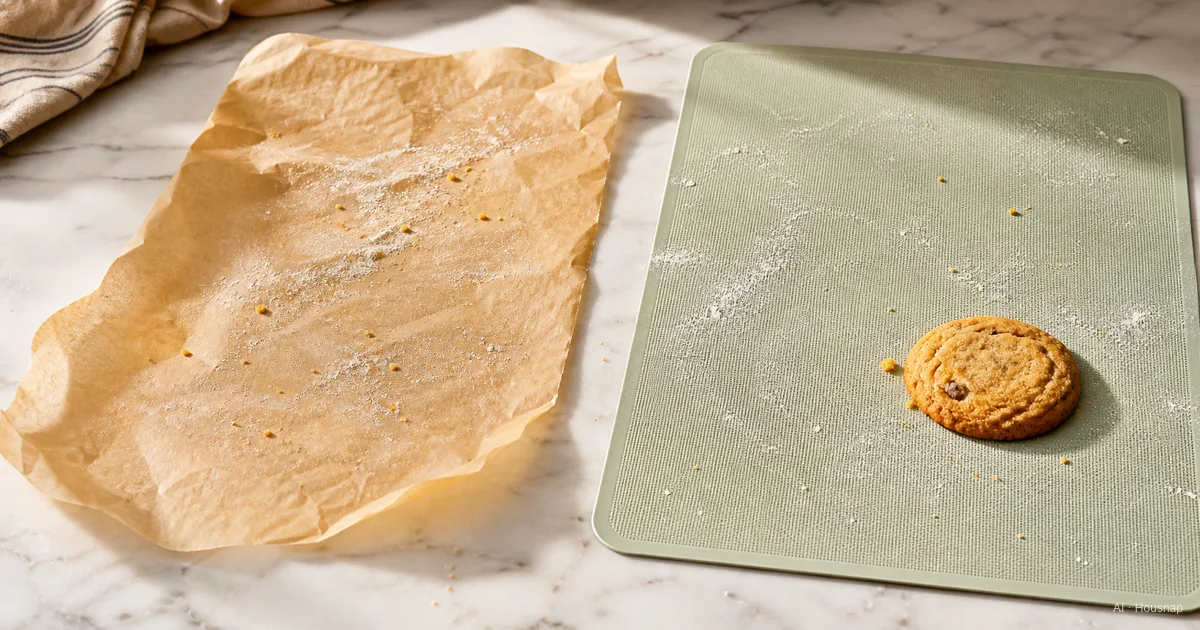
Neither surface guarantees a thicker, crispier or paler cookie. King Arthur’s cookie guidance reports good results with both parchment and its nonstick mat, and recommends baking one or two test cookies.
Use the specified liner first. If you switch, keep the dough portion, chilling and pan the same, then compare spread, bottom colour and texture before loading a full tray. Treat this as a recipe adjustment, not an automatic upgrade.
Check the package, oven setting and pan fit
An oven-safe label is only useful alongside its limits. For example, Reynolds’ parchment roll instructions specify 425°F, about 218°C, and exclude broiling and toaster-oven use. That rating does not cover a bread recipe at 230°C.
Silicone also needs a product-specific check. Maison Demarle’s professional Silpat sheet distinguishes recommended operating temperatures from a short temperature peak. Don’t treat a peak rating as permission for an entire bake.
Measure the pan’s flat interior before buying a mat; don’t plan to trim a reinforced mat to fit. If the pan itself is still undecided, start with choosing an aluminum or nonstick baking sheet, then choose its liner.
For exposed cookie-tray lining, wax paper is not a substitute. Reynolds explains that its wax paper melts when exposed to oven heat.
Compare the cost of your actual use
Work out paper cost per trayful as the sheet price divided by the number of suitable uses you actually get. Compare that with the mat price divided by your expected uses, then allow for washing and drying. These are budgeting calculations, not promised lifespans.
Parchment is not necessarily single-use. King Arthur’s reuse guidance allows suitable baked-on sheets to be reused, but says to discard paper used with meat or fish, or left wet and sticky with batter residue. Follow your paper’s instructions too.
If you bake occasionally or dislike washing a large flexible mat, paper may remain the better purchase even when a mat could eventually cost less per use.
Decide whether the care suits you
Maison Demarle’s care guidance calls for gentle cleaning and warns against cutting tools, folding and direct heat sources. Follow your mat’s washing instructions, rinse it thoroughly and let it dry before storage.
Don’t judge condition by colour alone: Silpat’s care sheet says discoloration and an oily feel can be normal. Inspect damage separately; if the surface is cut or the reinforcement is exposed, stop using it and ask the manufacturer about replacement.
Before buying, check three things together: it fits your pan, its instructions cover your cooking method, and you have somewhere to wash, dry and store it.
How this guide was built
This comparison was written by AI for Chexlow, using Reynolds’ product instructions, Silpat and Maison Demarle documentation, and King Arthur Baking’s published guidance. It focuses on choosing and using baking liners; the recommendations are editorial judgments, not results of our own product testing.
Edited by the Chexlow team · Images are AI-generated illustrations