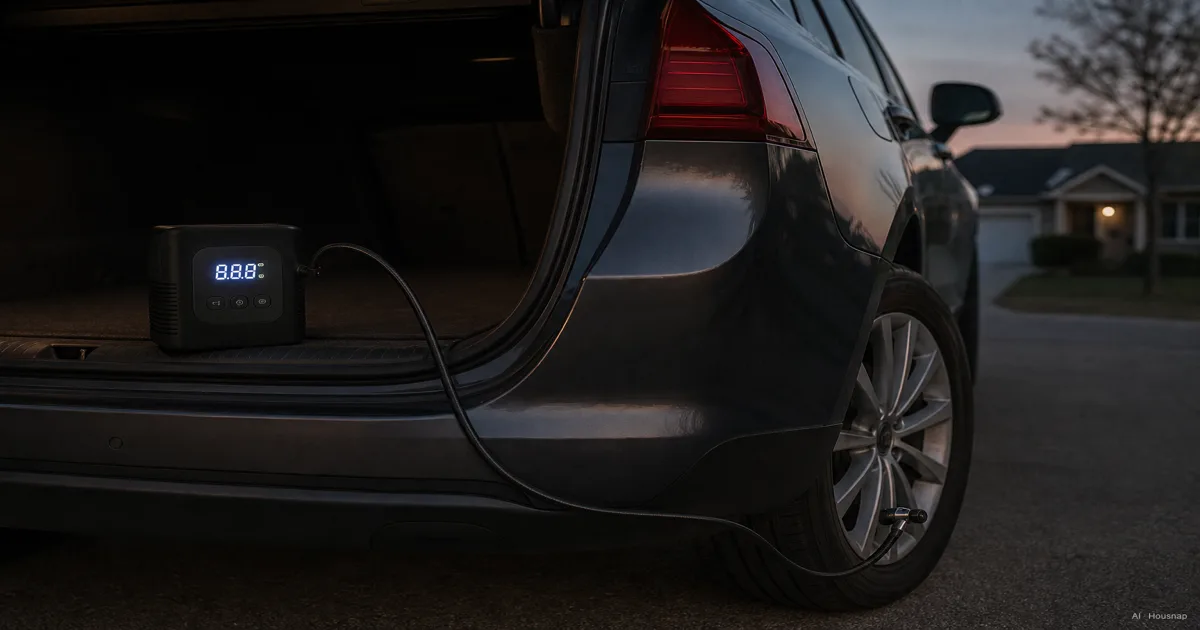
Start with your tires and the job you need done
Before comparing pumps, write down your tire size and the vehicle’s recommended cold pressures, including the spare if fitted. Use the vehicle label or handbook; the tire’s maximum pressure is not your target. NHTSA defines cold as at least three hours without driving. NHTSA tire guidance
Decide whether you need routine top-ups or repeated, larger fills. A flat or damaged tire changes the task: arrange inspection rather than treating a powerful pump as a repair. Michelin warns against reinflating a damaged tire before professional assessment. Michelin flat-tire guidance
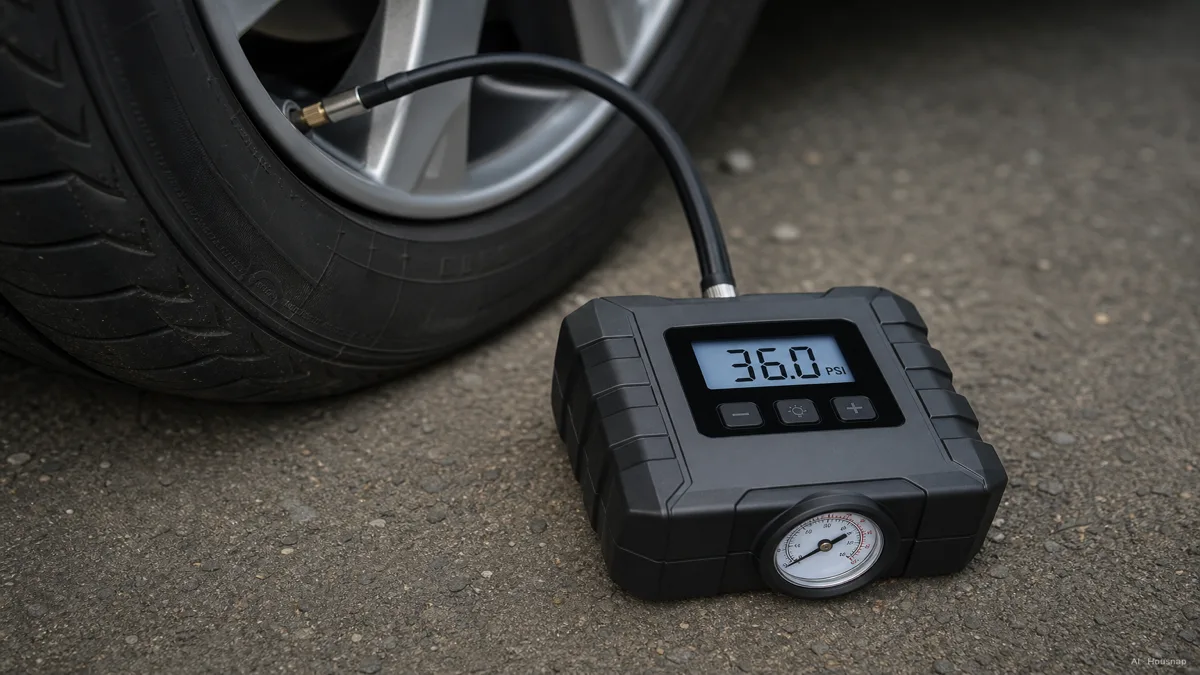
Choose the power connection you can actually use
- Cordless. Start here if avoiding a cable matters most and you can keep the battery charged. Check whether the battery is built in or uses a tool platform you already own. Xiaomi’s Air Compressor 2, for example, charges through USB-C at 5V/2A; a USB-C socket alone does not tell you its charging requirements. Xiaomi FAQ
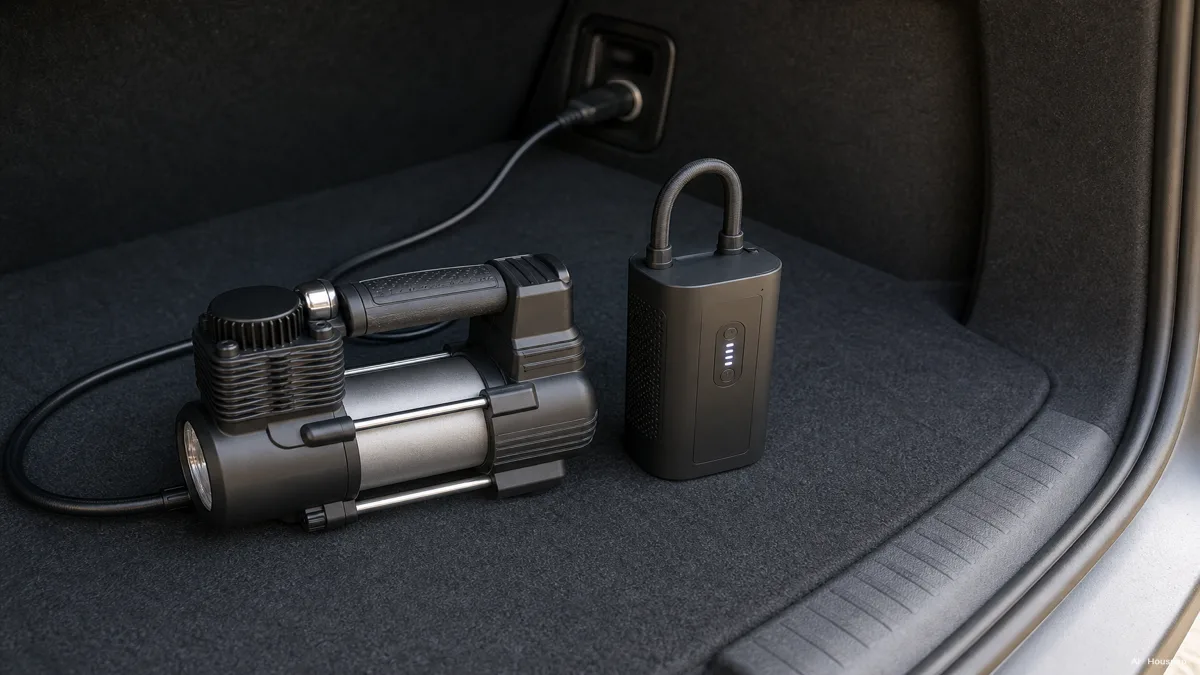
- Vehicle socket. Consider this for use beside the car, after checking the socket rating and cable reach. The DEWALT DCC020I requires a socket rated at least 10A and also accepts compatible tool batteries. Check the exact package for the battery, charger and power accessories you need. DEWALT manual
- Battery clamps. Read the connection instructions before buying. The VIAIR 88P uses clamps and requires the engine to run, so its operating setup differs from a socket-powered pump. Its manual also requires a well-ventilated location. VIAIR manual
These are connection choices, not a speed ranking. Narrow the field by the power you can provide, then compare performance.
If you also want to prepare for a discharged starting battery, continue with choosing a car jump starter. Treat starting the engine as a separate requirement when considering a combined device.
Compare filling work, not just the biggest number
PSI is a pressure unit; maximum PSI describes the pump’s pressure limit. CFM means cubic feet per minute, while LPM means liters per minute: both describe airflow. Ask what pressure the flow rating uses. VIAIR lists the 88P’s 1.97 CFM at 0 PSI, alongside a separate operating limit of 25 minutes at 30 PSI. Neither number promises that output or uninterrupted operation at every pressure. VIAIR specifications
For a useful speed comparison, ask for the same tire size, starting pressure, target pressure and power conditions. Xiaomi’s laboratory figures illustrate why: with a full battery at 25°C±2°C, its Air Compressor 2 takes about two minutes for a 205/55 R16 tire from 2.0 to 2.5 bar, versus eight minutes from 0 to 2.5 bar. Those are manufacturer test conditions, not a promise for your car. Xiaomi test details
For several tires, check the permitted running period and required cooling breaks as well as battery capacity. If the listing omits those limits, read the manual before choosing.
Check control, reach and the complete kit
Prefer a readable display, a target pressure you can set yourself and controls you can stop promptly. Automatic shutoff is useful, but stay with the pump and verify the result. DEWALT specifically calls for a separate tire gauge after inflation. A gauge is a supporting tool here; use a suitable one you already own or include it in your kit. DEWALT manual
Measure the route to the farthest tire and check hose reach at different valve positions. Xiaomi specifies a 200mm hose including its adapter, so a small body does not by itself answer whether the hose will reach comfortably. Xiaomi FAQ
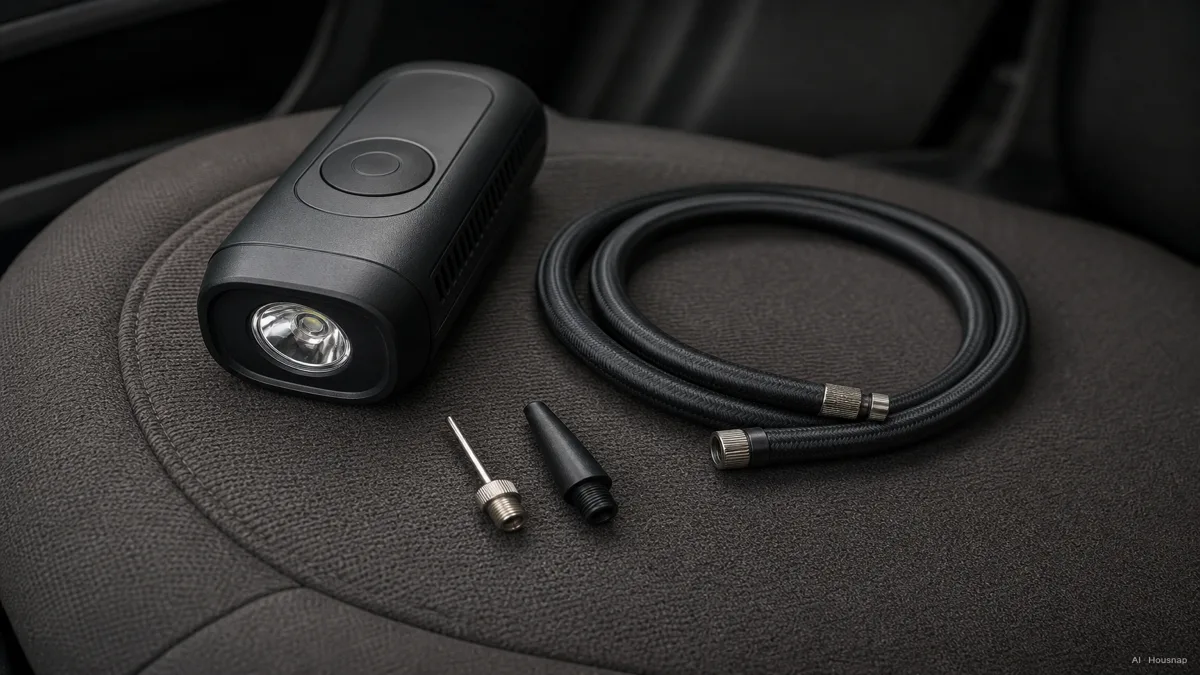
Do not buy on nozzle count alone. Xiaomi says its tire pump is slow for low-pressure inflatables; DEWALT offers a separate high-volume mode, but that mode has no automatic shutoff. Confirm the intended object, pressure range and mode before counting an air mattress as an extra use. Xiaomi FAQ · DEWALT manual
Before ordering, you should be able to answer:
- Does it fit the job? Supported tire size, target pressure and comparable filling data.
- Can I power it? Correct connection, adequate reach and the necessary charging equipment.
- Can I finish safely? Stated running and cooling limits, usable controls and a way to verify pressure.
How this guide was built
This guide was written by Chexlow's AI editor using NHTSA and Michelin tire guidance and manufacturer documentation from DEWALT, VIAIR and Xiaomi. It organizes those sources into first-purchase checks; model examples explain specific constraints rather than a tested ranking.
Edited by the Chexlow team · Images are AI-generated illustrations