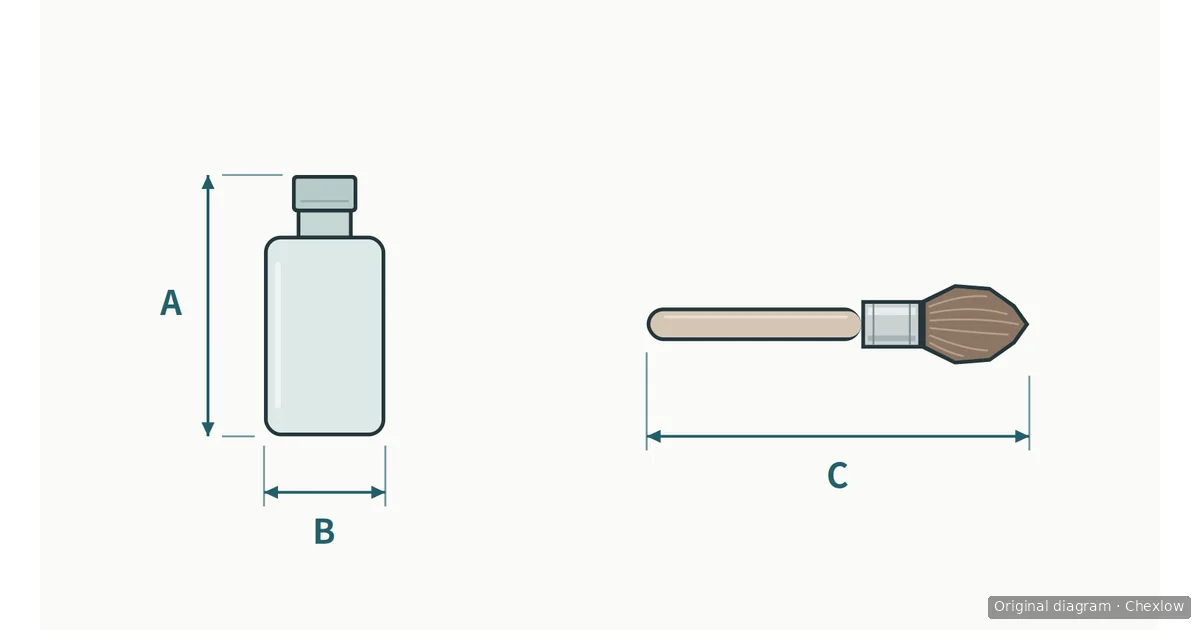

Measure the items that determine the fit
Start with the tallest bottle and longest brush you actually intend to carry. Use a measuring ruler or tape measure you already own, and record everything in the same unit.
- Bottles. Measure height with the cap or travel cover fitted, plus the widest part of the container. If you want bottles upright, ask for usable compartment height and the space available at the base.
- Brushes. Measure from the end of the handle to the tip of the bristles. Include any case or cover you will keep on, and check that the brush compartment has room for the head as well as the handle.
- The complete set. Arrange the bottles and brushes in the positions you intend to use. A tall bottle and a long brush may each fit separately but compete for the same space when packed together.
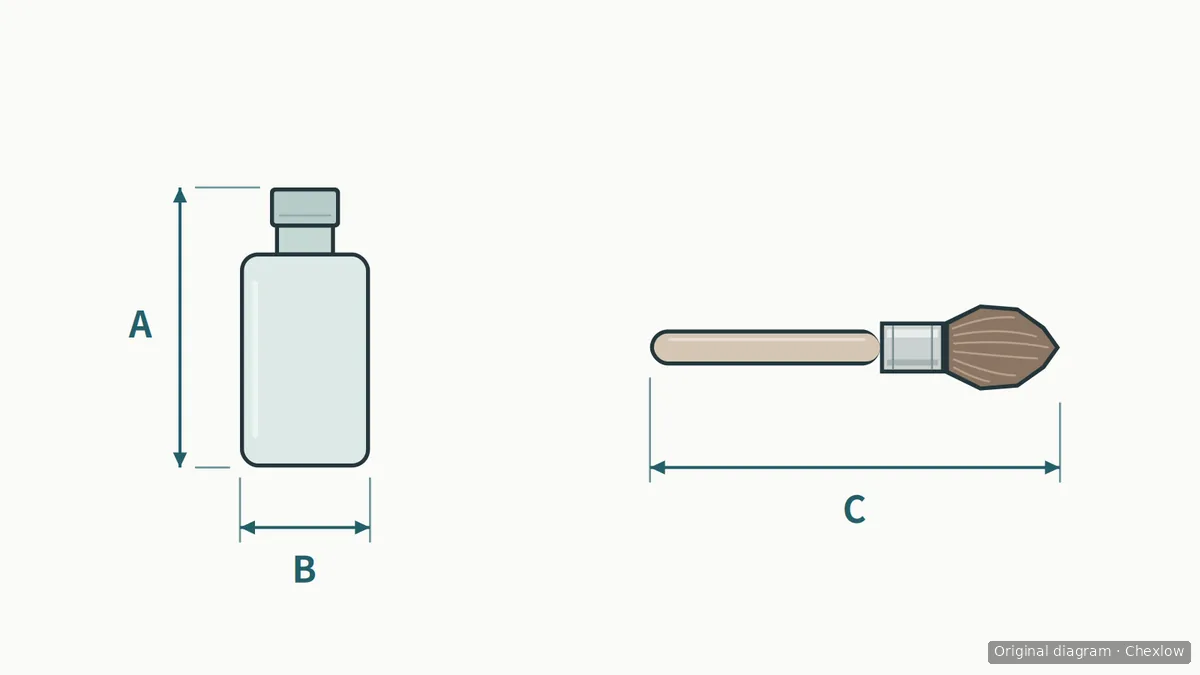
A is bottle height including the cap, B is the bottle’s widest span, and C runs from handle end to bristle tip. The diagram shows what to measure, not a life-size template or a pouch capacity test; measure any additional covers too.
Published pouch dimensions are only the starting point. For example, Anya Hindmarch’s Logo Make-Up Pouch lists H13.5 × W20.5 × D7 cm, brush slots and a bottom zipped pocket. That specification does not give the usable length of each brush slot. Ask for internal measurements and opening dimensions when your items look like a close fit.
Choose separation that earns its space
A single main compartment is worth considering when you carry a few bottles and already have a suitable brush case. Pack that case into your measurements rather than assuming it will disappear into spare space.
Choose dedicated brush storage when you want brushes kept apart from the bottles. Check the length and width of the slots, where the bristle heads sit, and whether the closed pouch presses against them. A stated brush count does not establish that your particular brushes fit.
For a more divided layout, Anya Hindmarch’s Logo Vanity Kit specifies a tools section with space for 10 brushes and elastic bottle holders in the main compartment. Its listed dimensions are H15 × W24.5 × D17 cm. Those features illustrate what extra structure can provide; they do not make this the right size for every kit.
Give each divider or holder a job. If the holder is too narrow for your bottle, or the brush section cannot take your longest brush, reject that layout rather than buying a larger version on guesswork. A roomy main compartment can be more useful than several pockets your items cannot use.
Check cleaning access separately from leak protection
Look inside the pouch, especially the bottom corners and brush section. Ask what the lining is made from, which cleaning method the maker permits, and whether pockets can be reached or pulled out for cleaning.
Peak Design’s Small Wash Pouch provides a concrete example: the maker describes wipeable interior and exterior surfaces, pull-out pocket linings, four silicone-coated mesh dividers and an interior zip pocket for small items. These are useful features to compare with a simpler pouch, particularly if you want to reach residue inside pockets.
Do not turn those descriptions into a promise that leaked liquid will stay inside. Wipeable surfaces, mesh dividers, bottle holders and a water-resistant claim answer different questions from whether the complete pouch contains a spill. If containment matters, ask for explicit evidence covering the finished pouch, including its seams and closure.
Before buying, read the care instructions for the exact model. Permission to wipe a lining is not permission to machine-wash the whole pouch, and a material name alone does not settle the cleaning method.
Make the final choice with everything packed
Try the candidate with your actual set whenever possible. The closure should work without pushing down bottle tops or bending bristles, and you should be able to take out the item you use most without emptying the pouch.
- Keep the smaller candidate if everything fits in its intended position and remains easy to retrieve.
- Change the layout if brushes and bottles compete for space despite unused pockets elsewhere.
- Size up only for a specific unmet need, such as the height of an upright bottle or the length of a covered brush.
- Ask before ordering if internal dimensions, brush-slot size or cleaning instructions are missing; check the seller’s return conditions too.
Finally, put the filled pouch into the bag you will carry. If the pouch works but your everyday bag no longer holds the rest of your essentials, use the handbag size guide to assess that separate decision. Choose the pouch for the cosmetics it must hold, then check the space the filled pouch occupies.
Wie dieser Guide entstand
This article was written by AI for Chexlow, using manufacturer pages from Anya Hindmarch and Peak Design to distinguish dimensions, compartment layouts and cleaning features. The measuring and selection sequence is editorial guidance, not an original packing or leak test, and specifications from one model should not be transferred to another.
Original SVG diagrams created for Chexlow