Chexlow

Category · Bags / Sizing

Handbag Sizes, What Mini, Small, Medium, and Large Actually Hold

Almost every time someone returns a bag without using it, the reason is the same. The size on the website looked fine, the size in the hand turned out to be slightly off for what the day actually needs. The labels mini, small, medium, large are not standardized across brands, so the same word can mean a 16 cm pouch at one maison and a 24 cm shoulder at another. The simpler way to choose is to know what each size actually carries and what it gives up.

Handbag Sizes, What Mini, Small, Medium, and Large Actually Hold

Current products to compare

These products come from Chexlow search results for this topic.

Current products are not ready yet

Use search while this guide waits for enough store prices.

Search current products

Mini, small, medium, large.

On a product page those four words feel obvious. In the hand, they are almost never as comparable as they look. The same word stretches across very different physical bags depending on the maison and the style — a "small" at one house can be a "mini" at another, and a "medium" tote sits closer to most people's idea of a large.

The simpler way to decide is to stop comparing labels and start comparing what each size actually holds. Width sits in a pretty stable range across brands once you do that, and the day each size is built for becomes a lot easier to see.

A note on measurements before going in. Bag dimensions are almost always listed as width by height by depth (W × H × D), in centimeters. The width is the single most important number — it is what decides whether your wallet or your sunglasses case lies flat or has to be wedged in. Height matters for what stands up inside; depth matters for what you can stack.

Mini, the going-out size

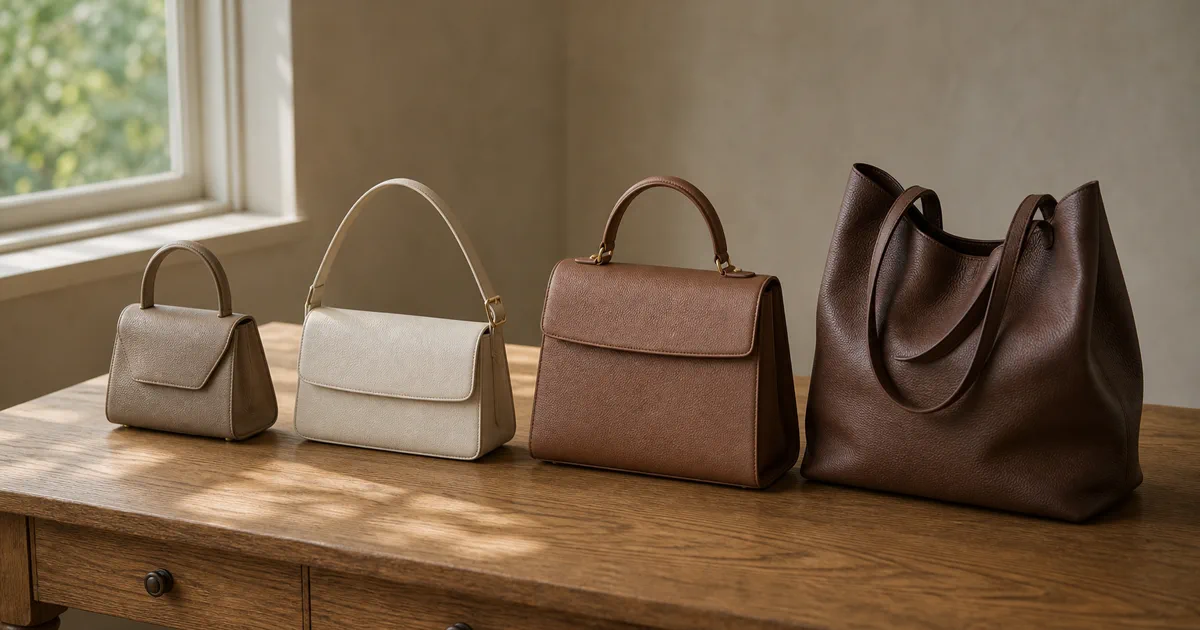
Four leather handbags arranged in a row on a matte oak desk in soft natural daylight, from a small structured top-handle to a roomy tote, showing the visible difference in width and capacity across mini, small, medium, and large (AI generated illustration)
AI-generated illustration

Mini bags sit roughly at 17-20 cm width, 10-18 cm height, and 4-8 cm depth.

That is enough room for a phone laid flat (a 16 cm iPhone Pro Max model fits in most mini bags but with very little extra room), a slim card case or short wallet, a key set, a lipstick, and one folded face mask or similar slim item. That is most of it. A pair of sunglasses in a case usually does not fit. A water bottle does not fit. A book does not fit.

The mini bag is the going-out bag, the dinner bag, the day-trip bag where you are not planning to carry anything you do not strictly need. It reads as deliberate dressing because the silhouette is small and structured, and because the shape is not trying to do too much.

The trade-off is that it gives up half a wallet. Most full-size wallets do not fit a mini; a short wallet or a card case is the move. If your daily wallet is full size, a mini bag means swapping wallets every time you go out, which most people stop doing after the first few months.

Small, the everyday minimal

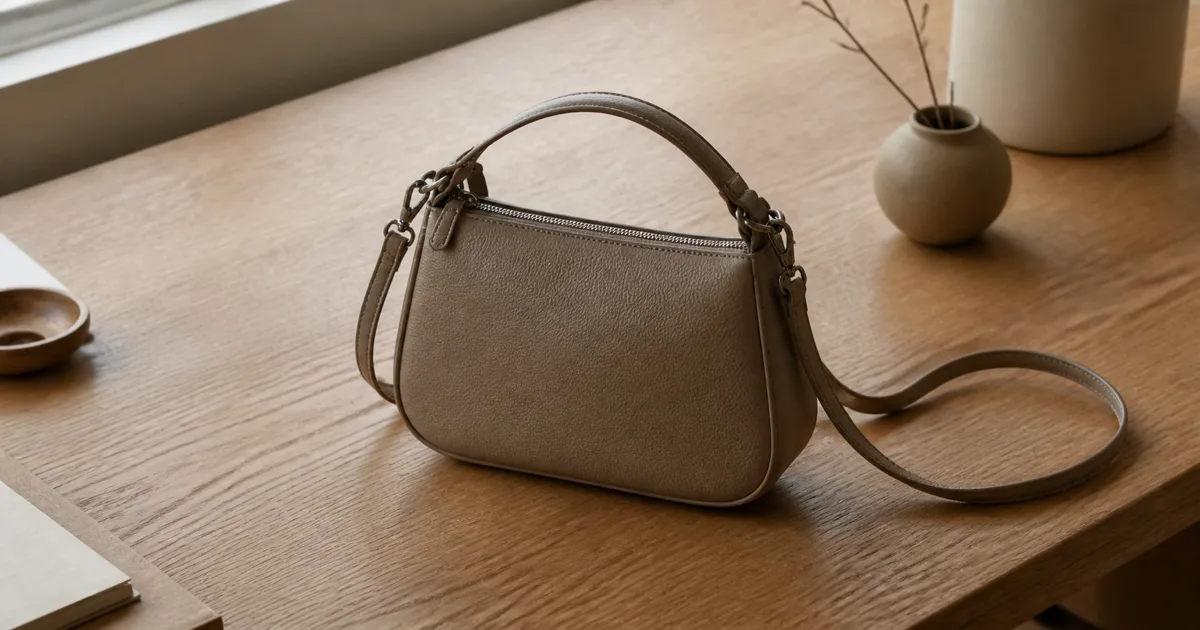
A single small leather shoulder bag with a short top handle and a thin shoulder strap, resting on a matte oak desk in soft natural daylight, photographed slightly from above (AI generated illustration)
AI-generated illustration

Small bags sit roughly at 18-24 cm width, 14-20 cm height, and 6-10 cm depth.

The capacity step up from mini is significant. A small bag fits a phone, a full-size short wallet, sunglasses in a case, hand cream, a compact mirror, and small daily essentials. It will not hold a 500 ml water bottle, a hardcover book, or anything tablet-sized.

This is the size most people land on after their first year of carrying a mini and realizing they are leaving small things at home every day. It is the smallest bag that supports a full-size wallet and a sunglasses case at the same time, which is the threshold most daily routines actually need.

Crossbody is the most common construction at this size. The bag is light enough to wear all day on a thin shoulder strap, and a small bag worn crossbody reads casual; the same bag worn by the top handle reads dressed.

Medium, the daily workhorse

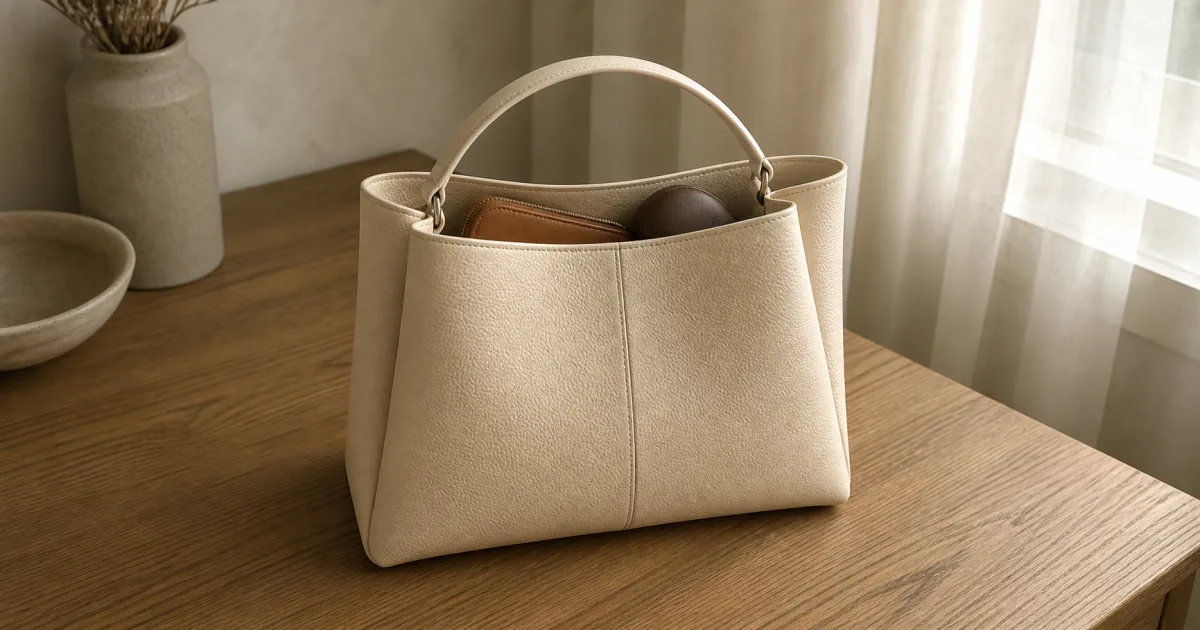
A folded medium leather tote on a matte oak desk in soft natural daylight, with a visible structured silhouette, a single top handle, and a small interior glimpse showing a wallet and sunglasses case inside (AI generated illustration)
AI-generated illustration

Medium bags sit roughly at 22-30 cm width, 18-26 cm height, and 8-13 cm depth.

This is the size that does the most everyday work. A medium bag carries a phone, a full-size wallet (including most long wallets), sunglasses in a case, a small water bottle, a paperback or a 8-9 inch tablet, a small makeup pouch, and a thin layer like a folded scarf or light cardigan.

The medium bag is the size most styled outfits in editorial photography end up holding, because the proportions read clean on the shoulder or in the hand without looking either too small or too commuter-like. It is also the size that holds its resale value the best in the second-hand market, because it sits at the intersection of dressed and daily.

Crossbody, top handle, or shoulder all work at medium. The same bag can read three different ways depending on which strap is being used, which is part of why medium is the size most house signature bags (Kelly, Birkin, Lady Dior, Galleria) sit closest to.

Large, the work and travel bag

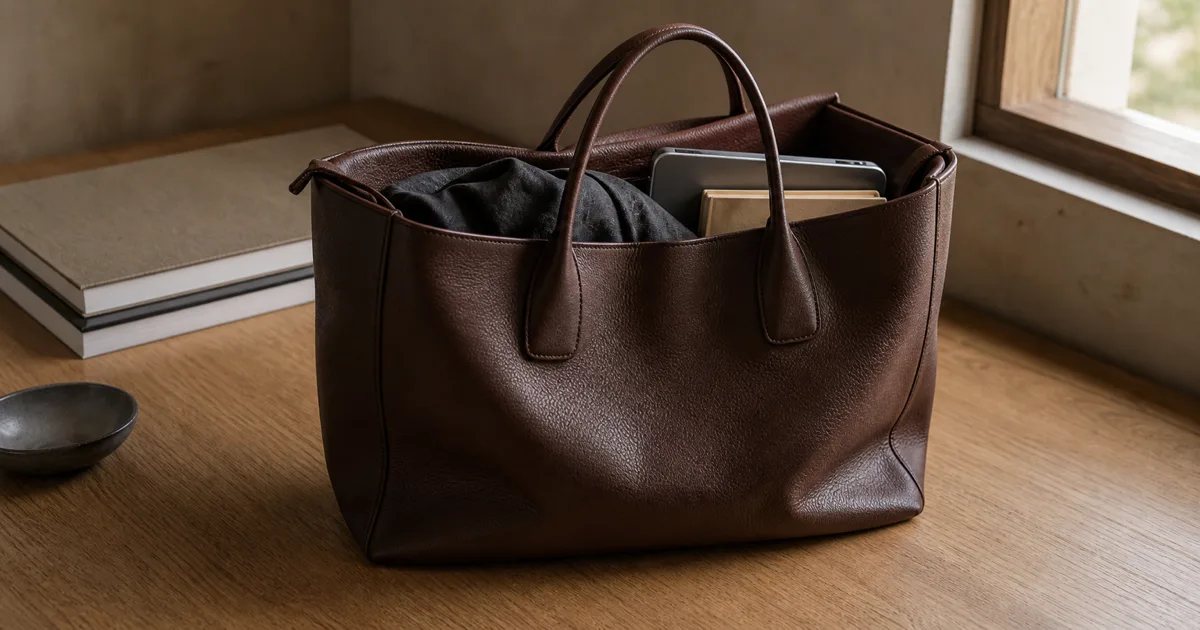
A roomy structured leather tote on a matte oak desk in soft natural daylight, with double top handles, a soft slouched profile, and a hint of contents visible through the open top — a folded jacket, a tablet, and a notebook (AI generated illustration)
AI-generated illustration

Large bags sit roughly at 30-40 cm width, 24-32 cm height, and 10-16 cm depth. Extra-large totes go past that range.

A large bag carries a 13-inch laptop comfortably, a tablet, a notebook, a 500-750 ml water bottle, a full makeup pouch, a folded cardigan or shawl, and the small daily essentials on top. A large tote is the bag that crosses over from a handbag into a commuter or a carry-on, depending on what is going inside.

The trade-off at this size is that the silhouette starts to read as work rather than dressed. A large bag worn with a tailored outfit can feel like the outfit is on the way to or from the office; the same outfit with a medium bag reads more like the outfit is at its destination.

A large bag is almost always worn on the shoulder or carried by the top handle; crossbody at this size is uncommon and usually only on travel-specific construction.

Quick reference

Read this as a fast lookup, not a rule:

  • Mini (~17-20 cm wide). Phone + slim card case + keys + lipstick. Going out, dinner, day events.
  • Small (~18-24 cm wide). Phone + short wallet + sunglasses case + hand cream. Everyday minimal.
  • Medium (~22-30 cm wide). Phone + long wallet + sunglasses + small water + paperback. Daily workhorse.
  • Large (~30-40 cm wide). Phone + wallet + 13-inch laptop + folded layer + water. Work and travel.

The width number is the single most reliable comparison across brands. If you are deciding between two bags on different websites, putting their widths side by side tells you almost everything you need about which one will do the day you have planned.

A few practical notes

  • House labels do not align. A "small" Kelly is much larger than a "small" Le Pliage. Always check the actual cm dimensions, especially the width.
  • Structure changes capacity. A soft bucket at 22 cm holds more than a structured top-handle at the same width, because the structured shape uses a few centimeters on the side panels to keep its line.
  • Strap drop is its own decision. A medium bag with a short top handle and a long crossbody strap is essentially two bags. Strap drop length decides where the bag sits on the body and changes the read of the outfit completely.
  • First-time mistake. Buying smaller than you actually need, because the bag looked elegant on a model. The medium-sized bag the model was holding was usually carrying nothing.

Sources

AI product analysis

How this guide was built

This piece is a cross-brand sizing guide, not a specific recommendation. The dimension ranges are pulled together from publicly available size charts including Ferragamo's bag size guide and aggregated specs from leather handbag industry references. The day-use mapping reflects what most readers find themselves carrying once they live with each size for a few months, not a single brand's category split.

Chexlow topic editor · AI illustration disclosed in image alt text

Related guides