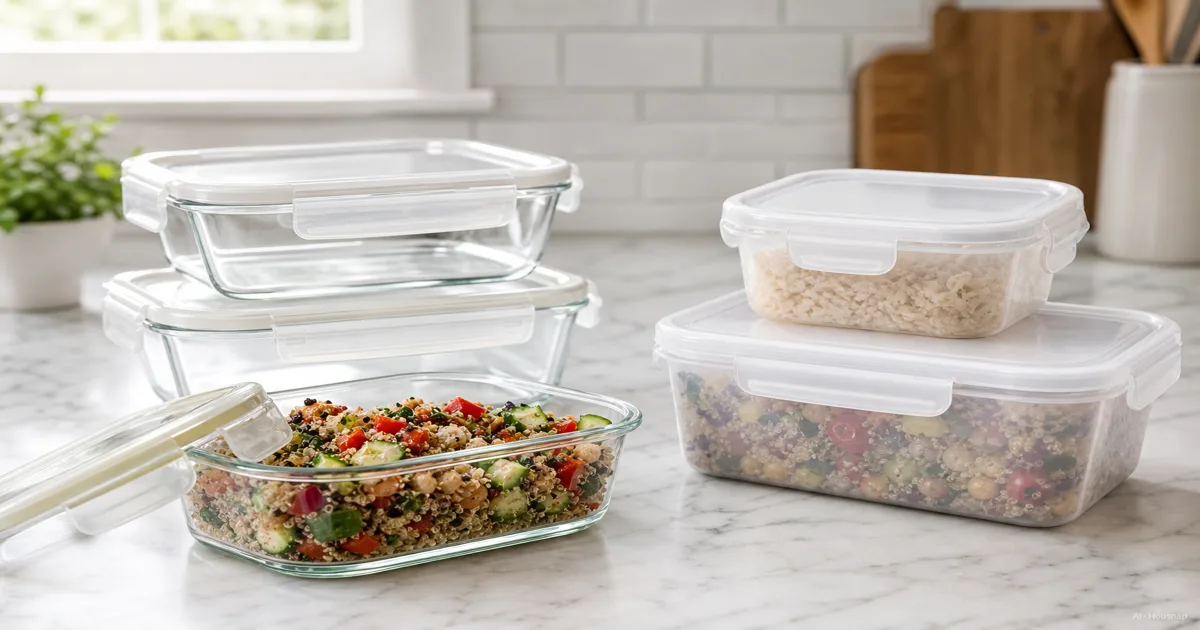

Choose for the job you do most
Before buying a set, picture one meal from packing to eating. Will you bake it in the same dish, carry it on a commute, or transfer it to a plate before reheating? That answer is more useful than choosing a material for the whole kitchen.
- Baking and serving in one dish. Shortlist glass containers explicitly approved for your oven. Check their filled weight before choosing them for daily transport too.
- Carrying lunch. Start with lightweight plastic candidates. Rubbermaid describes its cited Brilliance containers as lightweight and shatter-resistant; that is a product-specific example, not a promise that every plastic container survives a drop. Manufacturer details.
- Both jobs. A glass container for home and a plastic one for carrying can make sense. You do not need two complete sets before you know which sizes work.
If you already transfer lunch to a plate, oven compatibility should not decide the container purchase. Compare the lid, dimensions and carrying weight instead.
Check the heating instructions before the material label
Read the instructions for the exact container and lid separately. For example, the cited IKEA 365+ glass container can go in the oven, but its plastic lid cannot. IKEA also instructs users to leave that lid ajar during microwave heating. IKEA care instructions.
BPA-free is not a heating instruction. BPA is used in some plastics, including polycarbonate; its absence does not tell you which appliance or mode a container supports. FDA advises against microwave heating in plastic tableware without microwave-safe labeling. FDA on BPA, FDA microwave guidance.
For glass, check temperature transitions as well as the oven rating. Pyrex warns against direct freezer-to-hot-oven transfer and using chipped or cracked glassware. Pyrex safety instructions. If your planned freezer-to-reheating routine is not covered, choose another container or change the routine before buying.
Buying the appliance too? Read the solo versus convection microwave guide, then check container compatibility with the mode you intend to use.
Choose a lid for transport, opening and washing
For soup or sauce, look for an explicit leakproof claim for the exact container-and-lid combination. Do not infer it from the number of clips or the word “airtight.”
Check three things before ordering:
- Closure. Can you comfortably close every latch and reopen the lid? Inspect how the seal sits against the rim.
- Cleaning. Read whether the seal can be removed and which parts can go in the dishwasher. Do not assume a fitted seal is removable.
- Replacement. Look for the precise replacement-lid reference and compatible container sizes. A shared brand name is not enough to establish a fit.
Transport and heating need different lid settings. The cited Rubbermaid Brilliance instructions specify opening the latches when microwaving with the lid on. Rubbermaid instructions.
Buy the size your meals need, then expand
Use a familiar bowl or container to estimate your usual portion. Compare the candidate’s stated capacity with its outside dimensions, including the lid and clips. A nominal volume alone cannot tell you whether it fits your bag or shelf.
- A packed main meal. Start with one container that holds your actual lunch without forcing the lid shut.
- Separate sides or dressing. Add a smaller container only if you regularly keep those foods apart.
- Batch cooking. Plan several shallow portions rather than choosing one deep box solely for its capacity. FDA recommends shallow containers to help large quantities of leftovers cool faster. FDA storage guidance.
A practical first purchase is one main container, plus a smaller one if your meals need it. Use them for packing, washing and storage before duplicating that size. This is a buying strategy, not a universal portion prescription.
When comparing sets, count usable containers and matching lids separately. Then compare what you would actually use, rather than the largest advertised piece count.
Sources
- IKEA 365+ container and lid care
- Rubbermaid Brilliance product instructions
- Pyrex safety and usage
- FDA information on BPA
- FDA plastic tableware and microwave guidance
- FDA leftover storage guidance
Wie dieser Guide entstand
This guide was written by AI for Chexlow, using manufacturer instructions from IKEA, Rubbermaid and Pyrex and consumer guidance from the FDA. It separates product-specific permissions from editorial advice about choosing materials, lids and sizes; it does not report hands-on product testing.
Vom Chexlow-Team redigiert · Die Bilder sind KI-generierte Illustrationen